TheJakartaPost
Please Update your browser
Your browser is out of date, and may not be compatible with our website. A list of the most popular web browsers can be found below.
Just click on the icons to get to the download page.



On U.S. - Indonesian bilateral relations
A seasoned observer of Indonesia once remarked, "When you meet someone who declares they are an Indonesian expert, be careful
Change Size

A seasoned observer of Indonesia once remarked, "When you meet someone who declares they are an Indonesian expert, be careful." That is still good advice. I certainly am not an expert on this nation. But I do know that the American and Indonesian peoples share the same principles of tolerance, pluralism, and religious freedom that Indonesia embodied in its basic charter, the principles of the pancasila.
This country has seen extraordinary changes over the past decade -- first and foremost, a profound transition from decades of military-dominated rule to its current standing as one of the world's newest and most vital democracies. This shift has been all the more remarkable given that, during this time period, Indonesia experienced:
* A devastating tsunami;
* One of the world's most severe monetary and banking crises;
* A rise in extremist activity, including a number of terrorist attacks;
* A transforming experiment in government decentralization; and
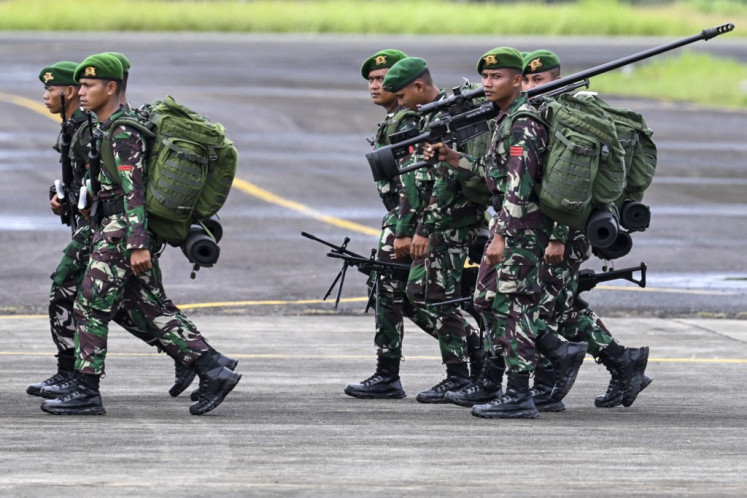
* Major reforms within the armed forces -- a process that has helped restore military-to-military relations between our two countries.
These internal changes have played out against the backdrop of great shifts in the region as a whole. Since the end of the Cold War, Asia's security environment has undergone remarkable change -- spurred in part by globalization and by the technological revolution of the last two decades. In recent years, the nations of Asia have, for the most part, achieved unprecedented wealth and stature as they have forged more mature political, economic, and military institutions.
All the while, new centers of power, as well as new sources of instability, are altering Asia's strategic landscape.
This prompts three questions I would like to explore with the rest of my time:
First, what is the role of the United States in this transformed and shifting environment?
Second, what new capabilities and approaches to security are we pursuing in light of Asia's new realities?
And third, where does America's partnership with Indonesia fit into this wider context?
I should start by reaffirming that the United States is and will always be a Pacific nation. I am confident that commitment will remain strong in the future.
The challenge for the United States has been to fashion defense policies that adapt to these new security realities -- but to do so in a way that preserves and protects our fundamental -- and enduring -- interests and values on the Pacific Rim.
Consider our relationships with long-standing treaty allies Japan and South Korea. We entered into these alliances in the early years of the Cold War when both nations were impoverished and virtually destroyed.
As Korea and Japan are more willing and able to take responsibility for their own defense, we have reduced the size and role of our forces in each country to a posture that is more appropriate to that of a partner, as opposed to a patron or protector.
These changes do not alter our fundamental commitment to the security of our allies or to protecting our interests in northwest Asia. Our treaty guarantees to Korea and Japan, as well as to Australia, are as solemn and firm as ever. In the central and western Pacific, we are actually increasing our military presence, with new air, naval, and marine assets based over the horizon in Guam -- prepared to respond to a number of contingencies, natural or man-made.
What we have seen in Asia in recent years is a very real shift that reflects new thinking in U.S. defense strategy overall. A shift away from the permanent presence of, and direct action by, U.S. forces -- and toward building the capacity of partners to better defend themselves. A shift away from conventional military deterrence as traditionally understood -- think of mechanized divisions poised along the Korean demilitarized zone or the central plains of Germany.
A shift toward a mix of the so-called "hard" and "soft" elements of national power -- where military, diplomatic, economic, cultural, and humanitarian elements are integrated in an effort to ensure long-term security based on our own capabilities but also on the enhanced capabilities of our partners. It is an approach that brings together various parts of the U.S. government to work more closely with diverse partners with a range of shared interests -- from old allies like Australia to former enemies like Vietnam.
When my colleague, Secretary of State Condoleeza Rice, spoke to this council two years ago, she discussed a host of issues from education to economics to democracy. While my main topic today is security, it has become clear in the last two decades that "security" encompasses far more than just military power.
This comprehensive approach to security mirrors the current Indonesian model: As President Yudhoyono said before this council with his first major foreign policy speech: "we cannot have security without development, nor can we have development without security, nor can we have both of them without respect for human right(s)." Indonesia's previous leaders also made the same point.
In this vein, the United States military -- even with ongoing operations in Afghanistan and Iraq -- is engaged with more Asian governments doing more things in more constructive ways than at any time in our history. Which brings me to the second topic I want to discuss: Capabilities and new approaches to security?
One of the areas in which we are most engaged is maritime security -- and efforts to combat piracy and proliferation. U.S. Pacific Command works closely with a number of nations -- Indonesia, Malaysia, the Philippines, Bangladesh, Sri Lanka, and more -- to provide the training and equipment -- from radars to patrol craft -- enabling them to assert control over waterways that have been used by drug traffickers, weapons smugglers, and terrorists.
The U.S. has also provided assistance designed to help Indonesia work with Malaysia, Singapore, the Philippines, and others to secure and improve transit routes such as the Strait of Malacca.
In addition to improving the capabilities of our Southeast Asian partners, we are encouraging them wherever possible to partner and cooperate more with their neighbors and other nations. Here we are overcoming the conventions and habits of the Cold War.
The writer is U.S. Secretary of Defense. The article an abridged version of his remarks to the Indonesian Council on World Affairs (ICWA) in Jakarta on Monday.




![A man walks across a pedestrian crossing near a billboard depicting named Iranian ballistic missiles in service, with text in Arabic reading “the honest [person's] promise“ and in Persian “Israel is weaker than a spider's web“, in Valiasr Square in central Tehran on April 15, 2024. Iran on April 14 urged Israel not to retaliate militarily to an unprecedented attack overnight, which Tehran presented as a justified response to a deadly strike on its consulate building in Damascus.](https://img.jakpost.net/c/2024/04/16/2024_04_16_149344_1713260233._medium.jpg)