TheJakartaPost
Please Update your browser
Your browser is out of date, and may not be compatible with our website. A list of the most popular web browsers can be found below.
Just click on the icons to get to the download page.


Popular Reads
Top Results
No results found. Please check your search term and try again
Can't find what you're looking for?
View all search results
Popular Reads
Top Results
No results found. Please check your search term and try again
Can't find what you're looking for?
View all search resultsSwine flu and the TNI
Swine flu has become a major international concern since its appearance in Mexico recently
Change text size
Gift Premium Articles
to Anyone
Share the best of The Jakarta Post with friends, family, or colleagues. As a subscriber, you can gift 3 to 5 articles each month that anyone can read—no subscription needed!

S
wine flu has become a major international concern since its appearance in Mexico recently. As fears of a global pandemic arose, on Monday, the World Health Organization (WHO) raised its warnings up one level to "phase 4", just two stops short of a full-blown pandemic. The change indicates that WHO believes this new strain of the H1N1 virus can be transmitted from human to human, possibly causing community-level outbreaks, but that it can still be contained before becoming a pandemic.
With today's global movements of people and goods, swine flu can spread faster than our efforts to contain it. On Tuesday, WHO spokesman Gregory Hartl told a news conference in Geneva that border controls and screening, the two primary methods that have been employed by countries to avoid outbreaks in their territories "don't work", because infected people may not show symptoms at airports or border crossings.
Learning from the war against avian influenza, President Susilo Bambang Yudhoyono's government has initiated a quick response. This shows the government's seriousness in dealing with the issue, although the health minister said swine flu constitutes less of a danger to Indonesia than avian influenza due to our hot climate.
Nevertheless, Indonesia has launched steps to stop the virus from entering its territories by establishing border controls; screening at ports and airports; banning imports of pork; and preparing Rp 38 billion to combat the disease. The Health Ministry have also designated more than 100 hospitals across Indonesia to handle any swine flu cases outbreaks as they appear.
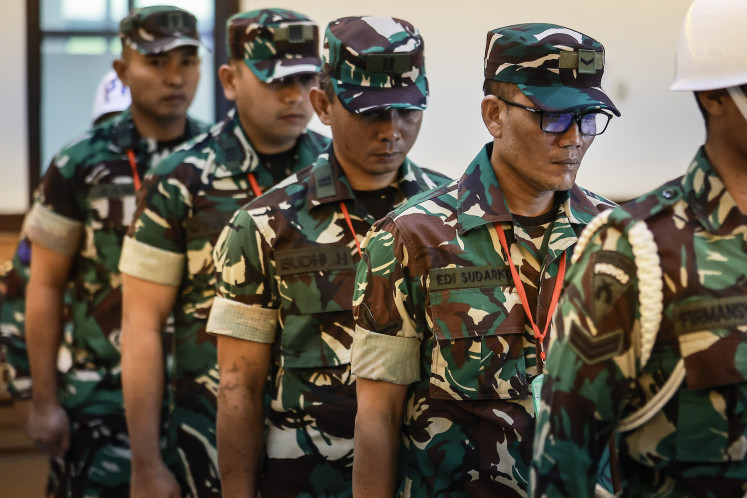
One thing we need to ask is whether the Defense Ministry and the Indonesian Military (TNI) should be involved in the response at this early stage. The contra argument is that having the military involved now would be premature, since the situation is still very far from the type of emergency that normally calls for military intervention (i.e. martial law), and could possibly trigger a panic if falsely perceived by the public. Moreover, the task of maintaining Indonesia's internal security is normally that of the National Police (Polri).
However, there would also be some positive aspects to involve the military. First, it would give the Defense Ministry and TNI (plus other parties involved) an early opportunity to harmonize their preparedness and contingency plans with other branches of government in the event of a serious outbreak here.
Under normal conditions, the Health Ministry would be in the front line. But if the situation escalates to a national emergency, mitigation efforts would need help, such as forced evacuations, forced vaccinations, or quarantine for infected people.
The health establishment would need to work closely with the military and police. Such efforts would require close coordination and understanding of roles and the nature of each party involved, and early involvement would facilitate these essential factors.
Second, the military could learn from civil agencies in dealing with such infections and apply these lessons to enhance its capabilities in defense against biological weapons. After years of a chronically insufficient defense budget, TNI's conventional force capabilities have deteriorated.
When its budget is insufficient to develop or even just to maintain its conventional capabilities, there is a big tendency for the military to neglect non-conventional threats, especially when such threats are deemed unlikely.
On the other hand, the constant battle against Avian influenza has helped the Health Ministry gain much knowledge and experience in facing this kind of biological threat. Clearly, TNI and the nation in general can benefit from this.