TheJakartaPost
Please Update your browser
Your browser is out of date, and may not be compatible with our website. A list of the most popular web browsers can be found below.
Just click on the icons to get to the download page.



Editorial: Time to put plans into action
Miscalculation, poor analysis and ignorance are perhaps the perfect terms to describe the reasons for the collapse of a 100-meter section of Jl
Change Size

M
iscalculation, poor analysis and ignorance are perhaps the perfect terms to describe the reasons for the collapse of a 100-meter section of Jl. RE Martadinata connecting Tanjung Priok and Ancol, North Jakarta, on Thursday last week.
A statement issued by Winarno, the director of PT Bina Marga Area II overseeing road construction, that the collapse was caused by land subsidence resulting from recent dredging of the canal running parallel to the road, confirms that the construction of the newly completed road and dredging activities in the area failed to satisfy standards of prudence, accuracy and thoroughness.
It is true that related institutions have started to rebuild the collapsed section. However, these measures are essentially more curative than preventive. And the collapse is only one example of many incidents that have occurred and may continue to occur in the future.
Still fresh in our minds is the recent collapse of part of the Pesanggrahan River dam in nearby Bintaro, and last year’s collapse of the Situ Gintung embankment in Ciputat, both obviously reflections of the poor performance of related government institutions and/or officials.
Government aside, last week’s incident in North Jakarta, the recent events in Bintaro, and last year’s Situ Gintung disaster all had one thing in common: they were largely the result of the destruction of the environment and ecosystems of Jakarta.
It has become a public secret, supported by research and surveys, that the city’s shorelines have been badly damaged, particularly by the intrusion of seawater. And the salt water from the ocean has contaminated underground water reserves at an increasing rate over the last few years.
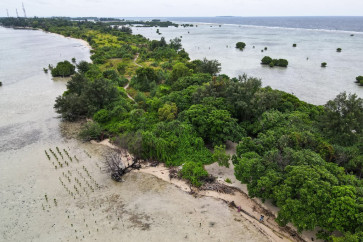
Reports show that seawater has penetrated all the way into parts of Central, South and West Jakarta and is even predicted to have reached neighboring Bekasi and Tangerang. Reports also show that the intrusion of seawater has also occurred as a result of the decreasing size of mangrove forests. As we all know, mangroves play a crucial role in protecting shorelines against strong waves and storms — preventing seawater intrusion.
Protecting and rehabilitating mangrove forests is thus critical, since our failure to do so will result in further degradation of the ecosystem and considerable changes to underground water reserves, particularly in coastal areas.
Besides decreasing the size of mangrove forests, groundwater use in the capital has reached alarming levels, with immediate and apparent impacts seen in land subsidence causing many areas to become highly susceptible to flooding.
This environmental degradation needs more serious commitments and actions — not only from authorities, but also from Jakartans themselves. For example, campaigns and commitments to build 1-square-meter biopores in residential areas and office complexes. These are expected to absorb excess water and prevent street flooding. Re-greening shorelines should be an obligatory measure for all Jakartans.
We must be committed to bringing an end to all environmental destruction and put all these necessary plans for recovery measures and prevention of further destruction into action. Otherwise, we must ask ourselves if we have the heart to let our children and grandchildren suffer from all the bad things we continue to do now? Certainly not.




![A man walks across a pedestrian crossing near a billboard depicting named Iranian ballistic missiles in service, with text in Arabic reading “the honest [person's] promise“ and in Persian “Israel is weaker than a spider's web“, in Valiasr Square in central Tehran on April 15, 2024. Iran on April 14 urged Israel not to retaliate militarily to an unprecedented attack overnight, which Tehran presented as a justified response to a deadly strike on its consulate building in Damascus.](https://img.jakpost.net/c/2024/04/16/2024_04_16_149344_1713260233._medium.jpg)