TheJakartaPost
Please Update your browser
Your browser is out of date, and may not be compatible with our website. A list of the most popular web browsers can be found below.
Just click on the icons to get to the download page.


Popular Reads
Top Results
No results found. Please check your search term and try again
Can't find what you're looking for?
View all search results
Popular Reads
Top Results
No results found. Please check your search term and try again
Can't find what you're looking for?
View all search resultsPoliticians must end bickering for the sake of economy: VP
With the Indonesian economy poised to sail through further global economic turmoil next year, Vice President Boediono says politicians should minimize differences and set aside interests that are not in line with the country’s need for growth
Change text size
Gift Premium Articles
to Anyone
Share the best of The Jakarta Post with friends, family, or colleagues. As a subscriber, you can gift 3 to 5 articles each month that anyone can read—no subscription needed!

W
ith the Indonesian economy poised to sail through further global economic turmoil next year, Vice President Boediono says politicians should minimize differences and set aside interests that are not in line with the country’s need for growth.
The global economy is predicted to slow next year as demand from rich countries slides over the eurozone debt crisis and the stalling US economic recovery. Indonesia’s economy has proven to be resilient, but not immune to the adverse impacts of the global crisis.
Vice President Boediono called for Indonesian politicians to gear up for the crisis by not repeating Europe’s experience, wherein the “inability of the political system or political party to create a joint agreement for a greater cause” showed signs of disconnection with the economic needs for the zone to recover.
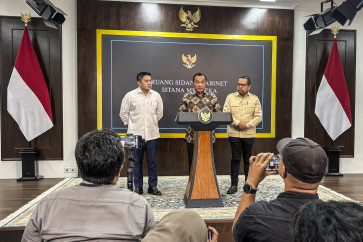
“If no agreements are made, disorderly adjustment would be created,” he told participants of the Bank Negara Indonesia (BNI) and Kompas 100 index’s CEO forum on Monday.
“The iron law of economics would apply regardless of the political situation.”
“We are optimistic that Indonesia will perform well in 2012. We are ready, but do not repeat Europe’s experience in which there’s a disconnection of economics and politics. That must not happen, especially at times of crisis. Minimize differences.”
Indonesia’s government and political factions at the House of Representatives have yet to agree on passing a financial safety net bill, with lawmakers asking that they be involved in managing crises over fears of a repeat of the Bank Century bailout case.
“The many businesspeople entering the political scene is causing a conflict of interests. The government wants businesses to grow and compete on the same playing field, but businesses tend to control all,” said Riant Nugroho, a public policy expert and director at the Institute for Policy Reform.
The country’s economy is expected to expand 6.7 percent this year, but Finance Minister Agus Martowardojo said that recent global developments that had resulted in growth downgrades by international financial institutions had prompted his ministry to set a lower economic growth range target of 6.5 percent.
Economists have said that infrastructure issues in Indonesia, like bad roads, ports and insufficient railway lines, are holding back the country from reaching its 7 percent economic growth potential.
The land acquisition bill, which the House of Representatives plan to pass this week, is expected to mitigate land procurement for public purposes and boost infrastructure projects, though lawmakers are still debating compensation for land owners.
Minister Agus said the land procurement law might also solve the government’s long-time issue of slow budget disbursement, which hindered potential multiplier effects and stimulus for the country’s economy.
A month before the year’s end, or as of Nov. 30, government spending was still 75.8 percent of the overall target, with capital expenditure disbursement at 47.3 percent of the budgeted spending.
Bank Indonesia has reiterated that faster government capital spending should enable the government to meet its economic growth target.