TheJakartaPost
Please Update your browser
Your browser is out of date, and may not be compatible with our website. A list of the most popular web browsers can be found below.
Just click on the icons to get to the download page.


Popular Reads
Top Results
No results found. Please check your search term and try again
Can't find what you're looking for?
View all search results
Popular Reads
Top Results
No results found. Please check your search term and try again
Can't find what you're looking for?
View all search resultsAnalysis: GDP preservation amid higher fuel prices and interest rates
All eyes are on two important macro factors: the fuel subsidy and the central bank's steps to control inflation
Change text size
Gift Premium Articles
to Anyone
Share the best of The Jakarta Post with friends, family, or colleagues. As a subscriber, you can gift 3 to 5 articles each month that anyone can read—no subscription needed!

A
ll eyes are on two important macro factors: the fuel subsidy and the central bank's steps to control inflation. These two policies are of paramount importance given that gross domestic product (GDP) in the first quarter (1Q13) decelerated to 6.02 percent year-on-year (y-y) (1.41 percent q-q), coming in below our, as well as the central bank's, expectations.
The culprits? Slowing investment (5.9 percent y-y) as non-building realizations (equipment & machinery) dropped due to floods in January while private consumption also dipped to 5.2 percent y-y (Fig. 1). These factors lowered the consumer tendency index (CTI) and business tendency index (BTI) (Fig. 2).
By industry (Fig. 3), 1Q13 GDP was driven by transportation & communications (+10 percent), financial (+8.4 percent) and construction (+7.2 percent).
Going forward, 2013-14 GDP growth will hinge on the subsidized fuel price. We expect the rising fuel price to exert moderate downward pressure on consumption due to erosion in purchasing power.
However, we expect some support from the higher minimum wage and income tax threshold. Furthermore, the government is pushing for around Rp 14 trillion (US$1.44 billion) in direct cash assistance to 15.5 million low-income households to preserve purchasing power.
Further GDP support will come from the 2013 investment target of $38 billion as Indonesia remains an attractive market for investors after the growing middle class.
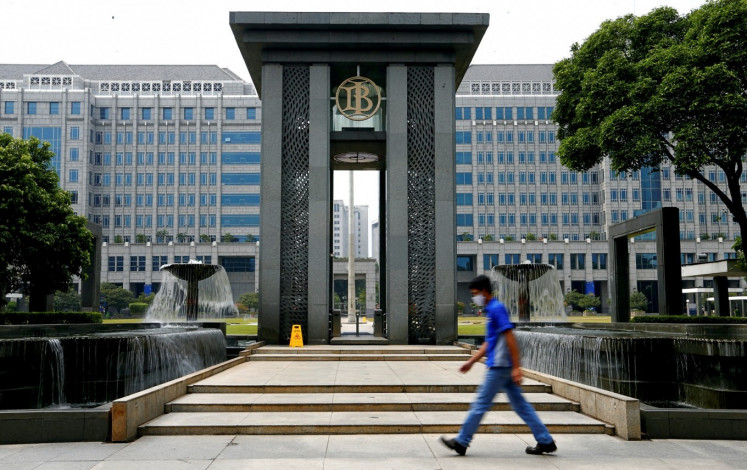
With that said, Bank Indonesia, for now, is just looking to apply stronger liquidity absorption through accumulation of long-term securities without adjusting its benchmark interest rate, which has been at 5.75 percent since March 2012.
Nevertheless, 100 basis point hike in interest rates is on the cards in our view to stop inflation of 8.85 percent assuming 33 percent (Rp 1,500 per liter) fuel price increase to Rp 6,000 (6 US cents) per liter. This would drag down 2013 GDP growth to slightly below 6 percent.
However, if the fuel price adjustment is postponed until the end of 2013, the negative impact on GDP will be less significant, carried over into 2014.


The writer is an analyst at the research division of PT Bahana Securities