TheJakartaPost
Please Update your browser
Your browser is out of date, and may not be compatible with our website. A list of the most popular web browsers can be found below.
Just click on the icons to get to the download page.


Popular Reads
Top Results
No results found. Please check your search term and try again
Can't find what you're looking for?
View all search results
Popular Reads
Top Results
No results found. Please check your search term and try again
Can't find what you're looking for?
View all search resultsRupiah falls victim to uncertainty on fuel prices
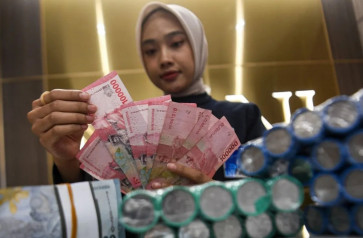
The rupiah spiraled into another precipitous depreciation cycle this week as President Susilo Bambang Yudhoyono's dithering over fuel subsidies propagated anxiety in the market
Change text size
Gift Premium Articles
to Anyone
Share the best of The Jakarta Post with friends, family, or colleagues. As a subscriber, you can gift 3 to 5 articles each month that anyone can read—no subscription needed!

T
he rupiah spiraled into another precipitous depreciation cycle this week as President Susilo Bambang Yudhoyono's dithering over fuel subsidies propagated anxiety in the market.
The rupiah closed at 9,757 to the US dollar, the weakest five day performance since April 5, according to Bloomberg. The currency previously touched 9,845, the lowest level since Jan. 10.
'If we persistently protract this debate over fuel subsidies, then the market has every reason to be concerned,' Deputy Finance Minister Mahendra Siregar said when asked about the fundamental cause of the weakening trend of the rupiah, in Jakarta on Friday.
The low price of fuel has been blamed for escalating oil consumption, and the resultant increase in oil imports.
The uncontrolled increase in oil imports have depleted Bank Indonesia's foreign exchange (forex) reserves by US$5.6 billion since January.
There is no doubt that this is mainly due to an increase in dollar demand from state oil and gas company Pertamina and state electricity firm PLN, the two biggest domestic oil importers.
Yudhoyono is prolonging uncertainty on the matter, saying that any fuel price rise will have to wait for the package of relief programs for those with low incomes to be approved by the House of Representatives.
This cannot occur until the deliberation of the revised 2013 State Budget (APBN-P).
Bank Central Indonesia (BCA) chief economist David Sumual warned the President that the ferment of negative sentiment brewing over fuel subsidies had been such that it caused an 'exchange rate overshoot'.
'It means that, by trading near 9,800 right now, the rupiah has depreciated far below its true fundamental rate,' he said on Friday. 'Looking at our economic fundamentals right now, our currency is just too weak.'
David argued that the rupiah could even breach the psychological threshold of 10,000 per dollar if the government failed to win the political battle with lawmakers to raise the fuel price ' exactly the situation which occurred last year.
'BI's forex reserves are being tested by this persistent inconclusiveness, as they have to keep intervening in the market in response to high oil imports,' he said.
Pressure on the rupiah may also be attributable to the possible halt of the quantitative easing policy implemented by the Federal Reserve, the US central bank, which created bearish perception of the dollar, helping Asian currencies strengthen.
The Federal Reserve stated this week that it might reduce the pace of quantitative easing as early as summer, if the central bank saw progress in US economic recovery and its labor market.
Economists also predict that the Bank of Japan (BOJ), the country's central bank, might end its quantitative easing policy sooner than planned, as the country announced this week 3.5 percent economic growth in the first quarter, well above market expectations.
Over the coming months, depreciation pressure for the rupiah will be generated by strong dollar demand, as multinational companies convert their dividends into dollars to be repatriated their headquarters overseas, according to Suriyanto Chang, the head of treasury with Bank QNB Kesawan.
That, coupled with the persistently weak exports and climbing oil imports, would weaken the rupiah considerably to average around 9,800 per dollar in the short run.
'Going forward, I expect BI to be very aggressive in their intervention in the market in support of the rupiah,' he said.