TheJakartaPost
Please Update your browser
Your browser is out of date, and may not be compatible with our website. A list of the most popular web browsers can be found below.
Just click on the icons to get to the download page.


Popular Reads
Top Results
No results found. Please check your search term and try again
Can't find what you're looking for?
View all search results
Popular Reads
Top Results
No results found. Please check your search term and try again
Can't find what you're looking for?
View all search resultsGovt preparing fiscal incentives to spur economy next year
The government will introduce next year a package of tax incentives to encourage innovation and reduce dependence on imports, newly appointed Finance Minister Chatib Basri said on Tuesday
Change text size
Gift Premium Articles
to Anyone
Share the best of The Jakarta Post with friends, family, or colleagues. As a subscriber, you can gift 3 to 5 articles each month that anyone can read—no subscription needed!

T
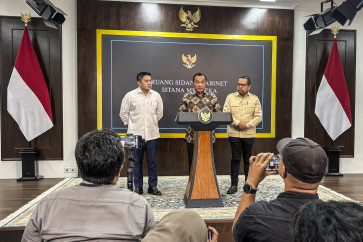
he government will introduce next year a package of tax incentives to encourage innovation and reduce dependence on imports, newly appointed Finance Minister Chatib Basri said on Tuesday.
Starting next year, tax-reduction schemes will be given to strategic industries producing intermediate goods.
Tax incentives will also be given to companies or investors planning to invest more in research and development (R&D) sector.
The intermediate goods industry was still underdeveloped, with over reliance on imports to fulfill the need for goods, Chatib told reporters in Jakarta on Tuesday.
'Whenever our economy inches up, our intermediate goods imports increases, widening our current account deficit,' the minister said. 'By giving the incentives, we hope to rely less on imports, so we can post high growth without destabilizing our current account.' Meanwhile, tax-reduction schemes for the R&D sector were necessary to encourage innovation, which is needed for sustainable economic growth.
In the long run, Indonesia must rely not only on natural resources to spur growth but also innovation-promoting industries, Chatib explained.
'But the stimulus will be given in the context of fiscal prudency ' we must carefully assess which incentives are the most effective for our economy before they can be implemented,' he noted.
The market expected Chatib's appointment as finance minister to result in more government-introduced fiscal incentives. The 47-year-old has built his reputation as an investor-friendly official, with record investments last year of Rp 313 trillion (US$32 billion) during his tenure as chairman of the Investment Coordinating Board (BKPM).
The government has set an economic growth target of 6.4-6.9 percent, a range that can only be achieved by attracting more investors going forward, economists have warned.
This is because officials have forecast a decline in investment growth for the upcoming quarters, mainly due to regulatory uncertainty and an unstable political climate ahead of the 2014 elections.
Institute for Development of Economic and Finance (INDEF) economist Ahmad Erani Yustika said that next year's economic growth target range of 6.4-6.9 percent was too high and unrealistic.
He predicted that, in addition to the likely decline in investments, there would be no quick recovery for exports due to prevailing global uncertainties, as well as the likely lag in government spending.
'There will be less contribution from government spending ' bureaucracy will not be effective and many projects will hit snags as many officials will have to set aside time for the elections,' he said.
Given the notable economic challenges to be faced next year, economists also suggest Chatib to focus on a short-term fiscal stimulus that could have a swift, direct impact on economic growth.
'The fiscal stimulus that he suggested ' tax incentives for intermediate goods industry and for R&D projects ' will only benefit Indonesia in the long-run, the impact of which can only be felt in the next five or six years,' said Juniman, an economist with privately owned Bank Internasional Indonesia (BII).