TheJakartaPost
Please Update your browser
Your browser is out of date, and may not be compatible with our website. A list of the most popular web browsers can be found below.
Just click on the icons to get to the download page.


Popular Reads
Top Results
No results found. Please check your search term and try again
Can't find what you're looking for?
View all search results
Popular Reads
Top Results
No results found. Please check your search term and try again
Can't find what you're looking for?
View all search resultsJapan holds unprecedented military exercise in US
Japanese troops will converge on California's southern coast in the next two weeks as part of an unprecedented military exercise with U
Change text size
Gift Premium Articles
to Anyone
Share the best of The Jakarta Post with friends, family, or colleagues. As a subscriber, you can gift 3 to 5 articles each month that anyone can read—no subscription needed!

J
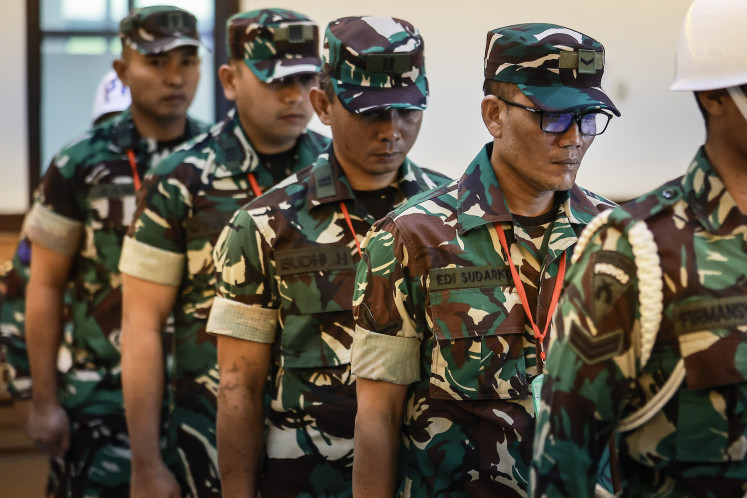
apanese troops will converge on California's southern coast in the next two weeks as part of an unprecedented military exercise with U.S. troops aimed at improving that country's amphibious attack abilities.
U.S. and Japanese military officials said the training will help Japan's Self-Defense Force better respond to crises such as natural disasters. But China may see it differently, given the tensions between Tokyo and Beijing over islands claimed by both in the East China Sea.
"It's another dot that the Chinese will connect to show this significant expanding military cooperation," said Tai Ming Cheung, an analyst of Chinese and East Asian security affairs and director of the Institute on Global Conflict and Cooperation at the University of California, San Diego.
The drill comes just days after Chinese President Xi Jinping's visit with President Barack Obama at a California estate, where they discussed topics including the Pacific region's mounting tensions.
China asked the United States and Japan to cancel the drill, scheduled to begin Tuesday, Japan's Kyodo News service reported, citing unnamed Japanese government sources. The Japanese Defense and Foreign Ministries would not confirm whether China had made any request but said they are going ahead with the exercises.
The Chinese Foreign Ministry did not respond to The Associated Press for comment on whether China requested a cancellation. In regard to the drill itself, Foreign Ministry spokesman Hong Lei said: "We hope the relevant sides can focus on peace and stability in this region, and do more to contribute to mutual trust and regional peace and stability."
U.S. military officials said strengthening Japan's amphibious capabilities is vital as the U.S. focuses more attention on developing an Asia-Pacific strategy amid ongoing Defense Department budget cuts. The region has been roiled by tensions due to North Korean long-range rocket and nuclear tests and maritime territorial disputes between China and its neighbors.
"If the 20th century taught us anything, it is that when democracies are able and willing to defend themselves, it preserves peace and stability," said Col. Grant Newsham, Marine liaison to the Japanese military. "Most Asian countries welcome ' even if quietly stated ' a more capable (Japanese force) that is also closely allied to U.S. forces."
China recently asserted its dominance over what they call Diaoyutai, and Japan calls the Senkaku Islands, by sending government ships into Japanese territorial waters in April. China has said it is only safeguarding its sovereignty.
The uninhabited islands are controlled by Japan but also claimed by China. Japan's nationalization of the islands in September triggered violent protests across China. Beijing has increasingly patrolled the area, prompting Japan to dispatch fighter jets to monitor Chinese aircraft, raising the risk of missteps that could trigger a clash.