TheJakartaPost
Please Update your browser
Your browser is out of date, and may not be compatible with our website. A list of the most popular web browsers can be found below.
Just click on the icons to get to the download page.


Popular Reads
Top Results
No results found. Please check your search term and try again
Can't find what you're looking for?
View all search results
Popular Reads
Top Results
No results found. Please check your search term and try again
Can't find what you're looking for?
View all search resultsRI seeks diplomatic success at Bali APEC
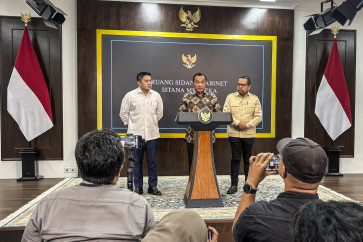
Summit countdown: Foreign Minister Marty Natalegawa (left), Tourism and Creative Economy Minister Mari Elka Pangestu (center) and National Development Planning Minister Armida Alisjahbana attend a media briefing in Jakarta on Wednesday
Change text size
Gift Premium Articles
to Anyone
Share the best of The Jakarta Post with friends, family, or colleagues. As a subscriber, you can gift 3 to 5 articles each month that anyone can read—no subscription needed!
 Summit countdown: Foreign Minister Marty Natalegawa (left), Tourism and Creative Economy Minister Mari Elka Pangestu (center) and National Development Planning Minister Armida Alisjahbana attend a media briefing in Jakarta on Wednesday. They met at the Foreign Ministry to discuss preparations for the upcoming APEC Summit in Bali, scheduled for Oct. 1-8. (Antara/Widodo S. Jusuf) (left), Tourism and Creative Economy Minister Mari Elka Pangestu (center) and National Development Planning Minister Armida Alisjahbana attend a media briefing in Jakarta on Wednesday. They met at the Foreign Ministry to discuss preparations for the upcoming APEC Summit in Bali, scheduled for Oct. 1-8. (Antara/Widodo S. Jusuf)
S
span class="caption" style="width: 509px;">Summit countdown: Foreign Minister Marty Natalegawa (left), Tourism and Creative Economy Minister Mari Elka Pangestu (center) and National Development Planning Minister Armida Alisjahbana attend a media briefing in Jakarta on Wednesday. They met at the Foreign Ministry to discuss preparations for the upcoming APEC Summit in Bali, scheduled for Oct. 1-8. (Antara/Widodo S. Jusuf)
Indonesia has set out its three priorities in the upcoming 2013 Asia-Pacific Economic Cooperation (APEC) Summit in Bali, they will also serve as indicators of Indonesia's success in the international forum.
According to government officials, the three goals are attaining the Bogor goals (APEC's commitments forged in Bogor, West Java, in 1994 to free and open trade and investment by 2020); achieving sustainable growth with equity; and promoting connectivity.
'On the 'achieving sustainable growth with equity', we have been preparing more detailed and substantial breakdowns relating to food security; energy security, particularly renewable energy; women's empowerment in small and medium enterprises; and financial inclusion,' National Development Planning Minister Armida S. Alisjahbana said on Wednesday.
On 'promoting connectivity', Tourism and Creative Economy Minister Mari Elka Pangestu said that Indonesia would propose simplified travel procedures to boost travel and tourism.
'This will be the first time a discussion about international travel procedures will combine multiple sectors; tourism, transportation, customs and immigration. The outcomes could be in the form of a simplified system such as smart
visas, or travel facilitation, or sharing of data or many others. The essence is to ease travel and tourism among APEC nations,' she said.
Mari said that Indonesia's APEC chairmanship this year would contribute to a significant increase in the number of foreign visitors to the country. 'We expect about 5,000 foreigners, both delegates and journalists, to come to Indonesia. So 2103 is not only the year of the APEC chairmanship, but it is also the year of MICE [meeting, incentives, convention and exhibition], an important aspect of tourism,' she said.
APEC, set up in 1989 in response to the growing interdependence of Asia-Pacific economies, brings together 21 member countries from around the Pacific Ocean ' from China, Southeast Asia and Australia to Chile via the US. Its core mission is to reduce tariffs and other trade barriers among members.
The membership accounts for 54 percent of world economic output and 44 percent of global trade.
Since its inception, APEC has helped reduce tariffs and other barriers to trade across the Asia-Pacific region. Business transaction costs were cut by 5 percent between 2006 and 2010, according to the APEC Secretariat, representing cost savings of close to US$59 billion for businesses.
Trade Minister Gita Wirjawan has previously said that Indonesia's success in APEC will only be measured by the concrete benefits it will bring to Indonesia's businesses.
According to Gita, the summit will be successful in Indonesian terms if the 21 member economies agree to include palm oil and rubber in the expanded list of environmental goods subject to tariff caps of up to 5 percent by 2015.
Last year's summit in Vladivostok, Russia, resulted in a historic US-initiated consensus on 54 environmental goods eligible for the tariff caps.
Meanwhile, Foreign Minister Marty Natalegawa said that preparations for the summit, themed 'Resilient Asia Pacific, Engine of Global Growth', were all on track.
According to Marty, Indonesia, as of June, had hosted 94 APEC-related meetings in many cities throughout the country.
However, despite the optimism, government officials have made little effort to disclose the summit's cost. When asked about the amount of the state budget allocated to organize the summit, Armida claimed that she did not know the exact figure. 'You can ask State Secretary [Sudi Silalahi] because he is the head of the summit's organization committee,' she said.
Sudi has repeatedly refused to disclose the budget.
Sources have estimated that at least Rp 1 trillion ($102 million) of taxpayer's money will be spent on the summit, including the purchase of dozens of luxury cars for VIPs, security and accommodation costs.
Armida said that all APEC-related meetings would be funded from the 2013 state budget, which was revised on Monday. 'An exception being the ABAC [APEC Business Advisory Council] which will be financed by corporations,' she said.
Armida said the budget allocation for the summit was distributed among multiple ministries and other state bodies. Senior official or ministerial-level meetings, for example, would be financed from the budgets of the respective ministries, she said.