The Jakarta Post
Please Update your browser
Your browser is out of date, and may not be compatible with our website. A list of the most popular web browsers can be found below.
Just click on the icons to get to the download page.


Popular Reads
Top Results
No results found. Please check your search term and try again
Can't find what you're looking for?
View all search results
Popular Reads
Top Results
No results found. Please check your search term and try again
Can't find what you're looking for?
View all search resultsHerald van der Linde brings Sriwijaya’s maritime world to life
Through the journeys of a Buddhist monk, the rise of port cities and the movement of goods and ideas, the Dutch historian traces the networks that connected ancient Sumatra to the wider world.
Change text size
Gift Premium Articles
to Anyone
Share the best of The Jakarta Post with friends, family, or colleagues. As a subscriber, you can gift 3 to 5 articles each month that anyone can read—no subscription needed!
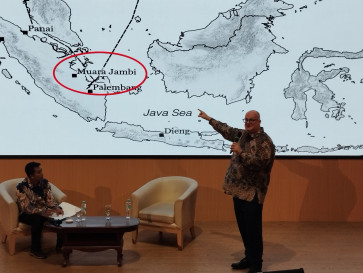
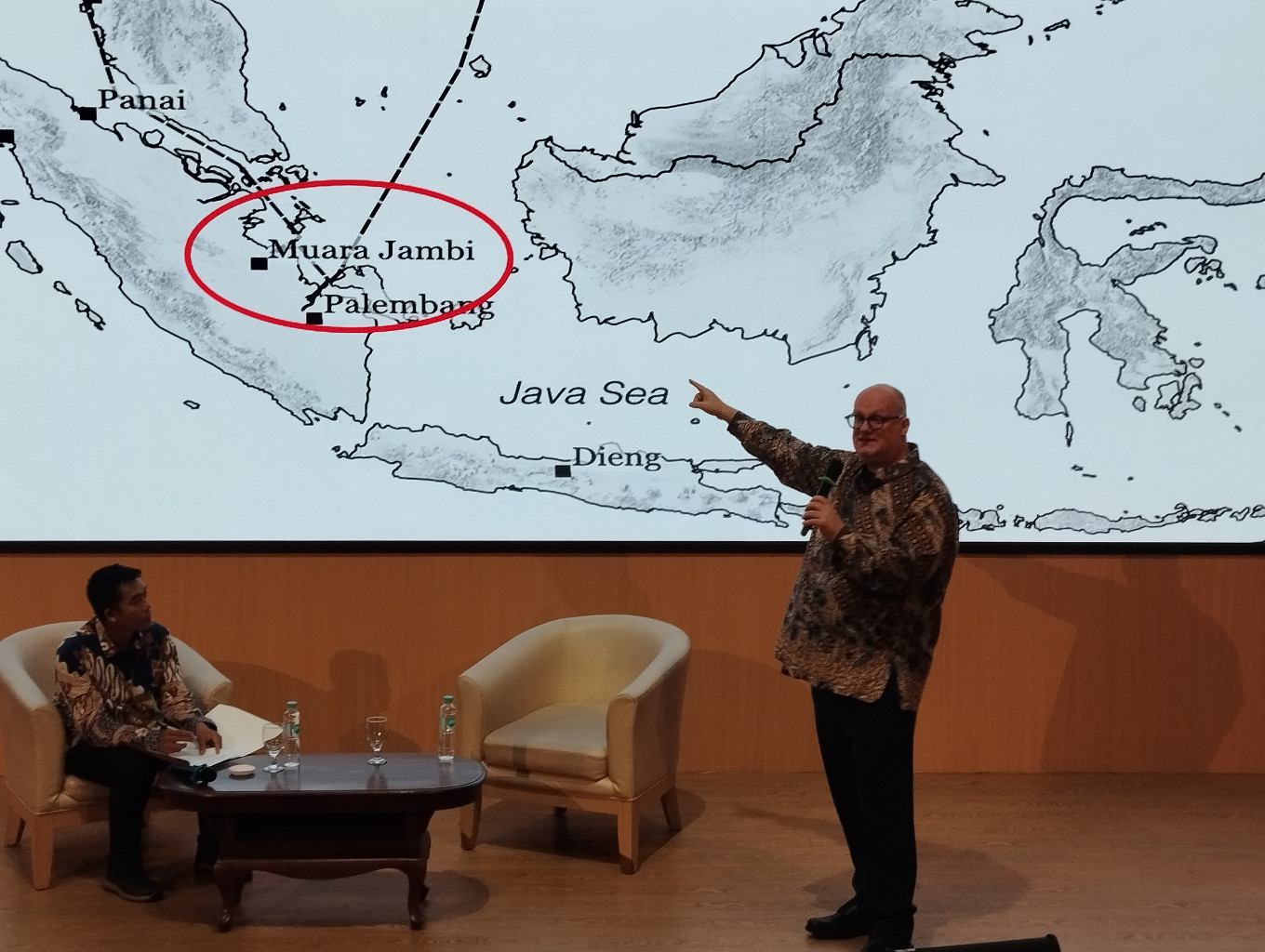 Tracing ancient ties: Historian and author Herald van der Linde (right) delivers a presentation on Sept. 26, 2026, during the launch of his book Srivijaya at the National Museum in Central Jakarta, describing how Chinese monk Yijing documented the Buddhist empire on present-day Sumatra while journeying to India. (JP/Nur Janti)
Nur Janti
The Jakarta Post/Jakarta

More than 1,300 years ago, a Chinese Buddhist monk named Yijing embarked on a journey to India to deepen his knowledge of Buddhism. His travels took him through Sumatra, where he found a thriving center of Buddhist learning that would leave a lasting impression on his account of the region.
In the seventh century, Yijing stopped in Palembang and Muaro Jambi to study Buddhism and Sanskrit before continuing to Nalanda, a renowned Buddhist monastic center in India. He later returned to Sumatra, bringing with him Buddhist texts that he translated into Chinese.
Sanskrit, a classical Indo-Aryan language, had become an important language of religion, scholarship and elite culture across parts of Asia, spreading alongside Hinduism and Buddhism. Its presence in Sumatra reflected the island’s connections to wider intellectual and religious networks.
Yijing’s accounts describe a community of monks studying Buddhist texts and Sanskrit in the region, offering an early glimpse of Sumatra’s role in the circulation of knowledge across Asia.
More from The Weekender

In between the kingdoms of the well and sick
In a clarifying Third Place between illness and recovery, life becomes both stranger and clearer than it's ever been.

Machines Without a Beating Heart?
As electric cars reshape the driving experience, enthusiasts wrestle with what makes a car special: the roar of its engine, the quirks of an aging machine, or the memories we leave behind the wheel.

FX Harsono revisits Indonesia’s unresolved past in Ambang/Threshold
The veteran artist reworks familiar images of violence and discrimination to confront a history that continues to shape the present.