TheJakartaPost
Please Update your browser
Your browser is out of date, and may not be compatible with our website. A list of the most popular web browsers can be found below.
Just click on the icons to get to the download page.


Popular Reads
Top Results
No results found. Please check your search term and try again
Can't find what you're looking for?
View all search results
Popular Reads
Top Results
No results found. Please check your search term and try again
Can't find what you're looking for?
View all search resultsBI looks to ASEAN framework to support RI banking expansion
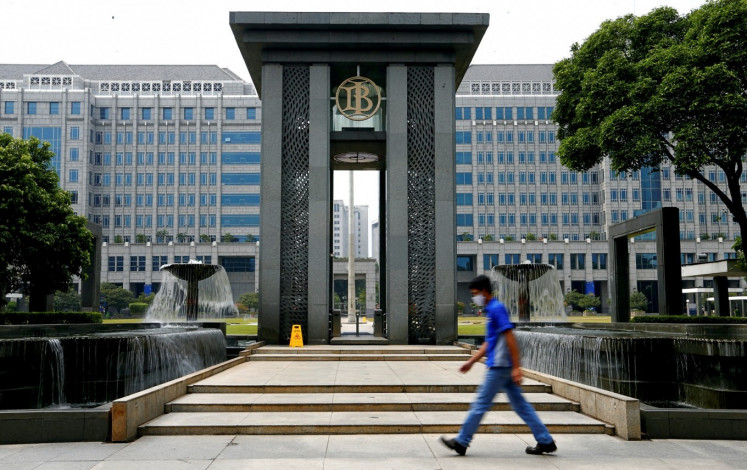
Bank Indonesia (BI) expects the upcoming ASEAN Banking Integration Framework (ABIF) to provide a solution to lingering expansion problems faced by Indonesian banks
Change text size
Gift Premium Articles
to Anyone
Share the best of The Jakarta Post with friends, family, or colleagues. As a subscriber, you can gift 3 to 5 articles each month that anyone can read—no subscription needed!

B
ank Indonesia (BI) expects the upcoming ASEAN Banking Integration Framework (ABIF) to provide a solution to lingering expansion problems faced by Indonesian banks.
The framework, part of the ASEAN Economic Community plan, is still being drafted by the central banks and banking sectors of the 10 ASEAN member countries ' Brunei Darussalam, Cambodia, Indonesia, Laos, Malaysia, Myanmar, the Philippines, Singapore, Thailand and Vietnam ' and is expected to be completed this year.
According to BI executive director Mulya Siregar, when completed, the ABIF will enable ASEAN banks, including Indonesia's, to enter and operate in banking markets in other ASEAN member countries.
'The framework will help us identify the banks that can be classified as QAB [Qualified ASEAN Banks]. Those having QAB status will then be able to expand overseas and be treated as domestic banks in the destination country,' he said in Jakarta on Thursday.
To acquire the status, a bank will have to meet certain criteria, such as possessing strong capital and good management.
'It is also a requirement to be an indigenous ASEAN bank, meaning that it is based in an ASEAN country and its shares are owned by ASEAN citizens,' Mulya said, adding that some Indonesian banks already had the potential to obtain the status.
'We hope the ABIF will help solve its current expansion problems, particularly over reciprocity issues,' Mulya said.
Banks such as Bank Mandiri and BNI have claimed they often meet difficulties in expanding their businesses overseas, especially in Singapore and Malaysia.
At the same time, local bankers claim the situation to be a paradox, since Indonesia boasts one of the world's most open banking systems with several local bank acquisitions by foreign lenders.
Data from BI shows that as of December 2012, foreign-owned banks, including local banks, some of the shares of which are controlled by foreign shareholders, accounted for 37 percent of the country's total banking assets.
Meanwhile, under the ASEAN Economic Community plan, the member countries will be brought together to integrate and share economic benefits by 2015. According to the Asian Development Bank (ADB) in its April 2013 report, 'The
Road to ASEAN Financial Integration', commercial banks are the most important type of financial institutions in ASEAN. Overall, they accounted for more than 82 percent of the total financial assets in ASEAN in 2009.
The average capital adequacy ratio (CAR) of all ASEAN commercial banks was higher than 15 percent and the average non-performing loan (NPL) ratio in most of the member states was less than 5 percent in 2009. 'These ratios suggest that, on average, most ASEAN banks meet the international standards for soundness and safety,' it wrote.
However, the ADB argued that although the ASEAN 5 ' Indonesia, Malaysia, the Philippines, Singapore and Thailand as original members of the association ' had taken steps to open up their banking industries, cross-border banking and cross-border penetration of ASEAN-based banks within ASEAN had been slow to develop.
'In 2010, not a single ASEAN-based commercial bank had either a branch or a subsidiary in all ASEAN member states,' it said.