TheJakartaPost
Please Update your browser
Your browser is out of date, and may not be compatible with our website. A list of the most popular web browsers can be found below.
Just click on the icons to get to the download page.


Popular Reads
Top Results
No results found. Please check your search term and try again
Can't find what you're looking for?
View all search results
Popular Reads
Top Results
No results found. Please check your search term and try again
Can't find what you're looking for?
View all search resultsDeflation follows lower food and garment prices
Bargains galore: A woman walks past a boutique in Tebet Market, South Jakarta, on Wednesday
Change text size
Gift Premium Articles
to Anyone
Share the best of The Jakarta Post with friends, family, or colleagues. As a subscriber, you can gift 3 to 5 articles each month that anyone can read—no subscription needed!
 Bargains galore: A woman walks past a boutique in Tebet Market, South Jakarta, on Wednesday. The Central Statistics Agency recorded deflation in April, when the consumer price index declined by 0.1 percent. Declining prices of food and clothes contributed to the fall. (JP/Nurhayati) (JP/Nurhayati)
B
span class="caption" style="width: 510px;">Bargains galore: A woman walks past a boutique in Tebet Market, South Jakarta, on Wednesday. The Central Statistics Agency recorded deflation in April, when the consumer price index declined by 0.1 percent. Declining prices of food and clothes contributed to the fall. (JP/Nurhayati)
Indonesia saw deflation in April, during which the monthly consumer price index (CPI) declined by 0.1 percent compared to a month earlier, thanks to a fall in food prices due to the harvest season, the Central Statistics Agency (BPS) reported Wednesday.
The deflation was mainly driven by a drop in the price of food and clothes, which fell 0.8 percent and 1.13 percent, respectively. Among the food commodities with declining prices during the month were rice, garlic, shallots, rice and tomatoes.
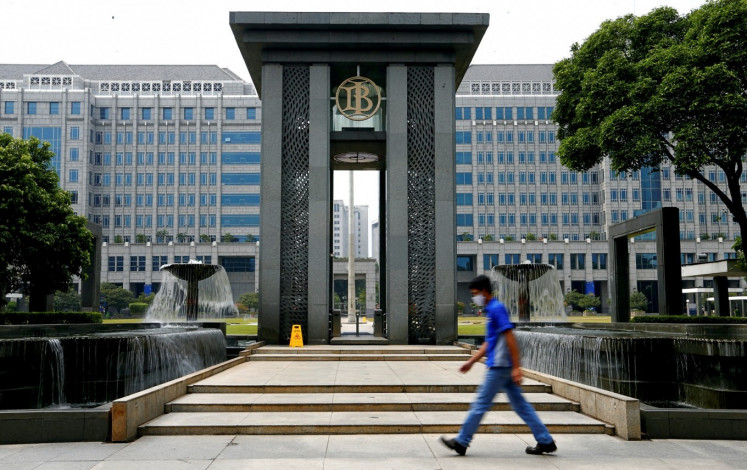
Nevertheless, year-on-year inflation in April stayed stubbornly high at 5.57 percent, above Bank Indonesia's (BI) target of 5.5 percent, posing a challenge for the central bank with more inflationary pressure ahead due to the impending fuel price adjustment.
BPS head Suryamin was optimistic that the target might still be achieved. 'This 5.57 percent figure does not mean that the government will not meet its inflation target by the end of the year,' he said. 'There are still eight months left to go. So many factors can still push inflation up and down.'
Suryamin warned that further deflation might not occur in the medium run, citing possible price increases in July during Ramadhan, when consumption usually increases.
Inflationary pressure will also stem from the government's plan to increase the price of subsidized fuel, analysts have warned. President Susilo Bambang Yudhoyono has said that he will opt for an outright price increase for subsidized fuel, meaning a one-price policy for all motor vehicles.
Inflation reached double-digits in 2005 (17.1 percent) and 2008 (11.06 percent) when the government raised the price of subsidized fuel.
Analysts say that the possible adjustment in fuel prices would have an impact on inflationary pressure, although they are upbeat that CPI would not go as high as in the past.
'Any adjustment in the price of subsidized fuel will push up annual inflation by around 2 percent,' Bank Negara Indonesia (BNI) chief economist Ryan Kiryanto said on Wednesday.
The situation would then force BI, the central bank, to raise its policy rate by at least 25 basis points as a reaction to rising inflation, according to Ryan.
The central bank has held its key interest rate at its current level, 5.75 percent, for more than a year, citing stable core inflation, a measurement of the real inflation trend that excludes prices of volatile foods and government-controlled commodities.
Core inflation stood at 4.12 percent in April, lower than last month's figure of 4.21 percent.
BPS' Suryamin said that, if the government wants to increase the price of subsidized fuel, then the policy is best implemented before Ramadhan, between May and June. 'The timing [of the fuel price rise] should be when prices are low, or when we experience deflation,' he said.
If the government raises the fuel price at a less favorable time, then inflation may rise uncontrollably, risking economic expansion, analysts have warned.