TheJakartaPost
Please Update your browser
Your browser is out of date, and may not be compatible with our website. A list of the most popular web browsers can be found below.
Just click on the icons to get to the download page.


Popular Reads
Top Results
No results found. Please check your search term and try again
Can't find what you're looking for?
View all search results
Popular Reads
Top Results
No results found. Please check your search term and try again
Can't find what you're looking for?
View all search resultsRp 30.1t proposed to cushion fuel price hike
The government proposed Rp 30
Change text size
Gift Premium Articles
to Anyone
Share the best of The Jakarta Post with friends, family, or colleagues. As a subscriber, you can gift 3 to 5 articles each month that anyone can read—no subscription needed!

T
he government proposed Rp 30.1 trillion (US$3.08 billion) to the House of Representatives on Wednesday to compensate for the increase in fuel prices following a planned fuel subsidy cut.
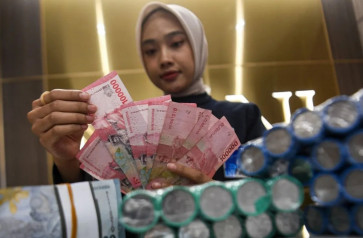
In a proposal of the revised 2013 state budget, the government will channel Rp 12.5 trillion to social security aid that includes the rice for the poor (Raskin) program and assistance for poor school children, Rp 11.6 trillion for direct cash aid and Rp 6 trillion to accelerate the development of infrastructure, such as irrigation channels and water sanitation.
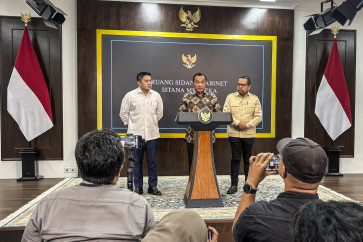
New Finance Minister Chatib Basri said the move, which was targeted at low-income families, would mitigate the impacts of fuel price increases planned by the government to start in June, the same month the government will introduce higher prices of subsidized fuel.
The government has took the decision to raise the prices of subsidized premium gasoline by Rp 2,000 per liter and subsidized diesel fuel by Rp 1,000 per liter from their current price of Rp 4,500. The measure will considerably push up inflation and the poverty rate in a nation of 240 million people.
'In the short term, low income people will need direct aid following the fuel price rise, but we will also try to combine these programs to mitigate impacts in a comprehensive way,' Chatib told reporters after proposing the revised budget to the House's budget body.
The reduction of fuel subsidies will consequently shore up fuel prices and has long been seen imperative amid a jump in global oil prices as it already puts heavy pressure on the government's spending against lower state income from tax, as well as lower oil and gas revenue.
In the proposed revision, the government also changes key macroeconomic indicators for the state budget.
It downgrades the annual economic-growth forecast to 6.2 percent from 6.8 percent, while increasing the yearly inflation target to 7.2 percent from the present 4.9 percent and the exchange rate to Rp 9,600 from Rp 9.300 against the US dollar.
The government also suggests a change in the assumption of the crude oil price to $108 per barrel, from $100 per barrel, and the oil production target of 840,000 barrels per day (bpd), down from 900,000 bpd.
All the changes will help the government keep the budget deficit at 2.48 percent of the gross domestic product (GDP), which is below the allowable level of 3 percent as stipulated by prevailing laws, but still higher than the 1.65 percent stipulated in the present budget.
Commenting on the new macroeconomic assumptions, Faisal Basri, an economist from the University of Indonesia (UI), said the changes were still 'conservative' as they were the last resort and that the government had for too long been delaying the implementation of the fuel price increase.
'The government has lost the momentum. This is a better choice among a set of bad options. Now the revision in the state budget doesn't aim to save spending anymore, but to avert a ballooning budget deficit,' he told The Jakarta Post.
As cash aid would be given in a short term, Faisal further questioned the effectiveness of the facility in helping cushion the impacts of fuel price rises.
Under the direct cash aid scheme, each of 15.5 million low-income households are expected to receive Rp 150,000 every month for only five months after the fuel price increase takes effect.
Tony A. Prasetiantono, the director of Gadjah Mada University's (UGM) center for economic and public policy studies, described the proposed revision of the state budget as 'realistic', saying it better reflected the current internal and external economic situation, giving the government a 'second chance' to accelerate growth.
'The proposed budget is expected to bring positive sentiment and boost confidence among investors because it is more sustainable,' he told the Post, adding that the economic targets proposed by the government would also be attainable.
Recently, top international rating agency Standard & Poor's (S&P) downgraded the outlook for Indonesia's economy from 'positive' to 'stable' due to 'stalling reform momentum'.