TheJakartaPost
Please Update your browser
Your browser is out of date, and may not be compatible with our website. A list of the most popular web browsers can be found below.
Just click on the icons to get to the download page.


Popular Reads
Top Results
No results found. Please check your search term and try again
Can't find what you're looking for?
View all search results
Popular Reads
Top Results
No results found. Please check your search term and try again
Can't find what you're looking for?
View all search resultsView Point: Reform without changes
Indonesia has what it takes to claim to be a democracy after 15 years of reform that not only forced an unshakeable president to step down but has bred freedom of expression, which was beyond everybody's imagination back then
Change text size
Gift Premium Articles
to Anyone
Share the best of The Jakarta Post with friends, family, or colleagues. As a subscriber, you can gift 3 to 5 articles each month that anyone can read—no subscription needed!

I
ndonesia has what it takes to claim to be a democracy after 15 years of reform that not only forced an unshakeable president to step down but has bred freedom of expression, which was beyond everybody's imagination back then.
Absolute power was put to an end and the way was paved for democracy to flourish. People have the right to vote for a leader of their choice ' and dump their leader after five years if that person in charge unable to live up to expectations, a stark contrast to the past. In the past hundreds of members of the People's Consultative Assembly (MPR) ' more than half of them handpicked by the ruler ' unanimously elected the same president six times in a row.
Given the all pervasive corruption beleaguering the county, however, one may be tempted to deride the reform movement as no more than a short-lasting euphoria. As soon as the reform movers, ranging from student protesters and opportunist politicians, gave president Soeharto no choice but to make a disgraced exit, it was business as usual.
Formerly a rubber stamp of the presidential wish, the MPR endorsed Decree No. XII/1998 on eradication of corruption, collusion and nepotism. Article 4 of the decree ordered an investigation into the corruption, collusion and nepotism of Soeharto, his family and cronies, active and retired officials and tycoons.
Raging corruption was one of the concerns that triggered reform, but through the decree the MPR attempted to lay the blame solely on Soeharto, the villain piece. The MPR decree was simply a political move to please the angry mob without any possibility of enforcement.
Soeharto was indeed was charged with corruption but until he died in February 2008 the former strongman never appeared in court.
The decree itself turned into a dead state document after the same MPR decided in a constitutional amendment in 2004 to exclude MPR decrees from the legal system.
Corruption eradication was politically motivated from the start rather than a national drive with clear and measurable targets and, more importantly, commitment.
It comes as no surprise that the public doubts whether and when the country will win its war on corruption.
Time after time the anticorruption body, the Corruption Eradication Commission (KPK) and other law enforcement agencies uncover graft cases inflicting more and more losses to the state. KPK said recently corruption cases it unveiled in the last six years were responsible for almost Rp 40 trillion (US$4.12 billion) of losses, enough to pay for the primary education of 68 million children.
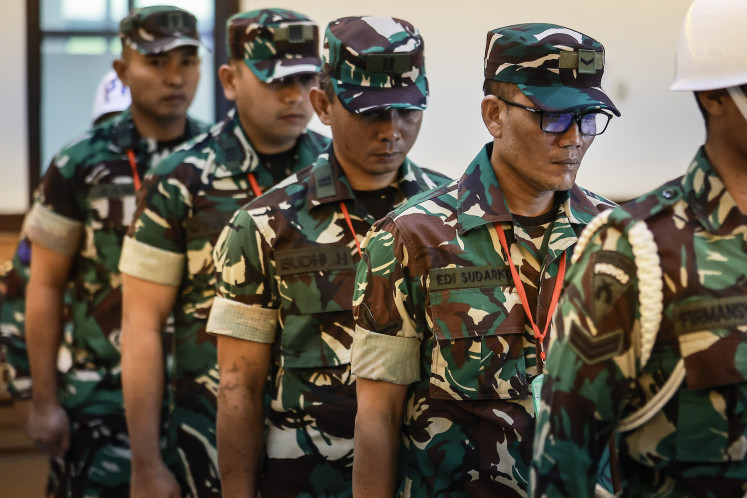
The public was flabbergasted when junior tax officer Gayus H. Tambunan was found to have amassed Rp 74 billion from bribes, or when another tax official Bahasyim Assifie had assets worth Rp 900 billion which he could not account for. The latest report says a low ranking police officer serving in West Papua, Adj. First Insp. Labora Sitorus, controlled accounts through which passed over Rp 1 trillion over a five-year period allegedly from fuel smuggling and illegal logging.
Since the formation of KPK in 2003, numberless of politicians, regents, governors and minister have been named suspects or convicted of corruption. They come from almost every political party represented at the House of Representatives.
The fact that more graft cases continue to come to light, despite the bigger role played by the civil society and the media, only shows that the lure of easy money outstrips fraudsters' fear of the legal consequences of their acts.
The law against corruption has not significantly deterred people from committing the crime. No maximum sentence has ever been handed down to a convict, not to mention generous remissions awaiting.
Worse, as the latest unannounced visit of Deputy Law and Human Rights Minister Denny Indrayana to Sukamiskin prison in Bandung recently, the convicts have facilities they are not entitled to, such as smartphones, TVs and computer gadgets. Some convicts like Muhammad Nazaruddin are allowed to leave their cells for dubious medical
treatment.
It is not exaggerating to perceive corruption in the reform era as not only more substantial, but also more sophisticated than it was in the New Order. Or perhaps reform has not yet impacted on the fight against corruption.
The annual corruption index has consistently ranked Indonesia among the most corrupt countries. The latest index released by the Transparency International in December 2012 saw Indonesia join the group of 56 countries where corruption remains deep-rooted. In the most corrupt countries, graft involves political parties, the parliament, the courts and the police force.
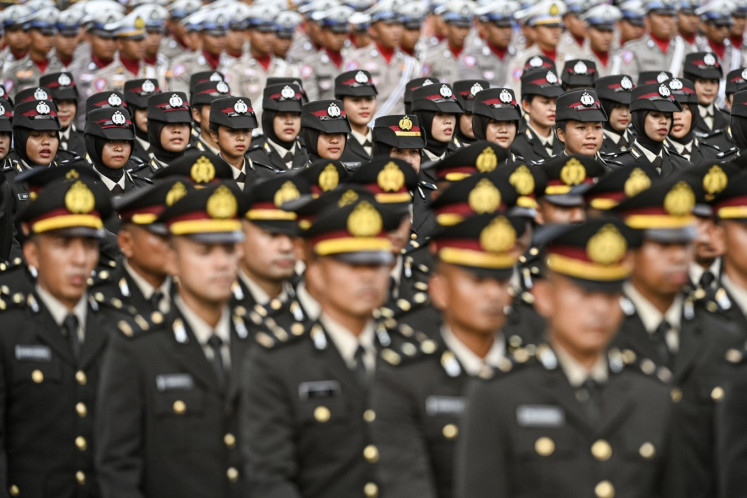
This has been confirmed in the last few years as politicians, judges and police officers were arrested and later found guilty. It is imperative for law enforcement agencies, particularly the KPK, to focus on the four sectors not only through curative but also preventive measures.
KPK has set a good precedent by showing no fear of high-profile figures, including those close to the President, but with certain people remaining untouchable despite the court findings, the war on corruption is not won yet.
At the end of the day, the political will of policymakers holds the key in the fight against graft. The KPK is just executor of legislation.
Policymakers indeed need the courage to empower, rather than weaken, the KPK.
The author is a staff writer at TheJakarta Post.