TheJakartaPost
Please Update your browser
Your browser is out of date, and may not be compatible with our website. A list of the most popular web browsers can be found below.
Just click on the icons to get to the download page.


Popular Reads
Top Results
No results found. Please check your search term and try again
Can't find what you're looking for?
View all search results
Popular Reads
Top Results
No results found. Please check your search term and try again
Can't find what you're looking for?
View all search resultsHigh hopes emerge as East Asia, Latin America forum concludes
A concluding joint press conference was canceled and some participating delegation members even left the venue before its final sessions but the sixth Ministerial Meeting of the Forum for East Asia and Latin America Cooperation (FEALAC) in Bali was claimed to have achieved a constructive and prospective outcome
Change text size
Gift Premium Articles
to Anyone
Share the best of The Jakarta Post with friends, family, or colleagues. As a subscriber, you can gift 3 to 5 articles each month that anyone can read—no subscription needed!

A
concluding joint press conference was canceled and some participating delegation members even left the venue before its final sessions but the sixth Ministerial Meeting of the Forum for East Asia and Latin America Cooperation (FEALAC) in Bali was claimed to have achieved a constructive and prospective outcome.
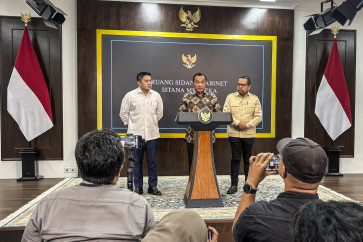
The press conference room and its two podiums, prepared to be used by co-chairs Indonesian Foreign Minister Marty Natalegawa and Colombian Deputy Foreign Minister Monica Lanzetta Mutis to deliver the final press address on Friday, had practically been unused during the two-day meeting.
But Foreign Ministry's director general for America and Europe Dian Triansyah Djani insisted the situation should not be used as a parameter on the meeting's effectiveness in reaching a successful outcome.
According to him, Marty needed to fly to Jakarta immediately to host Nicaraguan Foreign Minister Samuel Santos Lopez, who wanted to make an official visit after attending the FEALAC meeting. Mutis also had other events she must attend, Dian Triansyah said.
'The Bali meeting was a successful one. We managed to identify 30 new projects, in addition to the 248 projects since the first FEALAC meeting, to be carried out in the next two years under the new chairs, Thailand and Costa Rica,' Dian Triansyah told the few journalists left at the venue.
A 39-point communiqué, called the 'Uluwatu Declaration', was adopted in the final session, held in the famous tourism resort of Uluwatu, some 10 kilometers West of Nusa Dua, where the meeting's main events had been held.
According to Dian Triansyah, the meeting in Uluwatu, which was closed to the media, was very short as all participating nations immediately agreed to adopt the draft of the communiqué.
Some heads of delegations, however, did not witness the communiqué adoption as they left early. Seven out of 13 foreign ministers initially attending the early sessions even skipped a courtesy call meeting between heads of delegations and President Susilo Bambang Yudhoyono, held in Nusa Dua earlier on Friday.
In the meeting, Yudhoyono told the delegations that he hoped that the FEALAC could contribute more to global stability and engage with other regional forums such as the East Asia Summit and the Asia-Pacific Economic Cooperation (APEC), according to presidential spokesman for foreign affairs Teuku Faizasyah.
The Bali meeting also managed to facilitate some 49 sideline bilateral meetings between participating nations, which Dian said indicated that the Bali meeting had significantly enhanced cooperation between the two regions.
Indonesia, for example, managed to reach agreements on visa-free process for diplomatic and service passport holders with Colombia, Venezuela and Uruguay.
Among many agreements, there were two iconic projects which member states had agreed to focus on, namely a cooperation in Small and Medium Enterprises (SME) and in the education sector.
'The cooperation between universities, which was initiated by Brazil, will include exchange of students and researchers. Indonesia supports the idea. We will be identifying which of our universities are available for the project,' Dian Triansyah said.
In a previous interview, Brazilian Deputy Foreign Minister Maria Edileuza Fontenele Reis said the cooperation of universities was also aimed at contributing to narrow the knowledge gap between the East Asia and Latin America regions.