TheJakartaPost
Please Update your browser
Your browser is out of date, and may not be compatible with our website. A list of the most popular web browsers can be found below.
Just click on the icons to get to the download page.


Popular Reads
Top Results
No results found. Please check your search term and try again
Can't find what you're looking for?
View all search results
Popular Reads
Top Results
No results found. Please check your search term and try again
Can't find what you're looking for?
View all search resultsPeatland restoration remains half-hearted, study finds
The failure to restore degraded peatland by concession owners will increase the risk of forest and peatland fires in the future.
Change text size
Gift Premium Articles
to Anyone
Share the best of The Jakarta Post with friends, family, or colleagues. As a subscriber, you can gift 3 to 5 articles each month that anyone can read—no subscription needed!
W
hen the last embers of the 2015 forest and peatland fires were extinguished, the government immediately urged all relevant stakeholders, including in the private sector, to restore degraded peatland across the country to prevent a similar catastrophe from happening in the future.
The 2015 wildfires raged through around 2.6 million hectares of land in Sumatra and Kalimantan, costing the country more than US$16 billion. Haze from the fires reached the neighboring countries of Malaysia and Singapore and caused health problems for tens of thousands of people.
While most of the country’s peatland is located on concession lands, a recent study published by an environmental group has revealed that most owners have not properly restored the wetlands across the country, despite being obliged to do so.
In a study published in late May, environmental group Pantau Gambut examined a total of 1,222 peatland areas in which wildfires occurred between 2015 and 2019 on 43 concession areas spread across seven provinces.
According to the group, around 5.2 million ha, 39 percent, of the 13.4 million ha of Indonesia’s peatland are located within forest and plantation concession areas.
Read also: Indonesia faces gigantic task of restoring peatland destroyed by fire
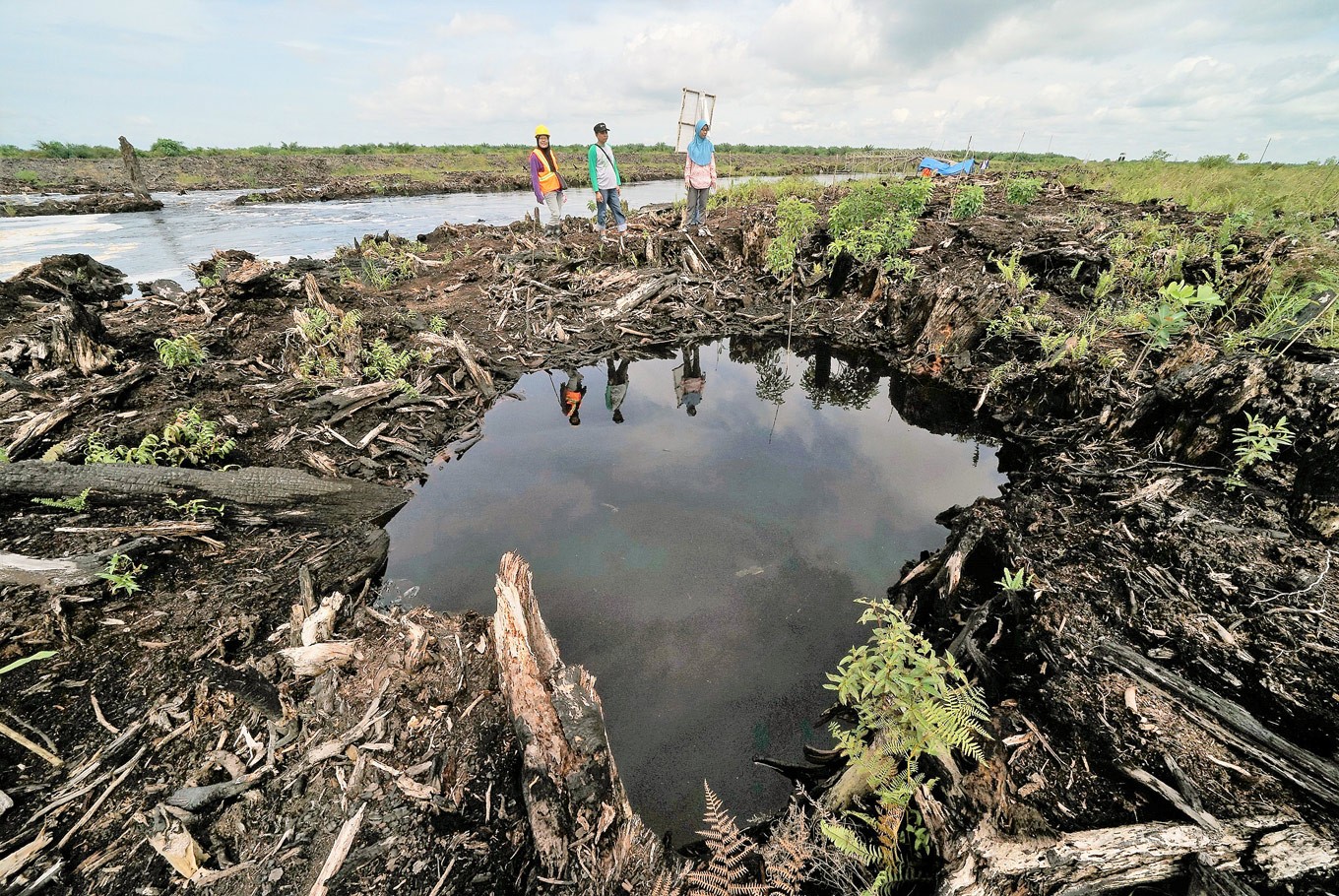
The group found during a field observation of 355 areas that most of them had no restoration infrastructure such as canals, dams or deep wells. Meanwhile, only about 2 percent had restoration infrastructure in good condition.
Canals, dams and deep wells are often used to rewet dried peatlands. The wells are used to pump out groundwater to rewet peatlands or extinguish fires breaking out on dried-out wetlands. Meanwhile, people use dams to store water, thus raising the water levels in the peatland.
Profit first
Pantau Gambut also found that of 405 peatland areas experiencing tree cover loss between 2015 and 2019, more than half of them had been replanted with oil palms or acacia trees for industrial forests. The total area amounted to around 420,000 ha.
Within the same period, around 1 million ha of peatland inside concession areas were burned. Of this 67.8 percent was left unrestored while the rest was planted using oil palm or acacia trees.
“The findings show that concession owners made almost no attempt to restore peatland or build restoration infrastructure,” Pantau Gambut’s Riau chapter coordinator, Romes Irawan Putra, said recently.
He added that Pantau Gambut’s discoveries on the peatland inside concession areas contrasted with the government’s claim on peatland restoration.
The Peatland and Mangrove Restoration Agency (BRGM) claimed that the agency had restored up to 645,000 ha of peatland as of late 2020. Meanwhile, the Environment and Forestry recently claimed to have restored up to around 3.6 million ha of peatland in concessions owned by 294 companies.
Following the 2015 forest and peatland fires, the government amended a government regulation on peatland protection and management, which stipulated concession owners’ responsibility to restore degraded peatland within their responsibility, among other additional provisions on peatland protection.
Many experts regard the peatland ecosystem as an important element in climate crisis mitigation thanks to its ability to store carbon emissions at twice the rate of rainforests. Degraded peatland cannot absorb and store greenhouse gases, therefore, it is necessary to restore the damaged wetlands.
Read also: Taking lessons from 2015 forest fire disaster
Pantau Gambut’s Jambi chapter coordinator Feri Irawan acknowledged that some concession owners had attempted to restore degraded peatland, although most of them were still engaged in activities that damaged the wetlands.
“The owners claim that [building canals to transport wood] could prevent forest fires. But they didn’t conduct any studies about whether the canals actually cause drought in the peatlands because it’s not linked to their profit-seeking activities,” he said.
Nicodemus Ale of the group’s West Kalimantan chapter urged the government to expand the moratorium on new business permits in forest and peatland areas. According to Pantau Gambut, fewer fire hotspots were detected in peatland under the moratorium compared with those areas outside the restricted zones.
In 2019, the government upgraded a moratorium on the issuance of new business permits for use of forest and peatland areas to a permanent ban. First issued in 2011, the ban was initially extended every two years. The restricted area covers around 66 million ha.
Lack of supervision
The government regulation requires concession owners to submit a general restoration working plan (RKU) and annual plan (RKT) to the Environment and Forestry Ministry, which must approve such plans.
But Romes claimed there was a lack of proof that the concession owners adhered to their plans in restoring the peatland. Civil groups’ requests to review such documents have been repeatedly rejected by the ministry, which states that they are not open to the public.
Romes added that authorities’ ground supervision and law enforcement on forest and peatland, as well as peatland restoration, were ineffective and not transparent.
BRGM head Hartono said the agency could not do much for peatland in concession areas as they were under the Environment and Forestry Ministry’s authority. “The BRGM is only focused on restoring peatland areas in areas owned by individuals or other non-concession areas,” he said.
The Environment and Forestry Ministry did not respond to The Jakarta Post's request for comment.
Read also: Jokowi extends, broadens authority of peat restoration agency
Roundtable on Sustainable Palm Oil (RSPO) Indonesia compliance manager Djaka Riksanto said it had included peatland management as one of the criteria to be fulfilled by any palm oil company wishing to obtain the international certification.
“We restrict our members in using peatland [for plantations] regardless of their depth and condition,” Djaka said, adding that the RSPO also had guidelines on the management of peatland within concession areas.
However, he acknowledged that there were currently 220 palm oil companies with RSPO certification in Indonesia, only around 20 percent of the total companies across the country.
Representatives of the Association of Indonesian Forest Concession Holders (APHI) and the Indonesian Palm Oil Producers Association (GAPKI) were not immediately available for comment.