TheJakartaPost
Please Update your browser
Your browser is out of date, and may not be compatible with our website. A list of the most popular web browsers can be found below.
Just click on the icons to get to the download page.


Popular Reads
Top Results
No results found. Please check your search term and try again
Can't find what you're looking for?
View all search results
Popular Reads
Top Results
No results found. Please check your search term and try again
Can't find what you're looking for?
View all search resultsDeindustrialization has really occurred in Indonesia
Indonesia needs to adopt a more open-minded approach to address the issue of premature deindustrialization and foster reindustrialization.
Change text size
Gift Premium Articles
to Anyone
Share the best of The Jakarta Post with friends, family, or colleagues. As a subscriber, you can gift 3 to 5 articles each month that anyone can read—no subscription needed!
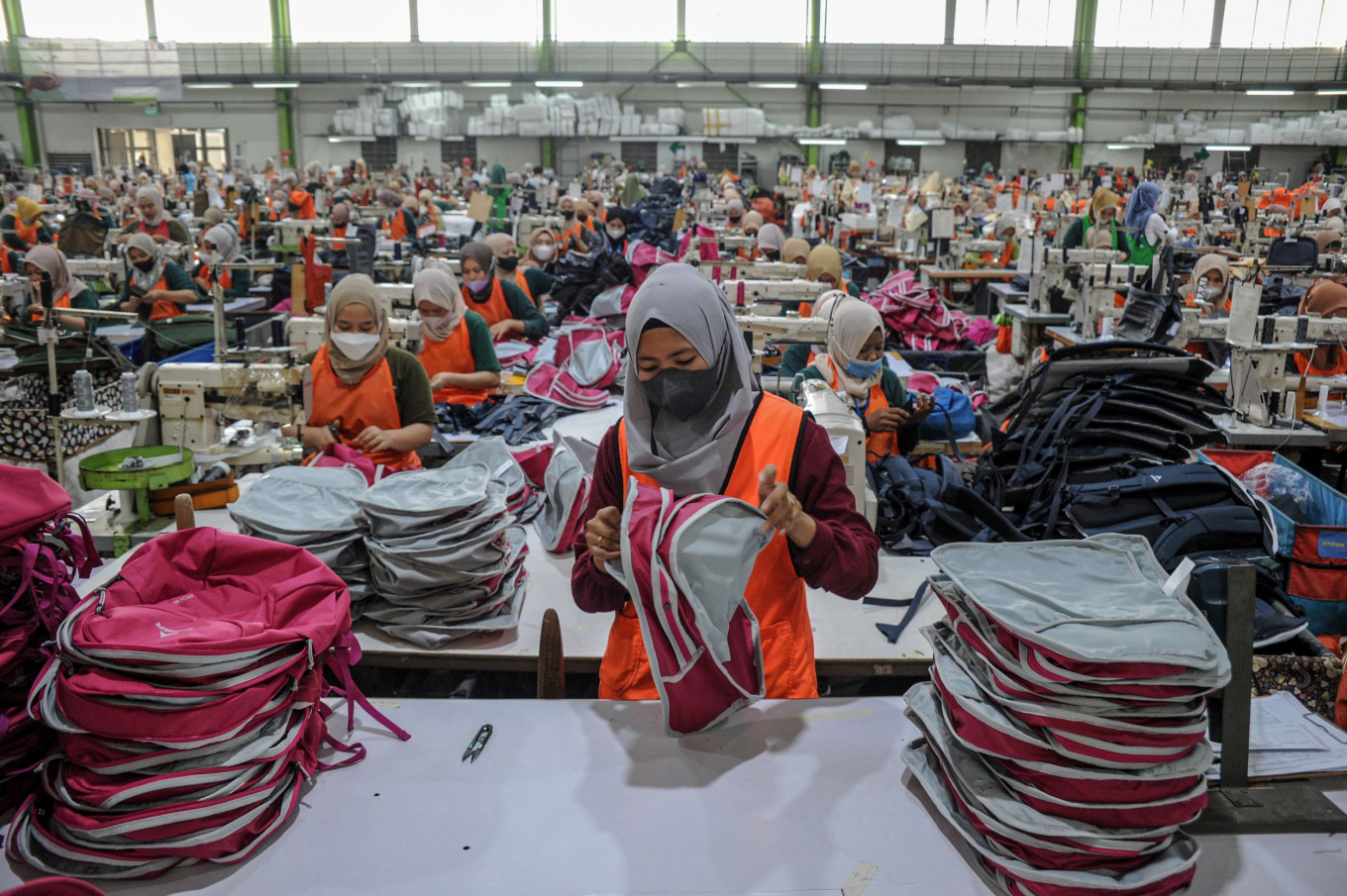
A recent opinion piece titled "Deindustrialization in Indonesia: An opposite viewpoint" by Affan Alamudi, published in The Jakarta Post on June 28, 2023, challenges the prevailing understanding. The article deviates from the realities on the ground and presents the complete opposite of the facts. From the very beginning, the author asserts that the observation of Indonesia is experiencing deindustrialization is groundless, a claim that lacks substantiation and appears more akin to a fairy tale than a well-founded argument.
As readers, we were initially intrigued by the title, expecting a thought-provoking perspective from an advisor to a leading institution focused on reindustrializing Indonesia. We hoped the article might provide breakthrough insight.
However, the article ultimately failed to present any substantive counterarguments to support its assertion that deindustrialization in Indonesia is groundless. Instead, the author briefly mentioned that the government has implemented policies to foster industrial growth, which, in itself, does not effectively challenge the fact of deindustrialization.
Moreover, the author's perspective conveniently overlooks the broader tapestry of Indonesia's industrial landscape, myopically fixating on nominal data from a solitary year. By highlighting the manufacturing sector's contribution to gross domestic product (GDP) and cherry-picking a 19 percent figure for 2021, the author boasts about the supposedly impressive contribution of industry.
However, if we analyze the conditions of the preceding 20 years, we can see that the manufacturing sector consistently contributed a higher percentage to the GDP. In 2000, manufacturing accounted for 23.09 percent of GDP, followed by a slight increase to 23.37 percent in 2005. However, the sector’s contribution fell to 21.47 percent of GDP in 2010. Subsequently, the manufacturing sector's share further decreased to 20.99 percent in 2015 and 20.26 percent in 2019. It is perplexing to witness such a narrow depiction of the economy from a senior advisor, as it oversimplifies the complexities at play.
Additionally, the author emphasizes the significant employment opportunities provided by the manufacturing sector. Yet, he conveniently overlooks the comprehensive analysis employed by Rodrik (2015), which considers multiple indicators such as the manufacturing value-added contribution to GDP in current prices, manufacturing value-added contribution to GDP in constant/real prices and manufacturing employment contribution to total employment. This selective use of data is more reminiscent of a magician performing sleight of hand than a serious analysis.
In a twist of irony, the author contradicts his own argument by acknowledging the potential employment disruptions posed by the Industrial Revolution 4.0.
To add to the discussion, one may question why Indonesia would implement an export ban on nickel ore if deindustrialization were not a concern. The purpose of this policy was to encourage domestic nickel processing smelters, and, hence, downstreaming raw commodities. Such denials somehow reflect a lack of understanding of Indonesia's industrial policy and its underlying motivations.
In the midst of an ongoing discourse surrounding Indonesia's deindustrialization, the call for robust and vigorous exchanges resonates strongly. It is through these intellectual engagements that we can embark on a profound exploration, delving deep into the heart of the matter. By unwaveringly scrutinizing the complexities surrounding Indonesia's deindustrialization, we can expose its true contours and unlock the key to meaningful solutions. This is a story that begins by relinquishing the role of deniers and embracing the quest for understanding.
We must recognize that Indonesia has already experienced some deindustrialization. In the global economies, deindustrialization often emerges as a natural phase, a turning point in a country’s developmental journey. However, Indonesia's experience of deindustrialization deviates significantly from the norm, giving rise to what economists term "premature deindustrialization." Unlike most advanced economies, where deindustrialization occurs at a later stage, Indonesia's industrial decline arrived unexpectedly early, disrupting the conventional trajectory.
Rodrik (2015) casts a revealing light on this phenomenon, elucidating the divergence between Indonesia and other nations. As he points out, by the post-1990 period, when a country’s industrialization reached its peak, these advanced economies boasted a per capita GDP of around US$31,000 (in 2010 international dollar based on purchasing power parity/PPP). In contrast, even after adjusting for Indonesia-specific factors, which the study by Islami and Hastiadi (2020) acknowledges, Indonesia’s industrialization peaked before reaching $6,285 (in 2010 international dollar based on PPP).
Indonesia needs to adopt a more open-minded approach to address the issue of premature deindustrialization and foster reindustrialization. It is crucial to prioritize well-informed and knowledgeable policymakers who can guide the country in the right direction. As highlighted by Rodrik (2013), the manufacturing sector holds the potential to drive growth in developing countries, enabling them to achieve convergence through its positive correlation with sectoral growth and productivity. From this standpoint, it becomes imperative for Indonesia, as a middle-income country aiming to escape the middle-income trap, to effectively harness the potential of its manufacturing sector. By doing so, it can better prepare itself for the challenges ahead and position itself for sustained economic development.
Indonesia's present trajectory toward achieving the coveted status of an industrialized nation falls significantly short of the threshold. Hence, it becomes imperative to intensify our efforts, directing unwavering attention toward the steadfast advancement of infrastructure development, substantial investments in human capital and the resolute pursuit of institutional reforms, as mentioned by Hastiadi in Trade Strategy in East Asia: From Regionalization to Regionalism (2016).
At the end of the day, rather than denying the incontrovertible truth of Indonesia's deindustrialization, it is essential that we cultivate a mindset of active engagement and foster collaborative relationships with stakeholders from various spheres. Why don't we seek and collaborate across stakeholders to cope with it?
Fithra serves as the executive director of Next Policy and works as a lecturer at the Department of Economics, the University of Indonesia. Askar is an economist affiliated with the Institute for Demographic and Poverty Studies (IDEAS). The views are their own.