TheJakartaPost
Please Update your browser
Your browser is out of date, and may not be compatible with our website. A list of the most popular web browsers can be found below.
Just click on the icons to get to the download page.


Popular Reads
Top Results
No results found. Please check your search term and try again
Can't find what you're looking for?
View all search results
Popular Reads
Top Results
No results found. Please check your search term and try again
Can't find what you're looking for?
View all search resultsWorld’s oceans set new surface temperature record: EU monitor
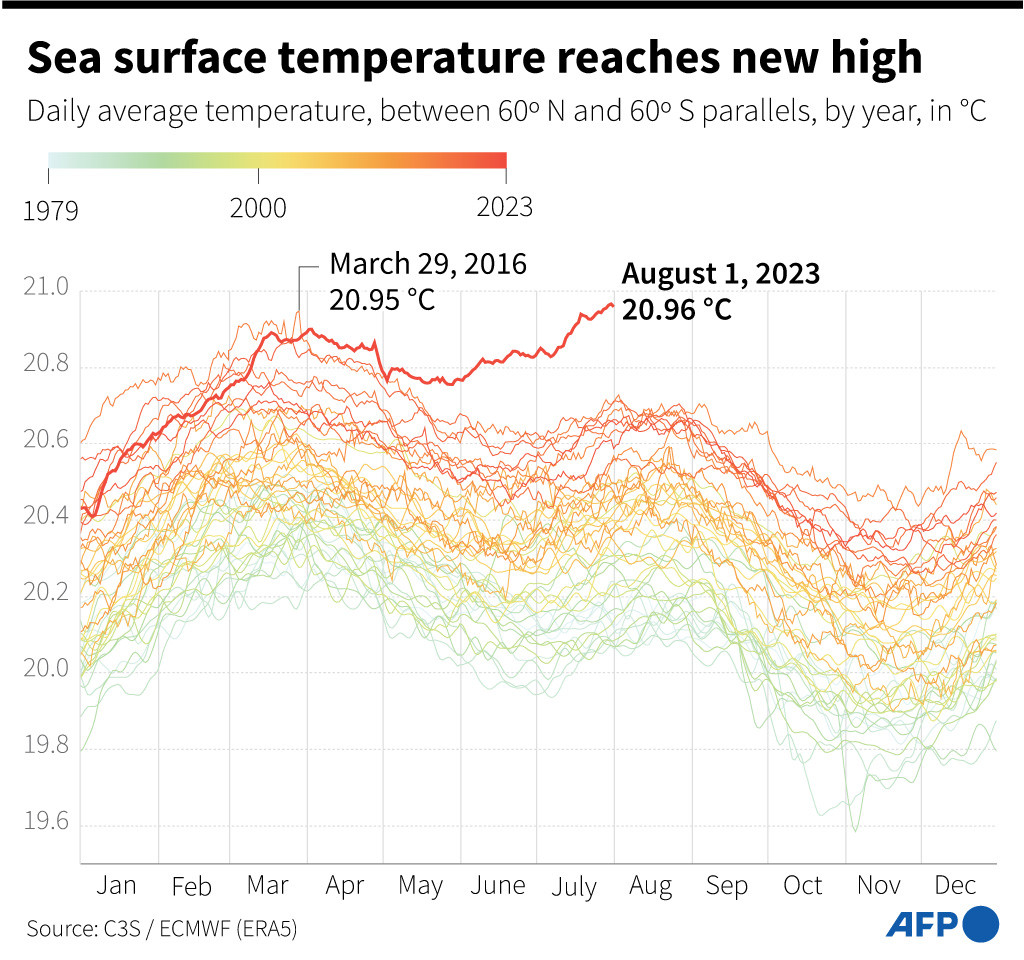
The temperature of the oceans' surface rose to 20.96 degrees Celsius on July 30, according to European Union climate observatory data.
Change text size
Gift Premium Articles
to Anyone
Share the best of The Jakarta Post with friends, family, or colleagues. As a subscriber, you can gift 3 to 5 articles each month that anyone can read—no subscription needed!
T
he world's oceans set a new temperature record last week, raising concerns about knock-on effects on the planet's climate, marine life and coastal communities.
The temperature of the oceans' surface rose to 20.96 degrees Celsius on July 30, according to European Union climate observatory data.
The previous record was 20.95 degrees in March 2016, a spokeswoman for the EU's Copernicus Climate Change Service told AFP on Friday.
The samples tested excluded polar regions.
The United States National Oceanic and Atmospheric Administration (NOAA), which uses a different database, has also recorded a similar trend in recent months.
It said the average sea surface temperature record was reached on April 4 this year at 21.06 degrees, overtaking the previous high of 21.01 degrees in March 2016. On Aug. 1, average temperatures were at 21.03 degrees, it said.
Oceans have absorbed 90 percent of the excess heat produced by human activity since the dawn of the industrial age, according to scientists.
This excess heat continues to accumulate as greenhouse gases, mainly from burning oil, gas and coal, build up in the Earth's atmosphere.
Globally, the average ocean temperature has been topping seasonal heat records on a regular basis since April.
'Immediate threat'
"The ocean heatwave is an immediate threat to some marine life," said Piers Forster of the International Centre for Climate at the United Kingdom's University of Leeds.
"We are already seeing coral bleaching in Florida as a direct result and I expect more impacts will surface."
The overheating of the oceans is predicted to have other effects on marine plant and animal life too, including on the migration of certain species and the spread of invasive species.
This could threaten fish stocks and thus undermine food security in certain parts of the globe.
Warmer oceans are also less capable of absorbing carbon dioxide, reinforcing the vicious cycle of global warming.
And higher temperatures are likely to come, since the phenomenon of El Nino, which tends to warm waters up, has only just begun.
Scientists expect the worst effects of the current El Nino to be felt at the end of 2023 and continue into subsequent years.
Like bath water
"While there are certainly short-term factors, the main long-term cause is without a doubt the accumulation of greenhouse gases in the atmosphere caused by human activity, primarily by the burning of fossil fuels," said Rowan Sutton, director of climate research at the University of Reading.
The latest figures follow a string of record highs around the world.
Last month, temperatures of 38.3 degrees, as hot as a jacuzzi, were recorded off the Florida coast, which could be a world-record high for a point measurement if the figure is confirmed.
The surface waters of the North Atlantic rose to a record-high average temperature of 24.9 degrees last week, according to provisional data from the NOAA.
The North Atlantic usually only reaches its peak temperature in September.
Since March, the month when the North Atlantic begins to warm up after winter, temperatures have been higher than in previous years and the gap with past records has continued to widen in recent weeks.
The region has become a key point for observing the heating of the world's oceans.
In July, the Mediterranean Sea broke its daily heat record, with a median temperature of 28.71 degrees, according to Spain's leading maritime research center.
Marine heatwaves have become twice as frequent since 1982, according to a 2019 report by the Intergovernmental Panel on Climate Change (IPCC).
By 2100, they could be 10 times more intense than they were at the beginning of the 20th century if pollutant emissions are not reduced.
The use of coal, oil and gas is expected to be at the center of debates in the upcoming United Nations climate talks, dubbed COP28, scheduled to take place at the end of the year in Dubai.