Noise

Forest, people sacrificed in Sebangau

How a national park in Central Kalimantan vanishes in plain sight

By Gembong Hanung June 30, 2026

After years of destruction, Sebangau forest was named a national park with the goal of protecting it from further deforestation. More than 20 years later, forest degradation is still happening inside the park’s borders from agriculture and mining, raising questions about authorities’ efforts to preserve nature.
For many Dayak people, the indigenous dwellers of Kalimantan forests, an old adage remains their way of life: “Ingat peteh Tatu Hiang, petak danum akan kolunen harian andau” (Remember the advice of our ancestors; the land and water are for generations to come).

But as their home in the Indonesian part of Borneo Island has become one of the world’s flashpoints of deforestation, their belief in guarding their homeland and passing it down to their children has faded, along with the forests.

Sebangau, a vast peat swamp forest in Central Kalimantan, has become a critical case in which rapid deforestation and forest fires have continued to occur even after it was granted national park status in 2004, the country’s highest level of conservation that legally protects an ecosystem along with its biodiversity.

Analysis: Anggun D. Napitupulu (Auriga Nusantara)

For many Dayak people, the indigenous dwellers of Kalimantan forests, an old adage remains their way of life: “Ingat peteh Tatu Hiang, petak danum akan kolunen harian andau” (Remember the advice of our ancestors; the land and water are for generations to come).

But as their home in the Indonesian part of Borneo Island has become one of the world’s flashpoints of deforestation, their belief in guarding their homeland and passing it down to their children has faded, along with the forests.

Sebangau, a vast peat swamp forest in Central Kalimantan, has become a critical case in which rapid deforestation and forest fires have continued to occur even after it was granted national park status in 2004, the country’s highest level of conservation that legally protects an ecosystem along with its biodiversity.

More than two decades later, the national park, which is eight times the size of Jakarta, has lost thousands of hectares of its forest cover to encroachment and tenurial conflicts, a pattern that has been widely reported across 57 national parks in the archipelago.

In April, The Jakarta Post went into the depths of Sebangau, witnessing the presence of illegal oil palm plantations that have become part of the supply chain of global brands like Cargill and Nestlé, while the Ngaju people, one of the largest subgroups of Dayak, have been uprooted from their ancestral homes.

Endless destruction

Sebangau sits on the doorstep of Central Kalimantan’s provincial capital of Palangka Raya, which also shares the park area with neighboring Katingan and Pulang Pisau regencies. Three ancient rivers of Sebangau, Kahayan and Katingan crisscross the park, nourishing a vast network of peat swamp forests.

It intertwines with 39 villages and subdistricts, two thirds of which have Dayak-majority populations. Some are also situated along the 650-kilometer-long Katingan River on the western side of Sebangau.

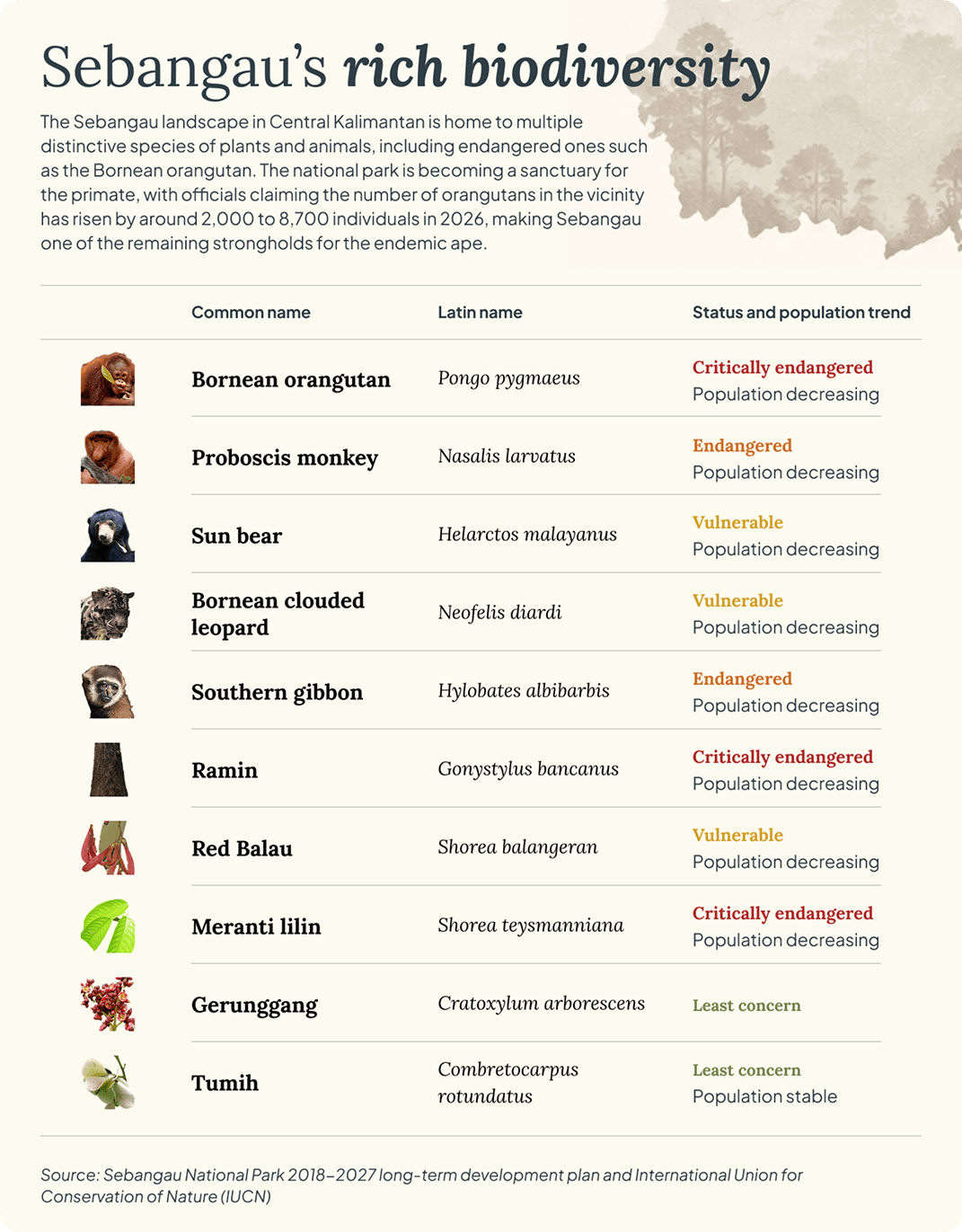
With 80 percent of the area consisting of peat forests, Sebangau is also one of the country’s largest peatland ecosystems and is home to more than 8,700 Bornean orangutans that live on the verge of extinction.

The destruction of Sebangau forests can be traced back to a period between the 1970s and early 2000s, when the area was designated as an industrial forest plantation (HTI) that hosted dozens of timber concessions. At that time, peatlands were heavily drained to make way for more than 400 canals built to transport timber logs, while major watercourses were also diverted to irrigate monocrops.

The damage was so enormous that official data estimated that up to 85 percent of Sebangau had been left barren and that it would take several centuries to restore it to its pre-logged state. The massive destruction prompted the government to grant the national park status in 2004.

Unfortunately, the status has not stopped the deforestation and forest degradation.

According to analysis from environmental watchdog Auriga Nusantara, the park lost around 23,000 ha of its forest between 2015 and 2025, marking a 10,000-ha increase in permanent loss compared with the previous decade.

The peat swamps are faring no better. A report published in August 2025 by peatland-focused NGO Pantau Gambut reveals that nearly half of 669,000 ha of degraded peatlands in Central Kalimantan, are located along the corridor of the Kahayan and Sebangau rivers, which overlap with the national park.

“Half of the damage also impacts and overlaps with the national park area, raising the risk of flooding and forest fires,” said Wahyu Perdana, advocacy, campaign and communication manager for Pantau Gambut

Illegal plantations

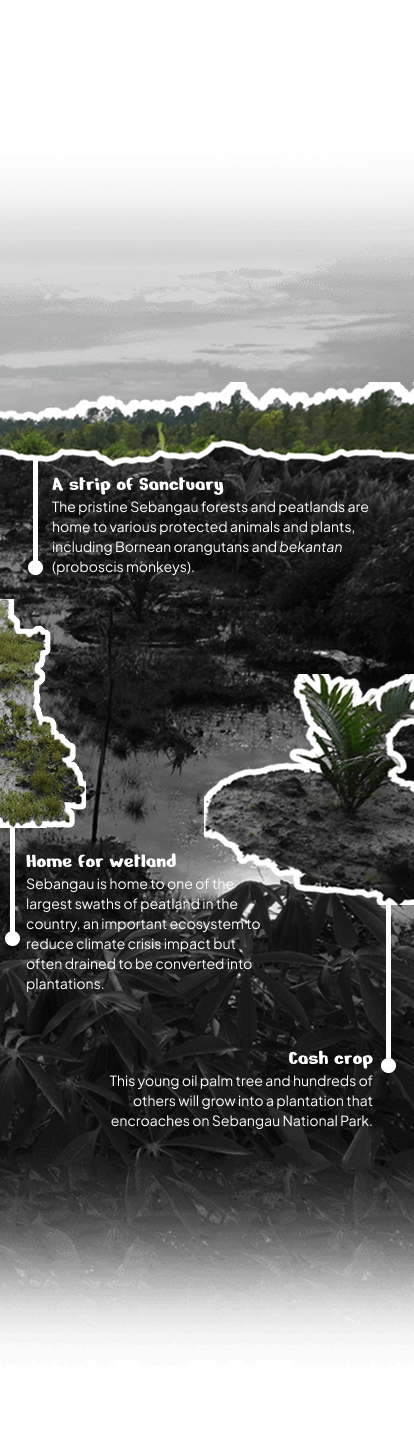
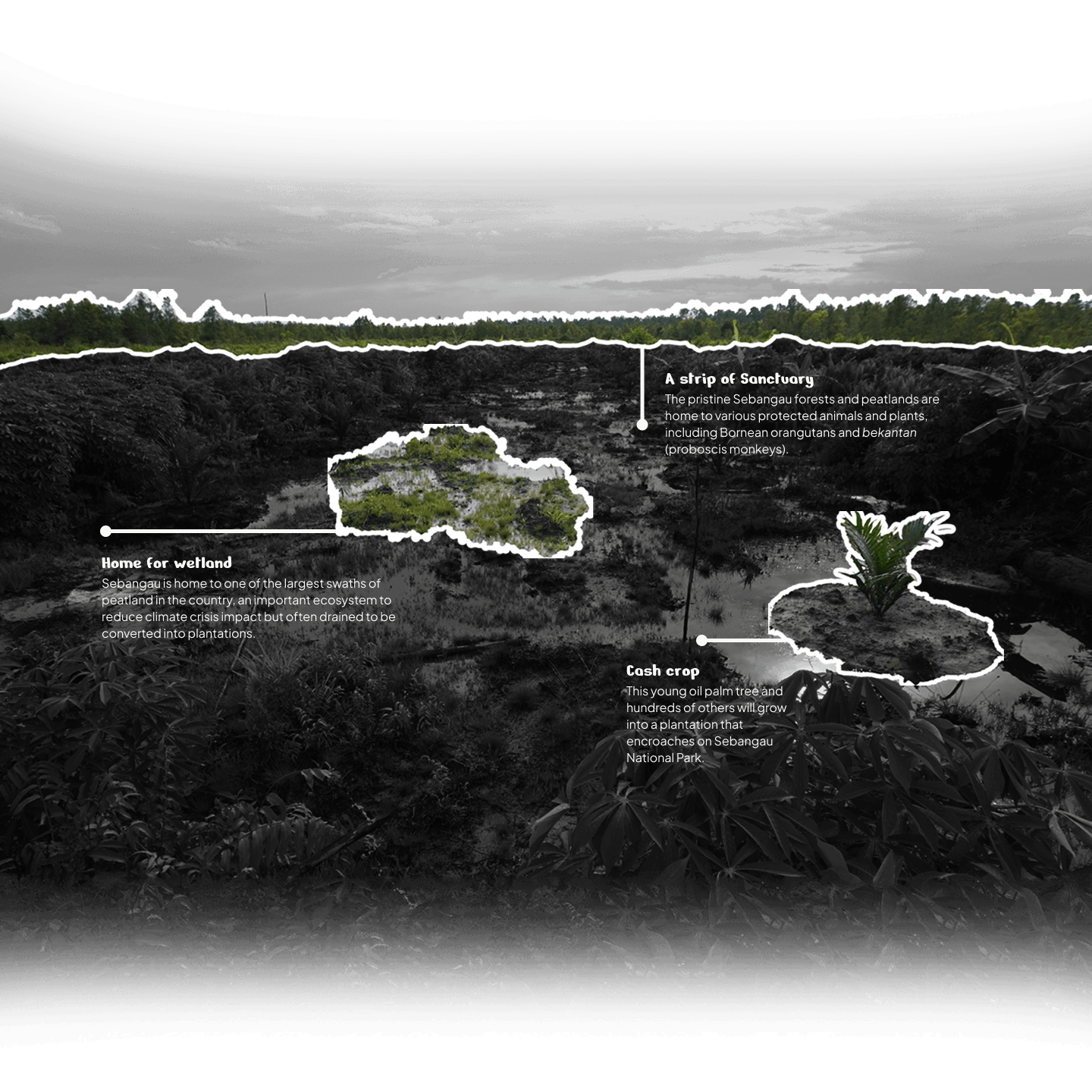
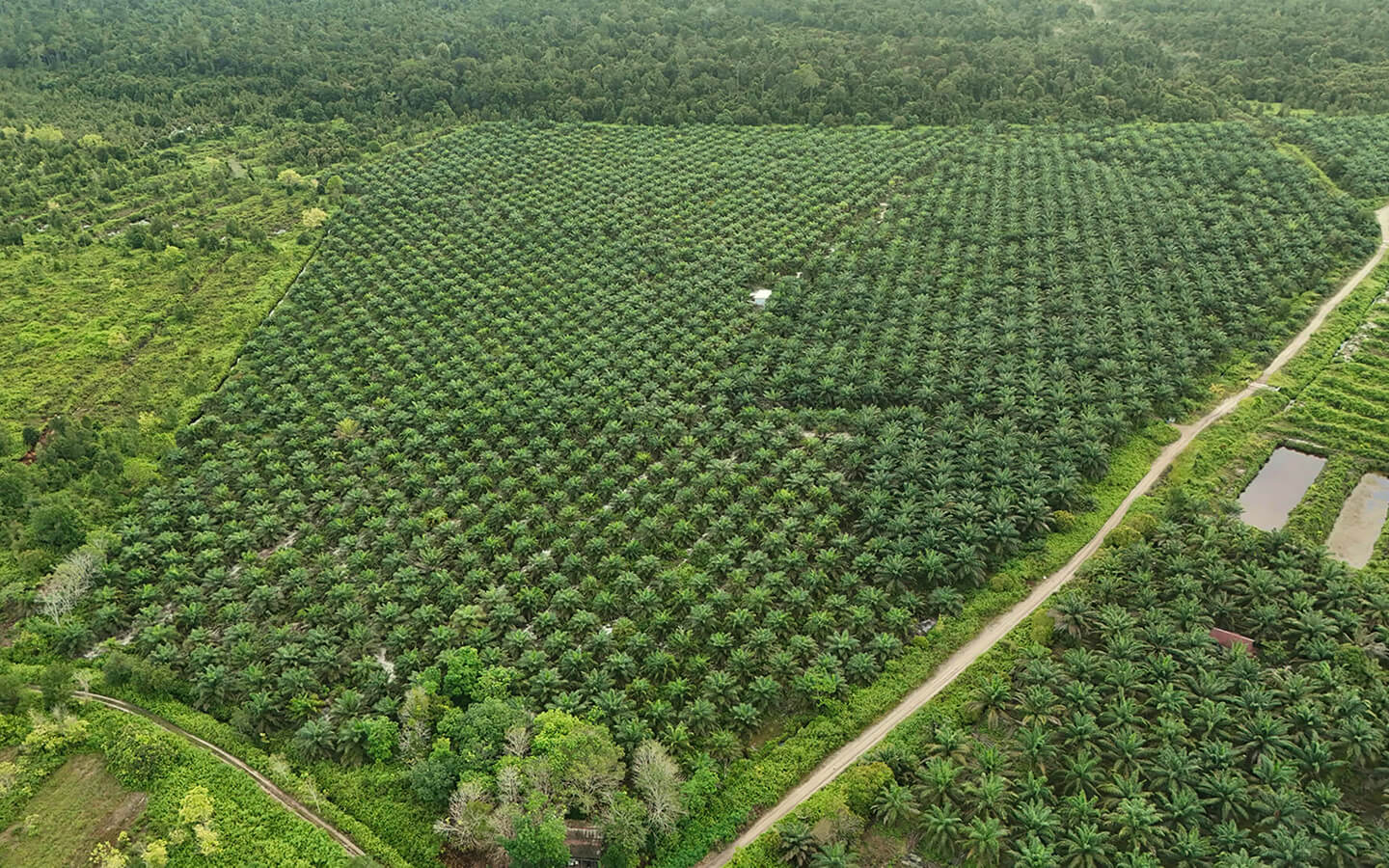
Palm oil has become the main force of deforestation in Sebangau. Situated in Central Kalimantan, a major palm oil producing province, many parts of the forests have been encroached and turned into illegal plantations.

Oil palm plantation within Sebangau National Park
An oil palm plantation within Sebangau National Park is pictured in this aerial photo on April 27, 2026. (JP/Noufal Helmy)
Ruswanto, Head Office of Sebangau National Park
Sebangau National Park office head Ruswanto sits in his office in Palangka Raya, Central Kalimantan, on April 30, 2026. (JP/Noufal Helmy)
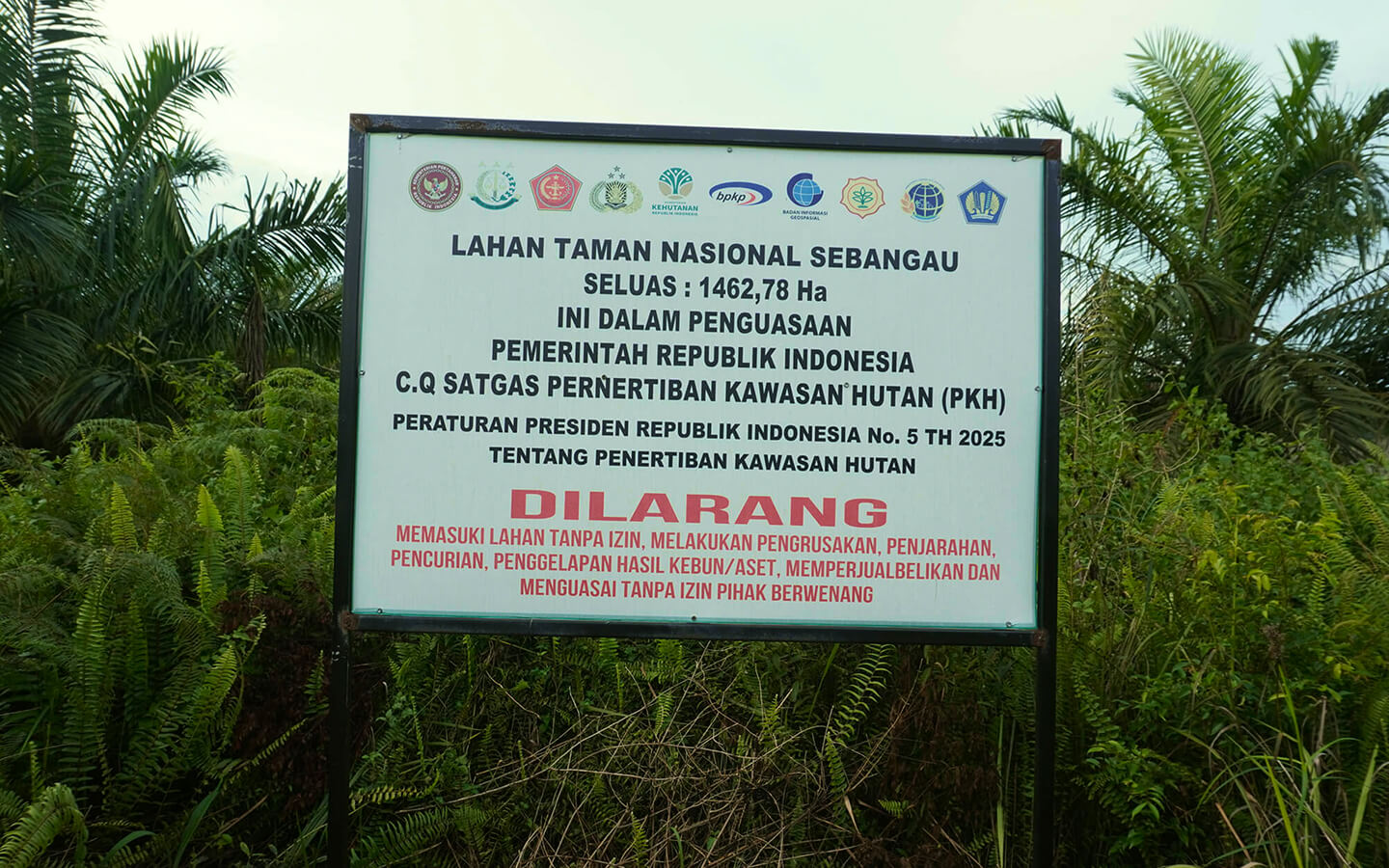
A warning sign from the Forest Enforcement Task Force (Satgas PKH)
A warning sign from the Forest Enforcement Task Force (Satgas PKH) is installed on a seized oil palm plantation inside Sebangau on April 27, 2026. (JP/Noufal Helmy)
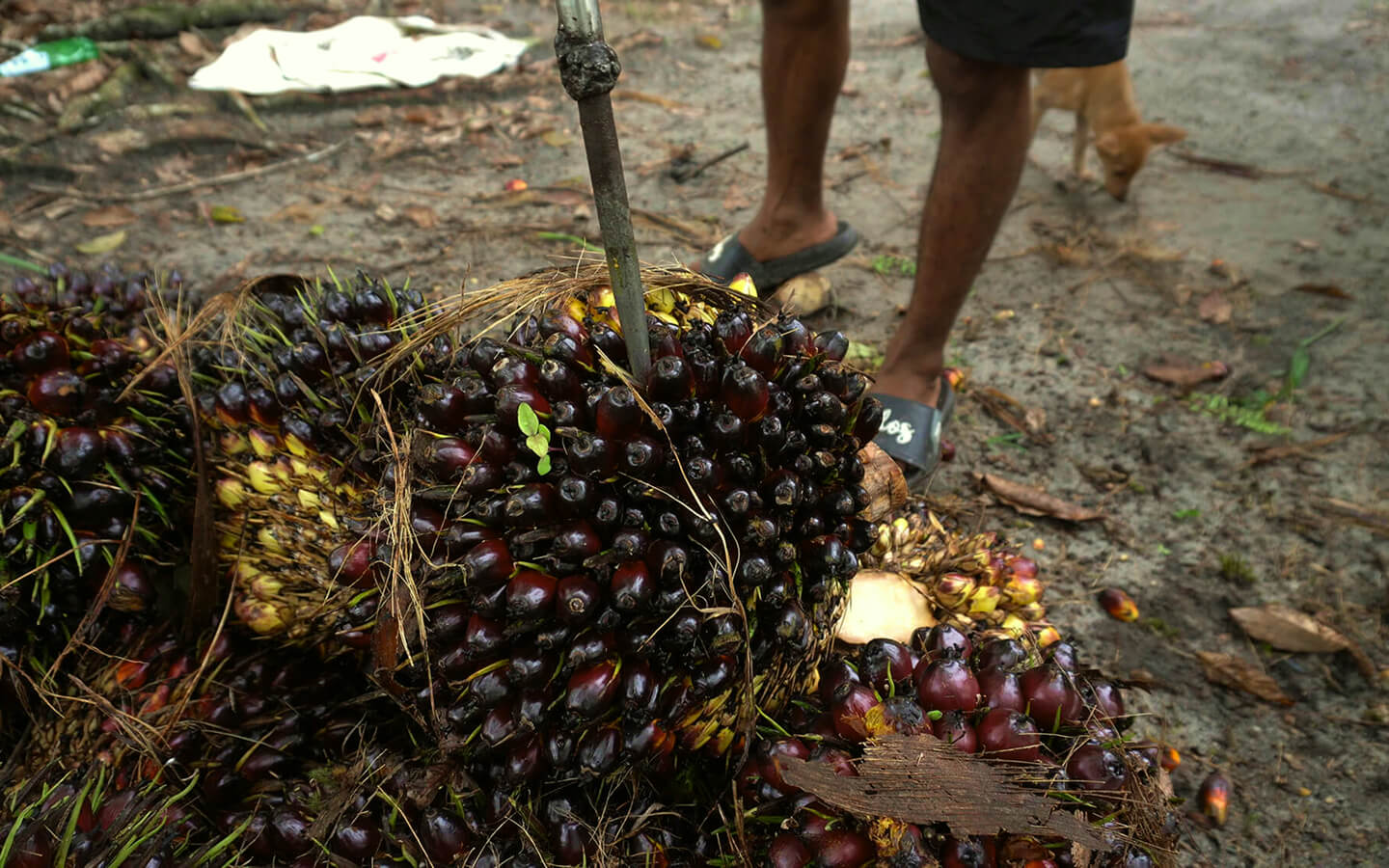
Oil palm fresh fruit bunches
Oil palm fresh fruit bunches harvested from a plantation inside Sebangau are collected prior to being loaded on a truck on April 27, 2026. (JP/Noufal Helmy)

An analysis by Auriga found that nearly 2,000 ha of Sebangau National Park and its buffer zone had been cleared to make way for oil palm plantations in 2024, making it the sixth-largest oil palm encroachment among 57 national parks in the country.

Despite their unlawful status, these plantations, often categorized as smallholder plantations, have contributed to Indonesia's palm oil production, which has been the world’s largest since 2007.

Sebangau National Park office head Ruswanto confirmed that oil palm plantations inside the conservation area are unlawful and are the result of unsolved tenurial conflicts between park authorities and local residents.

“The presence of these plantations and mining sites is a serious threat to our endemic wildlife, the orangutan, which is the umbrella species and key species, because their corridors are ultimately being cut off,” Ruswanto told the Post in his office in Palangka Raya on April 30.

National park offices cannot stop forest encroachment because they are tasked with managing the conservation areas, not to engage in law enforcement.

The widespread existence of illegal palm oil plantations inside protected forests across Indonesia has alarmed the government, prompting President Prabowo Subianto to form the Forest Enforcement Task Force (Satgas PKH) in February last year.

The task force claimed to have seized 5.8 million ha of forest initially occupied by illegal palm oil plantation and mining businesses across the country, regaining state assets in forest areas worth Rp 371 trillion (US$20.88 billion). The seized forests included those situated inside national parks and other conservation areas.

Sebangau was no exception.

It was in July last year when the task force, which is comprised military personnel and local prosecutors, seized thousands of hectares of illegal plantations inside the national park, located in Bukit Tunggal, Habaring Hurung and Banturung, three subdistricts under the jurisdiction of Palangka Raya city.

The task force has installed multiple signboards that display a prohibition on further utilizing, encroaching or trading the seized plots of land.

But when the Post visited Banturung twice on April 27 and 30, oil palm trees were still covering the cluster of 1,462 ha that had been seized by the task force. A couple of trucks loaded with fresh fruit bunches (FFBs) were seen passing through on what appeared to be a regular working day.

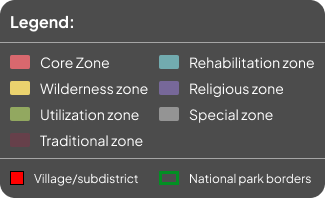
An aerial observation by the Post that has been verified by Auriga revealed that the area is situated inside Sebangau’s rehabilitation zone.

Conversion of land use within national parks is strictly prohibited under the 2024 Natural Resources and Ecosystem Conservation Law, including within rehabilitation zones, which are designated to restore damaged park areas.

“I know nothing about the plantation [located inside the conservation area]. I’m just a newcomer, not a native,” a plantation worker, who preferred anonymity, told the Post during the Banturung visit on April 27.

The worker, who hails from a town in Java, said he had been working in the plantation since 2023. He revealed that the plantation could generate over 500 tonnes of FFBs each year.

The worker also revealed that the plantation had been supplying tonnes of FFBs to a local mill called PT Panca Mitra Katingan (PMK) in Katingan regency, outside the national park. In the mill facility, the FFBs are processed into crude palm oil (CPO), one of the country’s top export commodities.

Another worker separately said on April 30 that more than 14 plantations in the Banturung cluster had been supplying oil palm FFBs to PMK. They were loading FFBs onto a truck that was reportedly going to the PMK mill, located two hours drive from the plantation.

“We have supplied the mill with tonnes of oil palm fruit bunches since I began working here three years ago,” the worker said.

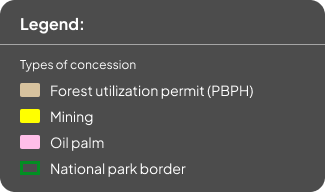
Legend zonasi
Legend konsesi
Source: Forestry Ministry | Analysis: Anggun D. Napitupulu (Auriga Nusantara)

Situating Sebangau

The giant park sits in three regions of Central Kalimantan: Palangka Raya city, Katingan and Pulang Pisau regencies. Three major watercourses, namely Sebangau, Kahayan and Katingan flow through the park, crisscrossing the network of critical peat swamp forests.

The park also intertwines with at least 39 villages, most of which are traditional Dayaknese villages, such as Petak Bahandang, Hiyang Bana and Talingke in the Tasik Payawan district of Katingan.

A besieged Sebangau

Currently, one of the biggest strongholds for orangutan populations is also under siege from 24 mining concessions, ten palm oil concessions and other forest utilization permits that either border the park or lie within a 25-kilometer radius.

At least 37,200 hectares of mining and 166,000 ha of oil palm concessions encircle Sebangau, while other licensed permits cover more than 350,000 ha around the park frontiers.

Nearly 2,000 ha of Sebangau were converted into oil palm plantations throughout 2024, as highlighted by analysis from Auriga Nusantara. These plantations reportedly supply tonnes of fresh fruit bunches to a mill operated by PT Panca Mitra Katingan.

A local activist, who has investigated the land conflicts in Banturung, said the mill had been receiving supplies from the plantations inside the park and possibly other illegal sources for at least five years, while noting that the mill was not the only one sourcing the oil-rich fruit from the park.

“The mill processes CPO by sourcing its supplies from locals who work inside the park zone. This means that their products are illegally sourced from the protected area without any legal consequences,” the activist, who requested anonymity, told the Post in early June.

It was not immediately clear who owns or runs the illegal plantations in Banturung.

Last year, a Greenpeace report titled Under the Eagle’s Shadow: Investigating the RGE/Tanoto Shadow Empire named PMK among the web of subsidiaries affiliated with Royal Golden Eagle (RGE), a diversified conglomerate founded by Sukanto Tanoto. RGE has denied all findings in the report.

The Post tried to reach out to PMK, but received no response by the time of the story’s publication

Further document analysis by the Post found that PMK is publicly listed under supply chain documents of multinational companies including fast moving consumer good (FMCG) giants PepsiCo and Nestlé, as well as major consumer goods companies Cargill and Kao.

According to PepsiCo’s 2024 supply chain document, PMK is among those listed under its palm oil suppliers. In a statement received on June 17 responding to the Post’s inquiry, a spokesperson with United States-based PepsiCo said the company had launched a review and engaged with its direct suppliers to “better understand any potential linkages” to the allegation.

The list of Nestlé’s oil palm mills dated April 2024 to March 2025 included PMK. A Nestlé representative also said on June 16 it had launched an investigation and engaged with its suppliers to "assess the situation and implement appropriate corrective action plans”.

The Katingan-based mill is also listed on Cargill’s palm oil suppliers throughout the second half of 2025. In an email received by the Post on June 29, a Cargill spokesperson confirmed the PMK mill supplies palm oil to the company through intermediaries.

The company added it has initiated a due diligence investigation and review to determine appropriate next steps. “We are not in a position to confirm allegations [that PMK sources its oil palm fruit from a plantation inside the national park] before our review is complete,” the spokesperson said.

Tokyo-based Kao denied sourcing from PMK, saying on June 2 that it had no direct business ties with the mill and has not “identified any facts indicating that raw materials derived from this mill are included in Kao’s fats and oils supply chain”.

The company, which produces brands such as Bioré and Laurier, included PMK on its palm oil mill list in a report in the second half of 2025. Kao later described the list as “a potential list” that is not necessarily connected to its supply chain.

Stronger law enforcement

The illegal plantations inside Sebangau National Park are proof that the government's decades-long record of poor law enforcement has resulted in failures in environmental protection.

Satyawan Pudyatmoko, natural resources and ecosystems director general at the Forestry Ministry, acknowledged the gaps, citing an inadequate number of forest rangers to combat crimes as the reason forest loss remains high in conservation areas.

With fewer than 5,000 forest rangers nationwide, the current size of the force leaves each ranger having to guard 25,000 ha of forest, an area 10 times larger than the ideal coverage. The ministry has proposed 21,000 forest rangers to be recruited by 2027.

“But now that Satgas PKH has regained state control over [encroached] forests, we can move on to the next phase: restoring the ecosystems,” Satyawan said on June 15.

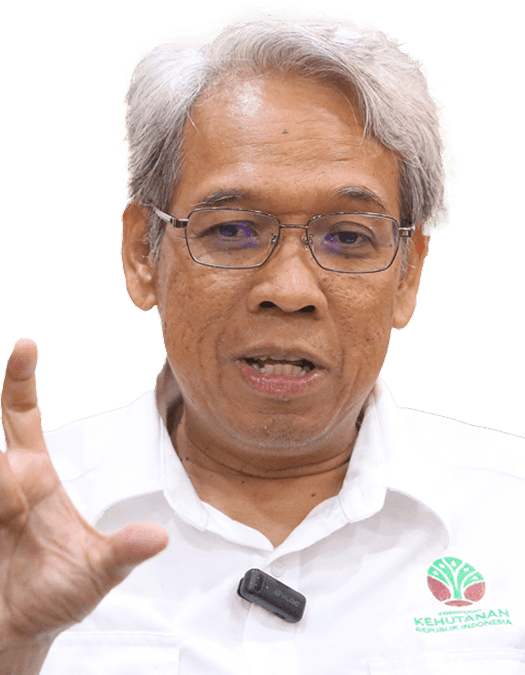
Satyawan Pudyatmoko, a director general of natural resources and ecosystems conservation in Forestry Ministry  Forestry Ministry natural resources and ecosystems conservation director general Satyawan Pudyatmoko acknowledges the lack of forest rangers in Sebangau and other national parks hinders efforts to prevent encroachment in conservation areas. (JP/Iqro Rinaldi)
Sebangau's rich biodiversity desktop Sebangau's rich biodiversity mobile

Confiscating illegal converted zones would be insufficient without strong law enforcement against parties supporting the plantations and clear commitment to solve any land dispute occurring inside conservation areas, according to Muhammad Ichwan, executive director of the Indonesian Independent Forest Monitoring Network (JPIK).

It becomes harder for these business activities to be cleared out from the national parks because mining and plantation commodities originating from non-extractable zones still reach consumers, despite various pushback measures against deforestation in other parts of the world.

European countries, for example, have put more pressure on agriculture and food conglomerates to disclose and map their supply chains, and apply bans on products related to deforestation.

Through the European Union Deforestation Regulation (EUDR), the European bloc is set to mandate large and medium-sized companies to submit geolocation data for commodities in their supply chain by the end of this year. The policy has been challenged by producing countries, including Indonesia.

Forced from ancestral lands

When Sebangau first appeared as a national park on the map over two decades ago, many indigenous Dayak people were forced to start rerouting their hunting grounds and finding other sources of livelihoods, as the boundaries that dictated the land use inside the giant park cut through their ancestral homes.

It later became the source of prolonged land conflicts between park authorities and indigenous residents.

One of the communities in dispute is the Ngaju community in Petak Bahandang village, Tasik Payawan district of Katingan regency. It is located on the banks of the Rasau River, an estuary of major watercourse the Katingan River.

The official zoning system, however, has proven incompatible with the shared culture of Dayak people. Instead of decoding satellite data, the audible range of a gong struck from along riverbank settlements has long served as an acoustic boundary, ruling how far inland the community is allowed to make use of the forest.

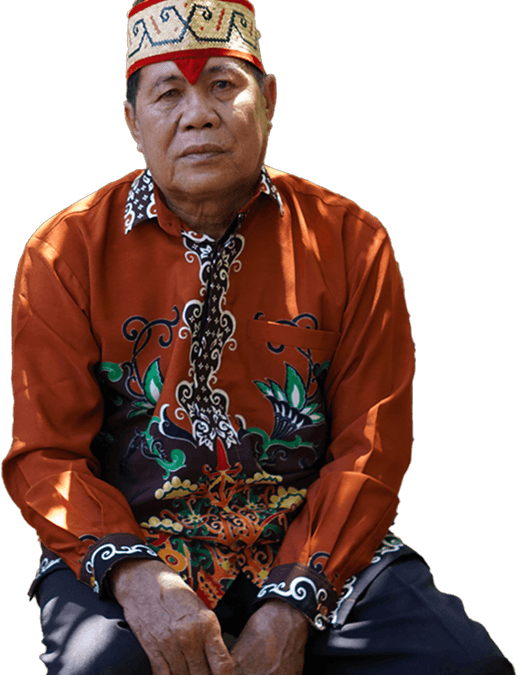
Dobe, a Dayak elder in Central Kalimatan Dobe, a Dayak elder in Central Kalimatan, blames Sebangau National Park for “squeezing out” the ancestral homes of the Ngaju people. (JP/Noufal Helmy)

“If you look at the actual ground, the [national park] boundaries should have been shifted. But our land is often just dismissed as a wild jungle,” said Dobe, head of the Tasik Payawan chapter of the Dayak Indigenous Council (DAD), which oversees eight villages.

In 2014, 10 years after the establishment of Sebangau National Park, at least 450 Ngaju members signed a petition to oppose the park, which was deemed to have pushed them out of their customary lands, as written in a copy of the document seen by the Post.

These residents came from three different villages along the Katingan River in Tasik Payawan, namely Petak Bahandang, Talingke and Hiyang Bana.

Petak Bahandang village in Katingan regency, nestles along the Rasau River near Sebangau National Park. (JP/Noufal Helmy)

Another decade has passed by, but the opposition remains. Some residents cite the absence of free, prior and informed consent (FPIC), an international principle introduced by the United Nations to uphold the human and territorial rights of indigenous peoples, during the park mapping process as the reason behind the continued opposition.

The tensions later took the form of an illegal gold rush inside the contested parts of Sebangau, where at least 13 traditional mining sites are operated by local residents on the banks of the Rasau River.

Hidden gold fever

From the edge of Petak Bahandang, it takes an hour by klotok (traditional wooden boat) to travel through Rasau amid the noise of heavy equipment thundering on the outskirts of Sebangau, where many miners are working to recover gold from under the peatlands.

A further ride passing through the same river route found that the gold rush had crept into the park area. Agus Rahman, a Petak Bahandang villager who hails from Central Java, was working with his wife Wita, a Ngaju woman, in a plot of peatland they had turned into a gold mining site since 2023.

During a lucky episode, Agus said he could bring home a whopping Rp 120 million from four days of extracting the gold, far exceeding his previous income as a plantation worker.

Heavy machinery has been brought into a strip of Sebangau that intersects with the village, where miners like Agus use mercury to bind the precious metal, unaware of the irreversible damage the toxic chemical poses to the environment and, by extension, to themselves.

Mercury residues can infect food chains when it reaches water and is consumed by river wildlife later eaten by humans. Prolonged direct exposure to the chemical may also cause health problems, such as kidney failure.

Despite multiple inspections from park authorities warning Agus about the ownership of the land and demanding he stop mining, he has refused to back down. The land, Agus said, has been passed down for generations in his wife’s family.

“Some time ago, [the Sebangau park authority] warned us, asking 'Pak, please clear this river area',” Agus said. “But why should we clear it? This is our land. My father-in-law grew up here and has nurtured this land since he was a child. We also have a rubber plantation here. We won’t leave unless there is fair compensation and a proper resolution.”

A vast tract of gold tailings can be easily seen along the Katingan roads to Petak Bahandang village, proving that gold fever has become contagious among the villagers and beyond. After the COVID-19 pandemic, extracting gold from the peatlands became widespread among the community as gold prices soared while cash crops like rubber and palm oil lagged behind.

For generations, the Ngaju people only practiced small-scale, traditional gold mining as part of their local beliefs. Others have also tried to grow rubber and wood crops like rattan and gaharu (agarwood) inside Sebangau for their living. But the designation of the national park has excluded them from their ancestral lands.

“We were never involved by the government. They only installed border markers along the forests, while grabbing our land,” said Hardianto, the damang (indigenous Dayak chief) of Tasik Payawan.

“Therefore, we no longer have land to grow cash crops to make ends meet,” he went on to say. “That’s why many Dayak decided to start mining gold. We don't want to only be bystanders.”

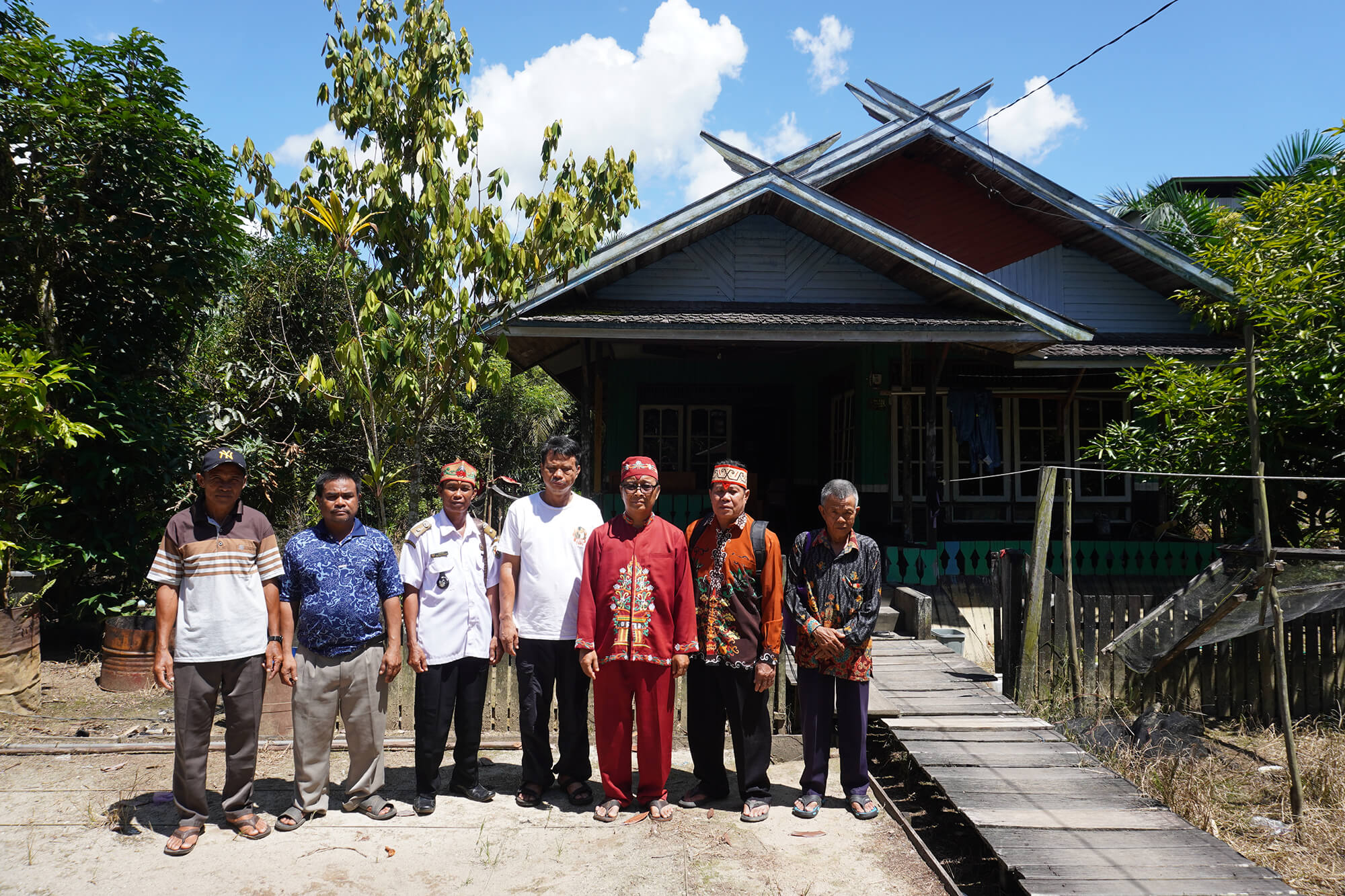
Elders Hardianto (third right) and Dobe (second right) of the Ngaju community, one of the largest Dayak subtribes, pose on April 29 with Petak Bahandang village chief Eman (third left) and other members of the tribe in front of a Dayak traditional house in the village, Tasik Payawan district, Katingan regency, Central Kalimantan. Elders Hardianto (third right) and Dobe (second right) of the Ngaju community, one of the largest Dayak subtribes, pose on April 29 with Petak Bahandang village chief Eman (third left) and other members of the tribe in front of a Dayak traditional house in the village, Tasik Payawan district, Katingan regency, Central Kalimantan. (JP/Noufal Helmy)

The land conflicts tell a bigger story of land grabbing that has plagued numerous indigenous Dayak communities across Kalimantan, according to Alfianus Genesius Rinting, head of the Central Kalimantan chapter of the Indigenous Peoples Alliance of the Archipelago (AMAN).

"The encroachment on our lands has gone slowly but surely, eroding the forests we used to rely on for survival. As these forests disappear, our ancestral traditions are fading away as well,” said Alfianus, who is also a member of the Ngaju community.

According to Alfianus, the designation of Sebangau as a national park put more pressure on the indigenous Dayak communities.

In multiple reported cases, indigenous and local communities were often not consulted before the establishment of national parks, though the boundaries overlapped their ancestral homes.

“It’s like it was decided merely from behind their desk. They saw the forest as an empty place and thought: ‘Let’s just draw the boundary lines’,” he said.

Ruswanto of Sebangau National Park office said the management had launched campaigns to educate residents on park boundaries. At the same time, joint authorities of village officials, as well as military and police personnel, launched raids targeting artisanal miners.

“But of course, we have to maintain a persuasive approach,” he said.

Authorities have recorded some 8,000 individual Bornean orangutans living in the wild within Sebangau National Park, an increase of around 2,000, thanks to joint conservation efforts with environmental groups. (Courtesy of BOS Foundation)

Pricing the parks, for whom?

Hundreds of kilometers away from Sebangau, government officials and politicians in Jakarta decided earlier this year to form a new National Park Financing Task Force, aimed at generating more revenue from various activities and projects inside several national parks.

President Prabowo officiated the new task force through a presidential decree that allows the government to turn specific zones of national parks into carbon trading and ecotourism venues.

The task force, led by the President’s younger brother and mining tycoon Hashim Djojohadikusumo, is planning to “seek innovative and sustainable funding models that involve the private sector” in the hopes of boosting the global standing of the country’s national parks.

“We see that several national parks haven’t been optimal at improving their governance,” said Satyawan of the Forest Ministry.

“But improving them needs money that cannot all be provided by the state budget, therefore, there’s a need to tap into innovative funding approaches in various forms.”

The task force has a monthly meeting to report the progress of its assigned duties to Hashim and his two deputies, Forestry Minister Raja Juli Antoni and senior economist Mari Elka Pangestu.

In one of the meetings, the task force decided to pick 13 national parks, including Sebangau, where such projects will be launched in the near future.

In the carbon market, governments or polluting companies can buy carbon credits by investing in forest recovery initiatives to balance out their emissions. One of the world’s largest carbon projects is located near Sebangau, where more than 140,000 ha of forest under the Katingan REDD+ initiative offers credits purchased by multinational companies, such as oil giant Shell and Dutch airline KLM.

Ichwan of the JPIK argued that creating new revenue sources inside national parks would not be sufficient without solving the entrenched problem of poor law enforcement and the collective abandonment of forest ecosystems, including the indigenous peoples, in the country.

Without accountability and transparency, Ichwan said that any projects assigned by the new financing task force would not benefit local and indigenous communities, and may well prolong the destruction and abandonment of national parks, including Sebangau.

The approach to calculate carbon values inside national parks would turn conservation areas like Sebangau into a mere commodity, according to Wahyu of Pantau Gambut.

"Adopting an approach that solely capitalizes carbon value will only result in the monetization of ecological ecosystems that may fail to guarantee restoration efforts, as it merely quantifies and values carbon metrics,” Wahyu said.

Locking certain forested areas for carbon projects, he added, would further displace and squeeze indigenous populations out from the area.

But Satyawan denied the move would commercialize the parks. Instead, the task force will find untapped potential revenues that could be generated through ecotourism and carbon projects without losing the core goal of nature preservation.

“The real objective is to improve the governance of national parks, elevate environmental services and make sure that the community will get more benefit from the parks.”

Moves to establish two task forces related to forested national parks have been perceived as decisions to tighten the government’s grip over forests that affect the lives of people dependent on the landscapes.

It was late in April this year, when more than a dozen Ngaju people gathered in Petak Bahandang to recall the two-decade impact of Sebangau, a national park they described as protecting everything on the forest but its people.

“If they genuinely acknowledge our customary law, a proper resolution must be established. If not, tensions will continue to persist as our community will relentlessly defend their ancestral rights,” Ngaju leader Dobe said.

“The Sebangau park authorities and the indigenous peoples must find common ground.”