TheJakartaPost
Please Update your browser
Your browser is out of date, and may not be compatible with our website. A list of the most popular web browsers can be found below.
Just click on the icons to get to the download page.


Popular Reads
Top Results
No results found. Please check your search term and try again
Can't find what you're looking for?
View all search results
Popular Reads
Top Results
No results found. Please check your search term and try again
Can't find what you're looking for?
View all search resultsIronclad mechanisms urged for tax penalty waiver plan
Some members of the House of Representatives have urged the Finance Ministryâs tax directorate general to create ironclad mechanisms before it waives the penalty imposed for late tax payments
Change text size
Gift Premium Articles
to Anyone
Share the best of The Jakarta Post with friends, family, or colleagues. As a subscriber, you can gift 3 to 5 articles each month that anyone can read—no subscription needed!

S
ome members of the House of Representatives have urged the Finance Ministry's tax directorate general to create ironclad mechanisms before it waives the penalty imposed for late tax payments.
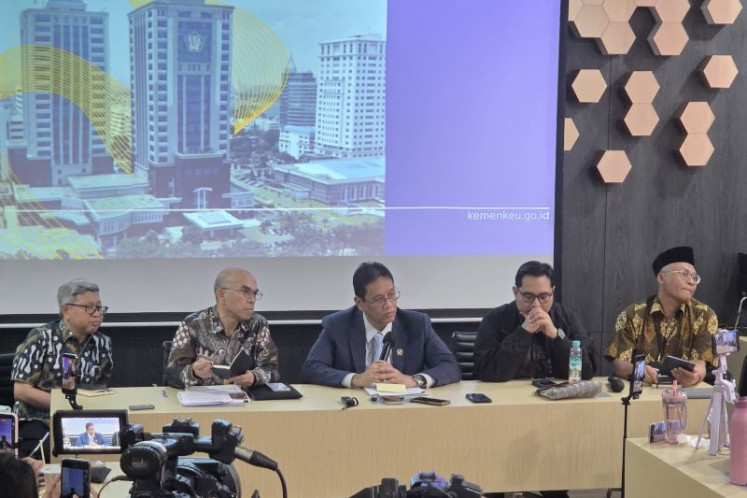
Mukhamad Misbakhun, a Golkar Party politician at House Commission XI overseeing finance, said on Wednesday that the Tax Office needed to work with the Supreme Audit Agency (BPK) to formulate detailed procedures for the penalty waiver, even though the Finance Ministry had issued its ministerial regulation.
'Some loopholes remain that may cause misinterpretations in the future. One example is the definition of oversight that will allow a taxpayer to enjoy the waiver,' he said.
'The office can only determine using strict and detailed procedures because we don't want to see the policy challenged in the future,' Misbakhun added.
The procedures are deemed important since the sheer amount of penalties stand to be written-off that can potentially be considered as state revenue.
In Jakarta alone, late penalties to be written off could amount to Rp 4 trillion (US$303.74 million).
As previously reported, the Tax Office will waive penalties for late tax payments in an effort to woo taxpayers to fulfill their obligations.
Article 36, paragraph 1 of the 2007 Taxation Arrangements and Procedures Law says that the office may write off administrative sanctions or penalties if it turns out that late payments occur because of oversight and not on purpose.
According to the law, a penalty will be issued when taxes are not paid by the due date and the penalty is 2 percent of the due tax payment per month.
With the write-off, taxpayers are now required to pay the principal amount only.
However, the write-off is only applicable for tax arrears that occurred between 2009 and 2014, and that should be paid this year.
The waiver plan is backed by a finance minister regulation (PMK), which the Law and Human Rights Ministry promulgated early this month.
So far, the Tax Office has only recovered Rp 6.75 trillion out of Rp 67.7 trillion in total tax arrears, which were recorded by the BPK at the end of 2014.
Similar to Misbakhun, Maruarar Sirait, an Indonesian Democratic Party of Struggle (PDI-P) lawmaker on the same commission, said the Tax Office must prepare a standard operating procedure (SOP) to prevent potential problems from arising.
'It has to make sure that such a policy is accountable and is line with a bigger legal foundation, which is the 2007 law,' he said over the telephone.
Gerindra Party politician Gus Irawan Pasaribu acknowledged that the waiver plan might cause quite an issue, but insisted that it was part of the Tax Office's strategy to reach its massive tax revenue target in 2015, which stood at Rp 1.29 quadrillion.
However, when contacted separately, BPK member Achsanul Qosasi said the Tax Office did not need to establish a separate SOP with his agency and added that the current PMK was sufficient for shielding it from possible controversy.
'This [the write-off] is some kind of a sweetener to attract people to pay their taxes. The Tax Office can do whatever it needs to do to reach its target,' he said.