TheJakartaPost
Please Update your browser
Your browser is out of date, and may not be compatible with our website. A list of the most popular web browsers can be found below.
Just click on the icons to get to the download page.


Popular Reads
Top Results
No results found. Please check your search term and try again
Can't find what you're looking for?
View all search results
Popular Reads
Top Results
No results found. Please check your search term and try again
Can't find what you're looking for?
View all search resultsA look inside Olafur Eliasson’s ‘Curious Journey’ at Jakarta’s MACAN
A sweeping three-decade survey at Museum MACAN traces the Icelandic-Danish artist’s evolving engagement with perception, color and climate, inviting visitors to step into luminous, shifting worlds.
Change text size
Gift Premium Articles
to Anyone
Share the best of The Jakarta Post with friends, family, or colleagues. As a subscriber, you can gift 3 to 5 articles each month that anyone can read—no subscription needed!
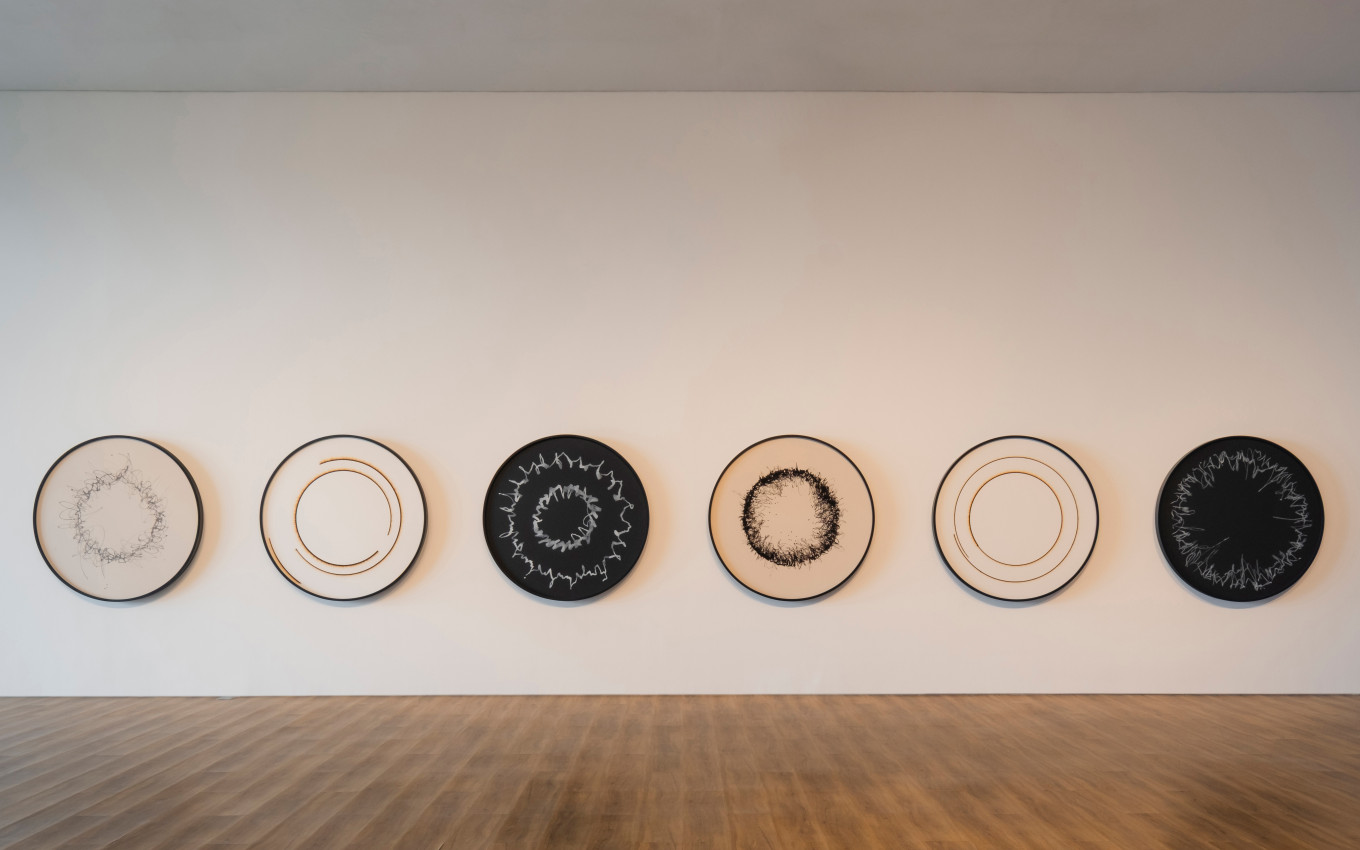 'Wind writings and Sun drawing' (2023) by Olafur Eliasson, black acrylic ink on canvas, white acrylic ink on canvas, burned white paper on composite board, 140 cm each. (Museum MACAN/Liandro Siringoringo)
A
mid the ongoing buzz around artificial intelligence, scientific innovation and a rapidly changing global art market, the arrival of Olafur Eliasson’s traveling retrospective Your Curious Journey at Jakarta’s Museum of Modern and Contemporary Art in Nusantara (MACAN) feels like a grounding force. The Icelandic-Danish artist, long recognized for fusing art, science and environmental inquiry, brings together works spanning 30 years, revealing how his ideas have expanded, deepened and adapted across time.
The exhibition includes both early investigations into perception and recent works addressing ecological fragility. Among the latter is The Last Seven Days of Glacier Ice, an arresting installation modeled from 3D scans of glacial fragments on Diamond Beach in Iceland, captured just before the ice vanished. The sculpted forms resemble oversized glass spheres, yet they are crafted from white-patinated bronze paired with glass elements. Arranged from the largest to the smallest, each form registers a digitally simulated stage of melting, offering an unfolding record of disappearance. For audiences trying to comprehend climate change through something more visceral than data, the installation becomes a realistic example to understand the discourse on climate change as visual ecological evidence. Nearby, photographs from Eliasson’s glacier melt series echo this narrative, documenting the shifting landscapes of Iceland’s glacial terrain.
Play of shadows

Color, one of Eliasson’s most recognizable tools, animates several works on view. Multiple Shadow House (2010) is an interactive installation where visitors’ silhouettes appear as layered, continuously shifting shadows. Translucent projection screens form the walls of a wooden structure, illuminated by a constellation of colored lamps. As bodies move, shadows multiply, lengthen and overlap, producing what can feel, in hindsight, like a ghostly experience.
Equally immersive is Beauty (1993), in which light shimmers across a fine mist, allowing a rainbow to appear and disappear within the darkened space. Eliasson makes visible the subtle negotiation between light, droplets, motion and distance; no two viewers see the same spectrum. Colors of different wavelengths emerge only briefly, shifting as each observer moves through the haze. The work exemplifies how Eliasson collapses scientific principle and poetic encounter into a single sensory moment.
The Yellow Corridor further tests the limits of perception. Saturated entirely in a sharp yellow hue, the passageway narrows the eye’s ability to detect other colors. Created through a low-pressure, mono-frequency lamp, the corridor offers a jarring yet illuminating experience, reminding visitors that the act of seeing itself can shape one’s understanding of the world.
Art, natural world
More from The Weekender

Show up, show off and call it self-care: Strong is the new flex
With toned arms as the new status symbol, maybe it’s time we rethink why we come to the gym and pick up those dumbbells.
When a friend becomes a stranger: Healing after a platonic breakup
We expect heartbreak in romance, but no one warns us how much it hurts when a friendship falls apart.
The power of small acts: Glimmers of hope from 2025
In a year marked by despair, it was small, human acts that broke through the noise, reminding us that hope doesn’t vanish. It’s passed hand to hand, one person to another.