The Jakarta Post
Please Update your browser
Your browser is out of date, and may not be compatible with our website. A list of the most popular web browsers can be found below.
Just click on the icons to get to the download page.


Popular Reads
Top Results
No results found. Please check your search term and try again
Can't find what you're looking for?
View all search results
Popular Reads
Top Results
No results found. Please check your search term and try again
Can't find what you're looking for?
View all search resultsLiterate, independent and abused: Indonesian women’s hidden reality
This International Women's Day, a landmark survey shatters the myth that education and financial independence protect Indonesian women, revealing instead a hidden crisis of structural violence and digital threats.
Change text size
Gift Premium Articles
to Anyone
Share the best of The Jakarta Post with friends, family, or colleagues. As a subscriber, you can gift 3 to 5 articles each month that anyone can read—no subscription needed!
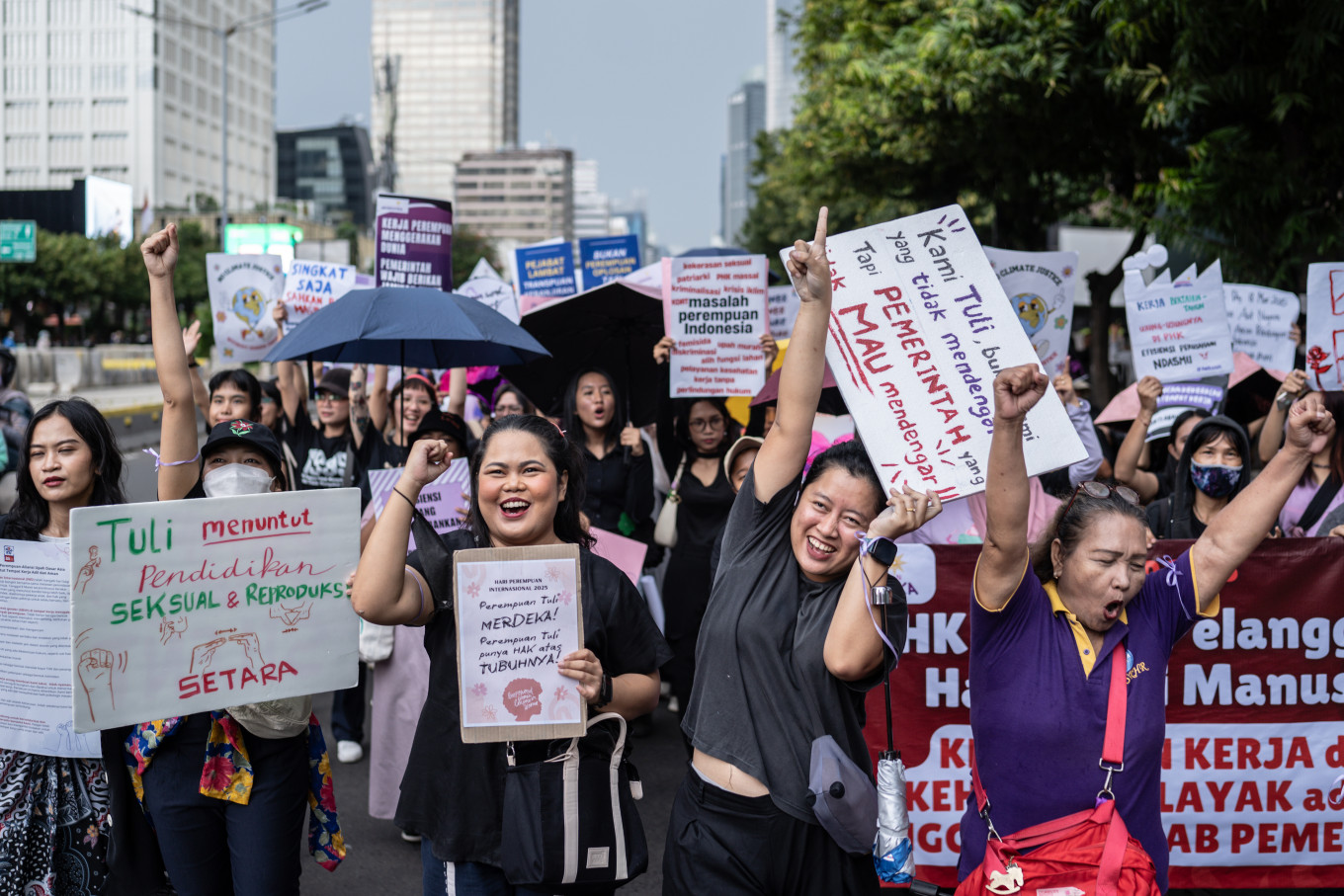 Participants march during a protest on March 8, 2025, organized by the Indonesian Women's Alliance (API) on the 50th International Women's Day to demand labor rights, gender equality and protections, in Jakarta. (JP/Muhammad Zaenuddin)
T
his year, the International Women’s Day theme, "Rights. Justice. Action. For ALL Women and Girls", offers a clear and hopeful vision. Embracing this spirit requires us to take an honest look at the daily lives of women in Indonesia. For years, our development programs operated on a flawed assumption: that a woman with a good education and a stable income would naturally be safe from harm.
The January 2026 released, "2024 National Women's Life Experience Survey (SPHPN)", supported by the United Nations Population Fund, forces us to challenge this narrative. The survey reveals that violence against women is a structural challenge deeply rooted in patriarchal traditions, policy gaps, and environments we previously assumed were safe.
The numbers are staggering: an estimated 23.3 million Indonesian women have faced physical, sexual, or psychological violence. Yet, the government's official tracking system (SIMFONI PPA) recorded a mere 27,658 incidents, while the National Commission on Violence against Women (Komnas Perempuan) reported 330,097 cases.
This massive discrepancy highlights a sobering reality: only 11.3 percent of women abused by a partner feel comfortable reporting the abuse to formal institutions.
Furthermore, the survey shatters the myth that earning a paycheck automatically buys safety. In fact, women working in the public sphere face a higher lifetime risk of physical and sexual mistreatment from a partner, 12.5 percent, compared to women who stay at home, 8.2 percent. Often, a woman who earns her own money is viewed as a threat to traditional gender roles. Education offers no absolute shield either; 36.8 percent of women with university degrees face psychological control, such as a partner closely monitoring their daily activities or friendships.
Why do these incidents remain so hidden? Deeply ingrained cultural norms are largely to blame. About 62.4 percent of women still believe a wife must obey her husband and his family, and 21.9 percent feel it is acceptable for a husband to physically assault his wife. Suspected infidelity, 17 percent, and disobedience, 7.9 percent, are the most commonly cited justifications for this violence.

Furthermore, violence is often passed down quietly across generations. If a boy grows up seeing his father hit his mother, his future partner faces a massive 57.3 percent risk of mistreatment. Conversely, if he grows up in a peaceful home, that risk plummets to just 8.8 percent.