Today
Jakarta

Abdul Khalik , The Jakarta Post , Jakarta | Wed, 06/04/2008 10:14 AM | Headlines
Members of the Islam Defenders Front (FPI) roam freely despite a history of frequently taking the law into their own hands and attacking and burning buildings of other groups.
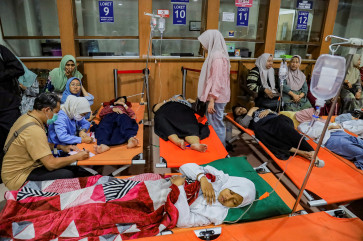
The latest attack blamed on this radical group took place Sunday. At least 70 people were injured in the assault on activists of the National Alliance for the Freedom of Faith and Religion (AKKBB), who were gathered to rally peacefully at the National Monument (Monas) in Central Jakarta.
However, no arrests were made by police after the much-condemned attack.
"The police have either so far been defeated by the FPI, or some police officers are working together with the organization for their own benefit," activist Rafendi Jamin of the Human Rights Working Group said.
He said that only with protection from the police had the FPI managed to survive despite the organization's record of violence.
Lawmaker Nadra Izahari of the Indonesian Democratic Party of Struggle concurred, accusing the police of letting the FPI operate outside the law.
He cited the attack on the AKKBB activists, saying the police failed to make serious efforts to counter the PFI's violent acts.
"We have reasons to believe the police and the FPI have mutually beneficial relations as the hard-line group has repeatedly committed violence without serious resistance from the police," Nadra told a group of activists calling for the FPI's disbanding at the House of Representatives.
Many observers have accused the authorities of backing hard-line groups, including the FPI, to counter the movements by pro-democracy and rights organizations or to shift public attention from crucial issues for political reasons.
"We should push for FPI members to receive punishment, but we should not let the problems shift our attention from key issues, such as the recent fuel prices increase and poverty," Hendardi of the Setara Institute said.
Since its establishment, the FPI has launched dozens of attacks on people or institutions it regarded as insulting or antagonistic to Islam.
In June 2000, some 300 FPI members attacked the National Commission on Human Rights (Komnas HAM) headquarters in Jakarta in a protest against the commission's report on the 1984 Tanjung Priok massacre. Several people were injured in the attack.
The FPI was also blamed on late night attacks of nightspots and billiard centers in October 2002, hurting dozens of people. The police reportedly did nothing to stop the attacks.
FPI leader Habib Rizieq Shihab was tried in 2002 and put in jail for seven months because of the incident.
In December 2006, two policemen were injured when about 100 FPI demonstrators attacked the Playboy Indonesia office in South Jakarta.
In April last year, 17 members of the United National Liberation Party (Papernas) were injured in an attack by the FPI during a rally against the newly passed investment law.
Asep jip (not verified) — Thu, 06/05/2008 - 11:55am
I think the government must take any action to tackle tis problem. not only punish the perpetrators but also investigate why this violent action happened, in order to avoid the similar accident in the future. so far that I know, the core problem is about ahmadiyah existence, so government must give vast concern to this, because the existence of ahmadiyah in Indonesia is not wanted by all islam supporters, because it deviates from islam.
If the gevernment want to look all moslem is compatible, so government must decide the strict decision. legitimate the existence of ahmadiyah but ask them to get out from islam, or totally ban the ahmadiyah existence and ask them to apologize to all moslem in Indonesia.
The Reader (not verified) — Thu, 06/05/2008 - 1:04am
FPI consisten for inforce Islam law. Ahmadiyah should disbanding.
Keep strike on The Allah, Allahhuakbar......FPI you good action.
Keith harding (not verified) — Wed, 06/04/2008 - 10:41pm
i post all the time but my comments never get online...jakarta post how about democracy? i work for CNN i think i will make an episode on you're un willingness to post comments that make sense
Admin — Thu, 06/05/2008 - 9:13am
Dear Mr. Harding,
We try to moderate all comments as soon as possible but, alas, we are a little bit shorthanded here. So some comments may have to wait longer than others.
At the moment we think it is necessary to moderate all comments to prevent improper ones as well as spams and junks from being published.
Regarding your planned "coverage" on the website, we can only thank you for such publicity.
The Jakarta Post Administrator
The Reader (not verified) — Wed, 06/04/2008 - 9:29pm
The year is 1986, and 25-year-old Habib is en route to war. He has joined the Peshawar-based mujahedin faction Jamiat-i-Islami. Here he is lectured on jihad and taught how to use the AK-47 he bought upon arrival. "It was with me day and night, like a wife," he recalls. To the west of the city lies the Khyber Pass. Beyond, the front awaits.
Habib led mob attack on Ahmadia Mubarak Campus-Bogor on July 8th and 15th 2005
Monday, Mar. 03, 2003
A Jihadi's Tale
What drives so many Muslims to find peace in a holy war? Andrew Marshall seeks to understand the path taken by an Indonesian cleric
BY ANDREW MARSHALL
Habib Abdurrahman bin Ismail serves coffee in tiny cups etched with Arabic blessings, coffee so strongly perfumed that perhaps it liberates a memory, because soon Habib is talking about his Afghan war and about how a man smells just before he dies. "It was the strangest thing," he says, recalling a bloody firefight at Mahmud-e-Raqi, a town northeast of Kabul. "If a Muslim brother was about to be martyred, even before the bullet hit him, he would smell wonderful, like dupa [an Indonesian incense]. Then we knew death was close."
"And after the bullet hit him?"
Habib's kohl-rimmed eyes fill abruptly with tears: "The smell grew stronger."
Today death is far away. Shaded by rambutan trees, Habib and I sit on the veranda of his neat, one-story house in Parung, a 90-minute drive from Jakarta. Habib, 42, who dresses in Middle Eastern robes and turban, with his straggly beard authoritatively flecked with gray, left his native Indonesia in 1986 to spend five years fighting with the Afghan mujahedin against Soviet forces. Jihad, he tells me, "is probably in my genes."
I had sought out Habib to better understand what propelled him down the turbulent path to radical Islam. In many ways his is not a typical jihadi's tale. Fundamentalists are born into poverty, we're told, or raised in strict religious environments, while Habib's background was neither. Habib was raised as a Muslim, yes, but he was also a son, a student, a businessman, a driver of fast cars and a fan of Western rock before experiencing an epiphany that sharpened his sense of his Islamic self and set him on the road to jihad. Now a cleric who preaches about obeying the Koran and following the Sunna, the customs of the Prophet Muhammad, Habib is secure in his belief that his Islam is the one and true faith. But beyond that, he does not see the world in the stark, apocalyptic terms we've come to associate with a jihadi; he is no longer waging a battle to the death against infidels. Yet Habib's peripatetic life helps explain the visceral appeal of jihad to some Asian Muslims—at a time when many Muslims perceive their faith to be under threat by the U.S.-led war on terror, and especially with another Gulf War looming. What was it that persuaded Habib, like so many Asian Muslims before and after him, to fight to defend Islam before he could call himself a true Muslim?
Certainly his pedigree is impeccable. Habib claims direct descent from the Prophet Muhammad himself by way of a Yemeni missionary who settled in Indonesia 13 generations ago. One of Habib's 17th century ancestors raised a 9,000-strong army of holy warriors to avenge Dutch colonial atrocities in the Maluku Islands. Family history repeated itself. At the end of the 20th century, Habib would also become the self-styled commander of his own paramilitary force, called Laskar Jundullah, or Army of Allah, with hundreds of troops recruited and trained personally by him to fight Christians—again, in the Malukus. (It is unrelated to the Sulawesi-based Laskar Jundullah whose alleged co-founder Agus Dwikarna, a convicted terrorist, is in jail in Manila for possessing explosives.)
Yet spending time with Habib can make him seem paradoxical about his faith—like when I tell him which Jakarta hotel I'm staying at. "That's near the Pink Panther Club," he remarks. "You know it?" I didn't, but he did, along with every other nightclub in Indonesia's notoriously hard-partying capital. That's how I find out that Habib Abdurrahman bin Ismail was once a big-time playboy. Later he produces a photo album that dramatically illustrates the before and the after. Its last pages show him standing with two of Indonesia's best-known Islamic extremists, one of whom served a 10-year jail sentence for the 1985 bombing of the Buddhist temple of Borobudur, and was now guarded by Habib's troops. Its opening pages hold a photo of a much younger Habib, with long hair and a rakish moustache, sprawling in T shirt and jeans across the hood of a large, red automobile. "Mercedes-Benz, a 1971 model," explains Habib fondly. "I love European cars."
What caused such a transformation? The son of a bureaucrat, Habib was studying business at a Jakarta university when, as he tells it, a "miracle" happened. But then those were miraculous times. Habib's formative student years coincided with the Iranian revolution and the Soviet invasion of Afghanistan, two hugely influential events that gave Muslims from Morocco to Mindanao a new sense of both power and victimization and signaled the birth of Islamic radicalism as we know it today.
Habib starts to tell the story of his journey into radical Islam, but first—another jarring note—his housekeeper arrives with his smokes. "Aha!" he cries, relishing my obvious surprise as he slowly peels the cellophane from a fresh packet of Marlboros. "You can write it all down in your little notebook: ‘Habib ... smokes ... American ... cigarettes.'"
Then the jihadi lights up and, amid richly competing aromas—Arabian coffee and American tobacco—starts again. It begins after midday prayers at Al-Azhar mosque in south Jakarta, with a young student—long hair, blue jeans, moustache—being confronted by an Indonesian man some 12 years his senior seeking recruits for the war against the Soviets in Afghanistan. "What are you doing while your brothers are being slaughtered?" the man reproaches him. "Don't call yourself a Muslim until you do something meaningful for Islam." Habib becomes furious, thinking, "‘How dare he talk to me that way?' I come from a religious background!" It is the mid-1980s, and Habib has just met the man who will alter the course of his life.
Habib's background is indeed religious, but not austerely so. His grandfather was a pious man who had visited many Muslim countries as the captain of a German-owned merchant ship, and who lived to the age of 97—just long enough to teach his grandson some first words of Arabic. Habib's late father made him recite a portion of the Koran each evening until the boy knew most of it by heart. When he was 10, Habib accompanied his father on the hajj. It was the same year a fanatic attacked the holy Kaaba, and with the atmosphere among the pilgrims particularly tense, Habib stuck close to his father's side. "I remember walking through the market, hearing him talk Arabic for the first time," he recalls. The rest was a blur of relatives—doting Arabs who boasted the same name as the Indonesian boy and the same illustrious bloodline. For the first time Habib became aware of his place in a larger Muslim world.
Though born in Ambon, Habib grew up in Jakarta in relative prosperity—"not rich like Osama," he winks, "but still good." Good enough that his father could buy him a secondhand Mercedes to tool around town after he enrolled in a business course at a private university. He also taught himself guitar. "This is Indonesia!" he cries. "You're not a man if you don't play the guitar." Or if you didn't dance: at that time the film Grease ruled cinemas across the globe. "Those were the John Travolta days," says Habib.
But his Travolta days were numbered. In 1979 the U.S.-backed Shah of Iran was deposed and Ayatullah Khomeini returned from exile to Tehran to proclaim an Islamic republic. For Muslims the world over, the Iranian revolution was an inspirational event that demonstrated that Islam could reinvent itself into a cleansing, populist force with the power to topple repressive regimes. "We all loved Khomeini," says Habib. "I had a big poster of him in my room. I remember my father telling me, ‘Khomeini is a very brave man for standing up to the Americans.' It was an amazing time. I went to the Iranian embassy in Jakarta to get free books about Khomeini. The people there asked me, ‘Are you Shi‘a, then?' And I replied, ‘Sure. What the heck?'"
The euphoria didn't last. The same year ended with the Soviet invasion of Afghanistan. At home, Islamic opposition to Suharto's rule was growing increasingly violent and would peak in September 1984, when troops opened fire on Muslim demonstrators at Tanjung Priok in Jakarta, killing 33 people. In the following years Suharto's security apparatus snuffed out almost all Muslim agitation and sent many radicals into exile. Among them was a still obscure Muslim cleric called Abubakar Ba'asyir who later earned global notoriety as the alleged spiritual leader of Jemaah Islamiah (JI), the regional terror outfit believed to be behind the Bali bombings and other atrocities. Abubakar—who, like Habib, is of Yemeni descent—fled in 1985 to Malaysia, which would soon become a breeding ground for radical Islamic groups from across the region.
The seeds of another form of extremism were also sown in these turbulent years. Saudi Arabia regarded the Shi‘a revolution in Iran as a direct challenge to its puritanical interpretation of Sunni teaching, known as Wahhabism—the same creed spouted by Osama bin Laden and other extremists. The Saudi government channeled millions of petrodollars into a campaign to prevent the spread of Shi‘ism worldwide, especially in Southeast Asia. In Indonesia, this campaign included distributing leaflets condemning any deviation from Wahhabi teaching, building mosques and paying Indonesian students to attend the hard-line Al-Jamia Al-Islamia University in Medina—"Wahhabi U.," as Sidney Jones of the International Crisis Group's Jakarta chapter calls it. It is no coincidence that most radical groups in Indonesia today have ideological affinities with Wahhabism.
The young Habib is not immune to the Islamic fervor of the times, yet dares not participate even in the comparatively tame Islamic student group on campus. He has a lot to lose. "The pressure of the Suharto regime on the Islamic community was huge. I was just a young man who went to discos and movies.
"I had a good life," he recalls. And while he is moved by Afghanistan's plight, he sneers at news that Muslims from other countries have begun to fight alongside their Afghan brothers. Why fight someone else's war, he wonders?
Then comes the chance encounter at al-Azhar mosque and Habib feeling that somehow the spiritual foundations of his secure life have been shaken. The young student can't sleep, and soon returns to confront the mujahedin recruiter who dared challenge his Muslim credentials. Instead of debating with the jihadi, he finds himself unusually desperate to prove his faith to this unsettling newcomer whose Afghan experience, in the eyes of the younger man, lend him a Sufi-like power and mysticism. As it dawns on Habib that pedigree alone does not make him a good Muslim, he finds himself considering an idea he had previously dismissed as "stupid": fighting in Afghanistan. But is this his true path? First, he prays for a sign. That night, his globe-trotting grandfather appears to him in a dream and says, "You have my blessing." Habib rushes to the mosque the next morning to tell the mujahedin recruiter. Both men burst into tears and then embrace. And that's it: the inner conflict resolved in a transforming moment, when Habib decides to park his red Mercedes and walk the path of a born-again Muslim. He leaves for Afghanistan the day after his exams, telling his tearful parents, "My fate now belongs to God."
For Habib and uncounted hundreds of Southeast Asians, Afghanistan is the ultimate culture shock: an alien landscape of forbidding mountains, plunging ravines and valley floors stretching off into shimmering dust; a country so cold in winter that snow falls waist-deep, and so hot in summer that you don't perspire because the sweat evaporates as it leaves your pores. The food is bad and sickness inevitable. Yet Habib finds such hardships inspirational: jihad was never going to be a night out at the Pink Panther Club. "From beginning to end," he now enthuses, a distant look in his eyes, "it gripped my heart."
The year is 1986, and 25-year-old Habib is en route to war. He has joined the Peshawar-based mujahedin faction Jamiat-i-Islami. Here he is lectured on jihad and taught how to use the AK-47 he bought upon arrival. "It was with me day and night, like a wife," he recalls. To the west of the city lies the Khyber Pass. Beyond, the front awaits.
Anyone reporting the war in the 1980s encounters Muslims from across the globe: Bangladeshis, Lebanese, Chinese Uighurs, Sudanese, Saudi Arabians and even the occasional Thai or Malaysian. But Indonesians are seldom met, and rarely spotted on the front line. "We Indonesians were small and physically weak," says Habib. "All we had was our courage. So very few of us went in the front line. We were cooks or medical staff, or else we carried ammunition."
During his first bitter Afghan winter, a Soviet missile tears into a Kandahar-bound truck, part of a convoy carrying mujahedin medicine and food supplies. Fifteen mujahedin are blown apart. This is the young Habib's first taste of real battle, and he feels fear and revulsion—and also a new type of sadness not only at the martyrdom of 15 fellow fighters but because he himself has not been martyred. Later he will have the chance to fight—and to kill. "I'm not proud of doing that," he now says, "but I'm proud that I did my duty." Despite having Allah on their side, not all of Habib's fellow jihadis are brave. Some are courageous. But he notices that others, when they are ordered to stand up and shoot, piss themselves with fear. "We didn't win because of one or two men," he insists today. "We won because of Allah." In Afghanistan, Habib, born and bred a Muslim, realizes the true dimensions of that faith. Jihad, a holy war fought and won by righteous Muslims against godless Soviets, is a purifying ritual, and he believes he learns of both the brutality of man and the sweetness of Allah. No experience will ever come close. "Experts still wonder how the mujahedin beat the Soviets," Habib marvels. "It was because the Soviets fought for rubles, and we fought for what we believed." How many Indonesians actually served in Afghanistan? Untold thousands, some radicals will reply. "A couple of hundred?" ventures Habib, an estimate supported by several experts. This makes him very rare indeed in a nation of 180 million Muslims. Habib is exceptional for another reason: he is actually willing to talk. Since the Bali blasts in October, Indonesian radicals who had once bragged about their mujahedin experience now refuse to speak of it or deny they've ever been in Afghanistan. Who can blame them? An arrested Bali attack suspect, Imam Samudra, supposedly honed his bombmaking skills in the country; another, Ali Ghufron, confessed to meeting bin Laden while fighting there. Riduan Isamuddin, a.k.a. Hambali, who as head of JI's Malaysia-Singapore chapter is wanted for terror attacks across the region, is also a mujahedin veteran.
The last time I see Habib he is leading the evening prayers at the small mosque in a corner of his walled family compound. His amplified voice booms through the humid night air, hypnotically repeating God's name until he is almost hoarse with emotion. When the prayers are over, the congregation disperses and a contented-looking Habib emerges in flowing white robes, clutching prayer beads and walking with the aid of a carved wooden stick.
We return to the veranda, where a simple meal of rice, chicken and fiery sambal is laid on mats before us. Habib removes his turban to reveal damp, thinning hair. He seems tired. As we eat he talks about corruption and poverty in Indonesia, and by the time the Arabian coffee arrives his previous air of religious contentment has evaporated. I belatedly comprehend that though Habib has realized his vocation, he is not at peace with himself but intensely disillusioned with the world beyond the walls of his bucolic Parung retreat. And that disillusionment began in 1991, the year he left Afghanistan.
Empowered by victory over the once mighty Soviets, many foreign jihadis returned home with dreams of toppling their own repressive governments and, funded by deep-pocketed Saudis, created their own militant groups. Habib harbored no such dreams. Fearful of Suharto's pervasive spy network, he spoke of Afghanistan to no one but his parents. It was as if he had never gone. But he watched with increasing dismay as Afghanistan descended again into warlordism and chaos. "We got rid of the Soviets but afterward there was no peace," he mourns. "The Afghans began fighting each other. I couldn't understand it. I asked myself, 'Is this the true Muslim way?'"
After five ascetic years in Afghanistan, Habib apparently had little problem fitting back into Indonesian society—and no qualms about capitalizing on its then booming economy. But war had killed his inner playboy. He married, became a father and started a successful business making bags for hajj pilgrims and golfers, then embarked upon what he depicts as a natural transformation from businessman to cleric. Dakwah, or proselytizing, had been a familial obligation since his grandfather's day, and Habib began touring mosques and prayer halls across Indonesia's main island of Java, preaching about how to lead a truly Islamic life.
His disenchantment survived the long-awaited collapse of the Suharto regime in 1998. The following years saw a resurgence in Islamic militancy, fomented in part by the return from exile of radicals such as Abubakar Ba'asyir, while violence between Muslims and Christians provided Habib with what seemed like an opportunity to wage another righteous war. Fellow mujahedin veteran Jafar Umar Thalib, the leader of the now supposedly disbanded paramilitary group Laskar Jihad, sent thousands of his warriors to exact revenge on Christians for the December 1999 bloodletting at Tobelo in north Maluku, when at least 500 Muslims were killed and another 10,000 forced to flee. Inspired (and perhaps envious), Habib assembled Laskar Jundullah, using stirring tales of his Afghan experience to recruit young men eager to prove their faith—just as his nameless mentor had done all those years before. Both groups escalated a conflict that would kill more than 5,000 people and create 500,000 refugees, but Habib makes no excuses. "If your mother or father are going to be killed," he asks, meaning fellow Muslims, "do you sit and do nothing?" Habib is reluctant to elaborate on Laskar Jundullah's bloody record in the Malukus. He admits he fought and killed there, yet prefers to credit himself—the honorable jihadi—with enforcing Islamic rules of war in a conflict waged with appalling viciousness by Muslims and Christians alike. He recalls one episode, when his men urged him to kill an old Christian woman fleeing a torched village where her entire family had just been burned to death. Habib let her go. "They asked me, ‘Why didn't you kill her?' I told them, ‘We are only at war with the men with guns,'" he explains proudly. To me, it spoke volumes about the conflict's brutality—and Laskar Jundullah's murky role in it—that Habib apparently expected praise for not murdering an old lady. The attempt by mujahedin veterans like Habib and Jafar to wage a jihad in the Malukus was not just bloody and inconclusive. For Habib, I sensed, it also somehow cheapened the memory of the war he had fought as a younger man. When I urge him to compare the Malukus with earlier times, he grows defensive. "It was not like Afghanistan," he says sadly.
I had once met Jafar Umar Thalib—like Habib, of Yemeni descent—and listened to two hours of his kill-a-Yankee, win-a-Honda-dream brand of populist militancy. He taught me nothing about Islam but a lot about hate. Habib was very different. He was not hate-filled, I realized, but angry. He was angry at what he viewed as the continuing inability of the world (he meant America) to distinguish between a Muslim and a terrorist. He was angry that jihad—a word which for him meant camaraderie, sacrifice, righteousness—had become, because of 9/11 and the Bali attack, synonymous with criminality. "I went to Afghanistan to defend religion and to help my Muslim brothers," he says. "But I also strongly condemn the Bali bombings. What will you call me?" He shoots me a challenging look. "Am I a fundamentalist? Yes. Am I a radical? I'm not sure what that means. Am I a terrorist? Absolutely not."
That makes it sound so simple. But no fundamentalist I'd ever met chain-smokes Marlboros or interrupts his own exegesis on Koranic rules of engagement to ask suddenly, "You like the Rolling Stones?" Because of the multifaceted life he has led, Habib is nearly impossible to categorize (and, after many hours in his company, equally impossible to dislike). He condemns the Bali bombings, sure, yet believes they were part of a "black campaign" by the U.S. to besmirch Indonesian Muslims and secure the archipelago as a future American military base. He is no fan of either Saddam Hussein or the Taliban ("They are not the face of Islam but the face of arrogance"), yet still regards bin Laden as a "Muslim Che Guevara" whose complicity in the 9/11 attacks remains unproved. He is proud that most Indonesians reject the hard-line Wahhabi creed in favor of a more tolerant form of Islam, yet believes the imposition of Shari‘a law—particularly its more gruesome punishments such as hand chopping—is the only solution to Indonesia's lawlessness. He is convinced that Abubakar Ba'asyir is "a good man" wrongly accused, and that JI is yet another U.S. fabrication.
It is perhaps to avoid such contradictions that Habib doesn't leave his compound very often these days, not even to see his wife and son who live just an hour or so away by car. Only here can he persuade himself that Islam is still the rhythm of life, not its deafening drumbeat or a rallying cry for ambitious politicians or the urban dispossessed or opponents to the evils of modernization and Westernization. Only here, with his gardens watered by running streams, can Habib wage his own private jihad in some kind of peace. "What is the real meaning of jihad?" he asks. "It is a holy path to Allah's blessing." A bat swoops low through the veranda, plucking an insect from the striplight. "The war with yourself," he reflects. "That is the hardest." For Habib Abdurrahman bin Ismail, jihad will never end.
With reporting by Zamira Loebis/Parung
From TIME Asia Magazine, issue dated
Copyright © 2005 Time Inc. All rights reserved.
Reproduction in whole or in part without permission is prohibited.
Privacy Policy | Terms & Conditions
The Reader (not verified) — Wed, 06/04/2008 - 3:11pm
Few years back a colleague witnessed as FPI members attacked a bar in JAkarta. They ransacked the place, confiscated the booze and drank it to the last drop in front of the guests. It's a tragic comedy that they still demand respect after such hypocrisy. FPI and its violent act are definitely responsible for creating the ill reputation of indonesians muslims. Based on that and the terrorizing practice as well the misuse of religion, FPI should be banned in Indonesia and labelled as a terrorist group.