The Jakarta Post
Please Update your browser
Your browser is out of date, and may not be compatible with our website. A list of the most popular web browsers can be found below.
Just click on the icons to get to the download page.


Popular Reads
Top Results
No results found. Please check your search term and try again
Can't find what you're looking for?
View all search results
Popular Reads
Top Results
No results found. Please check your search term and try again
Can't find what you're looking for?
View all search resultsProtests mar passage of education entity bill
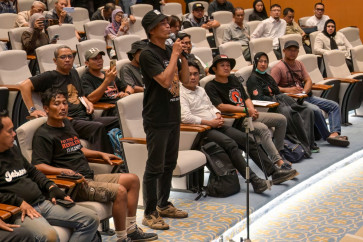
EDUCATION FOR SALE: Students from various universities stage a boisterous rally outside the House of Representatives in Jakarta on Wednesday in protest at an education bill that will turn universities into legal business entities
Change text size
Gift Premium Articles
to Anyone
Share the best of The Jakarta Post with friends, family, or colleagues. As a subscriber, you can gift 3 to 5 articles each month that anyone can read—no subscription needed!
 Set as preferred source

EDUCATION FOR SALE: Students from various universities stage a boisterous rally outside the House of Representatives in Jakarta on Wednesday in protest at an education bill that will turn universities into legal business entities. Despite the protests, the House passed the bill later in the day. (JP/Arief Suhardiman)
Critics and education experts are up in arms after the House of Representatives on Wednesday passed a bill on educational legal entities, which detractors say will lead to the commercialization of education in the country.
After three years of deliberations, the bill was unanimously endorsed during a House plenary session, amid strong protests from students and community groups who demanded the endorsement be delayed.
All 10 factions in the House argued the bill’s final draft was complete makeover of the previous draft, particularly with regard to with controversial articles on education funding.
“Previously, the bill didn’t even include a chapter on funding, and so raised fears it would lead to commercialization. But this final draft obliges the government to provide financial aid for poor students and to pay most of the costs,” the Golkar Party’s Anwar Arifin said when presenting his faction’s final views to the plenary session.
“The final draft of the bill spells good news for the education sector. The public should no longer worry about education turning corporate.”
The new law, he added, was also expected to end decades of mismanagement in the sector.
Anwar, who also heads the bill steering committee, said the new regulation barred schools from imposing levies on students, adding that violators would face disciplinary measures, including possible revocation of school operating licenses.
Article 41 of the educational legal entities bill states the government is responsible for all the expenses of state schools that provide nine-year basic mandatory education.
This means once the bill becomes law, the government must cover all operating costs, investments, scholarships and financial aid for these schools, thus bringing the country closer to universal free basic education.
Senior high schools and universities may still charge students a maximum fee of one-third of operating costs, while the government will be obliged to cover at least one-third of the operating costs of high schools and half of those of universities.
The remainder of operating expenses must be covered by the schools themselves.
Unlike the articles on the “autonomous, accountable and transparent” management of educational institutes that apply to both state and private schools, the articles on funding apply only to the former.
Ever since the university autonomy policy was issued in the early 2000s, the absence of a regulation on funding has sparked continued increases of tuition fees at seven state universities granted autonomous status.
The fee increases are part of the reason the bill is facing resistance.
Wednesday’s House session was interrupted for about 10 minutes when 20 students from the University of Indonesia staged a noisy protest inside the hall.
Outside the House compound, more than a hundred students staged a similar rally against the bill.
In Yogyakarta, education foundation Tamansiswa, one of the country’s oldest educational institutes, also lambasted the bill, which it said would allow foreign institutions to invade the country’s education sector.
Slamet Susanto contributed to this story from Yogyakarta.