The Jakarta Post
Please Update your browser
Your browser is out of date, and may not be compatible with our website. A list of the most popular web browsers can be found below.
Just click on the icons to get to the download page.


Popular Reads
Top Results
No results found. Please check your search term and try again
Can't find what you're looking for?
View all search results
Popular Reads
Top Results
No results found. Please check your search term and try again
Can't find what you're looking for?
View all search resultsLetter: FPI, Pancasila and the govt
The attack on the (Batak Pastoral Church) HKBP congregation by the Islam Defenders Front (FPI) on Aug
Change text size
Gift Premium Articles
to Anyone
Share the best of The Jakarta Post with friends, family, or colleagues. As a subscriber, you can gift 3 to 5 articles each month that anyone can read—no subscription needed!
 Set as preferred source

T
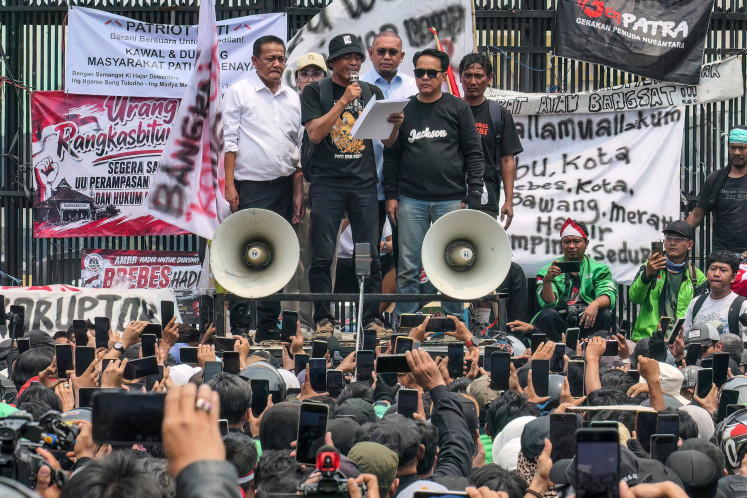
he attack on the (Batak Pastoral Church) HKBP congregation by the Islam Defenders Front (FPI) on Aug. 7 has evoked public demand to disband the organization. Previously, the FPI has carried out several attacks that were mostly based upon a religious rationale, as they freely admitted.
The HKBP attack might be the apex for the public, whereby the FPI is now perceived as a violent and cruel organization. Indonesian Muslims might simply oppose the FPI and label them as deviant, to undertake such attacks in the name of Islam, as they say Islam does not teach violence.
If we refer to the Pancasila state ideology, the stance against the FPI might be strengthened. As an essential basis of being Indonesian, Pancasila is aimed at cultivating a pluralistic perspective in every Indonesian. We are taught to be respectful, tolerant and fair. I believe the FPI has violated all the values within Pancasila.
Since they were disrespectful to the non-Muslim community by attacking them, it is a violation of article one and two of Pancasila on disregarding others’ divinity and humanity.
It could be considered neglecting the essence of the third article too, as they generated disorder, which threatens unity. The fourth and fifth articles were also contravened through them resolving problems, not through discussion but by attacking, and by ignoring social justice.
Having said that, when I referred to an opinion article by Sudirman Nasir published in The Jakarta Post on Aug. 8, I paused to rethink. It wrote that the FPI mostly comprised of unemployed and/or underemployed youths. They were easily recruited because of the lack of availability of ways for them to form an identity, and as a recognition of masculinity. This power was undoubtedly channeled in the wrong direction.
An ignorant government that is careless in governing the people causes this phenomenon, in my view. It is the government that provides almost no means for youths to educate and develop themselves responsibly. Yet, simply presenting the problem is not enough; a solution is required to overcome it.
Regarding the composition of the FPI members, mostly these youths seeking a sense of identity, they would be better channeled into a youth army corps. The government should be asked to generate such corps so that the power of Indonesian young people could be useful rather than destructive. They could act as backup for the existing Indonesia Military (TNI).
They could fight for Indonesia and undertake projects for the sake of the nation. Surely, this sounds a better way. Furthermore, I predict the youths would not refuse recruitment, since the motive of being recognized as strong and extremely masculine would be gratified.
Gilang Reffi Hernanda
Jakarta