TheJakartaPost
Please Update your browser
Your browser is out of date, and may not be compatible with our website. A list of the most popular web browsers can be found below.
Just click on the icons to get to the download page.


Popular Reads
Top Results
No results found. Please check your search term and try again
Can't find what you're looking for?
View all search results
Popular Reads
Top Results
No results found. Please check your search term and try again
Can't find what you're looking for?
View all search resultsRI, China considering shift to rupiah, yuan for settling trade
China is persuading Indonesia to use their own currencies, renminbi (yuan) or rupiah, in settling the growing business transactions between the two countries to ease the process and to reduce costs
Change text size
Gift Premium Articles
to Anyone
Share the best of The Jakarta Post with friends, family, or colleagues. As a subscriber, you can gift 3 to 5 articles each month that anyone can read—no subscription needed!

C
hina is persuading Indonesia to use their own currencies, renminbi (yuan) or rupiah, in settling the growing business transactions between the two countries to ease the process and to reduce costs.
The Financial Services and the Treasury Secretary of Hong Kong’s special administrative region, KC Chan, said in Jakarta on Tuesday that rather than the US dollar, it would be more advantageous for China and Indonesia to use their own respective currencies to settle trade arrangements with each other.
Speaking to reporters following a business luncheon held in Jakarta as part of the campaign to internationalize the renminbi, Chan said that renminbi or rupiah could serve as better alternatives for future trade.
The Chinese delegates, who included the director general of the Shanghai Municipal Government’s financial services office, Fang Xinghai, met with Bank Indonesia Governor Darmin Nasution and Finance Minister Agus Martowardojo to discuss the currency issue.
The delegates said that Indonesia was chosen as the first overseas destination in the renminbi internationalization campaign because of its growing role in the regional economy and its position as one of China’s largest trading partners.
“We really see the benefits for the bilateral trade between Indonesia and China if renminbi or rupiah are used,” he said. “If we use our own currencies instead of other currencies, we could avoid all the risks of using the US dollar back and forth,” he added.
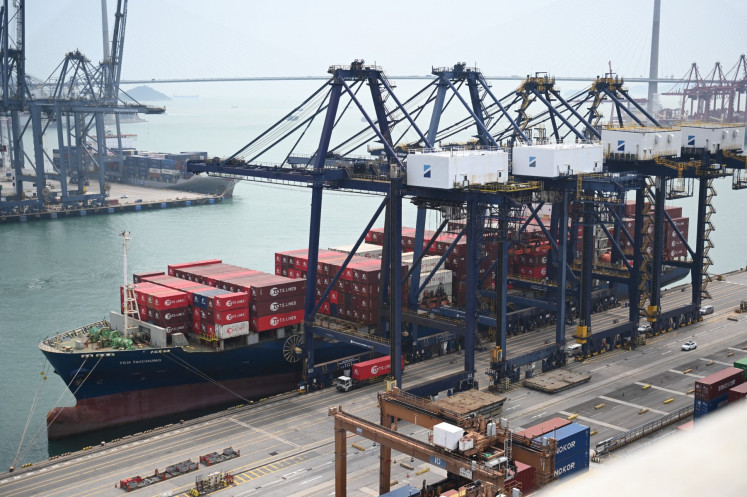
China is one of Indonesia’s biggest trading partners, with two-way trade reaching US$42.7 billion in 2010. However, Indonesia still suffered a deficit of $5.6 billion in its trade with the country.
Fang said that many companies in Asia preferred to use renminbi in dealing with their business partners in China since the campaign for the internationalization of the renminbi was launched in 2009.
China recently overtook Japan as the world’s second-largest economy and also holds the world’s largest share of foreign reserves. It has since significantly increased its financial integration with the rest of the world, with its domestic development and policy choices having stronger external effects than ever before.
Throughout most of its history, the value of the renminbi was pegged to the US dollar. As China pursued its gradual transition from central planning to a free market economy and increased its participation in foreign trade, the renminbi was devalued to increase the competitiveness of Chinese industry.
Global economists viewed China’s move in promoting the use of renminbi as a possible indication of the end of the era of US dollar dominance, as China, an export-reliant economy, could count most of the world’s countries as trading partners. A recent World Bank study predicts the end of the US dollar’s dominance by 2025.
China’s currency is expected to outrank the British pound to become one of the three most favored international trade settlement currencies in the latter half of this year.
According to HSBC, in a recent research report posted on CNBC.com, the top five settlement currencies for the second half of 2011 will be the US dollar, euro, Chinese yuan, British pound and Japanese yen.
The government agreed with the Chinese officials on the importance of using local currencies in their bilateral trade. In 2009, China and Indonesia agreed on a 100 billion yuan currency swap to ease foreign exchange shortages and aid bilateral trade, investment and economic growth, but the agreement was hampered by the inability of local banks to implement it.