The Jakarta Post
Please Update your browser
Your browser is out of date, and may not be compatible with our website. A list of the most popular web browsers can be found below.
Just click on the icons to get to the download page.


Popular Reads
Top Results
No results found. Please check your search term and try again
Can't find what you're looking for?
View all search results
Popular Reads
Top Results
No results found. Please check your search term and try again
Can't find what you're looking for?
View all search resultsRupiah rises most in three years as officials calm market
The rupiah climbed at its fastest pace in three years on Wednesday as officials pushed efforts to stabilize the currency, with Bank Indonesia’s (BI) new measures and the Finance Ministry considering the recent sell-off “not yet worrisome”
Change text size
Gift Premium Articles
to Anyone
Share the best of The Jakarta Post with friends, family, or colleagues. As a subscriber, you can gift 3 to 5 articles each month that anyone can read—no subscription needed!

T
he rupiah climbed at its fastest pace in three years on Wednesday as officials pushed efforts to stabilize the currency, with Bank Indonesia’s (BI) new measures and the Finance Ministry considering the recent sell-off “not yet worrisome”.
The nation’s currency surged 1.9 percent to Rp 9,435 per US dollar at 4:34 p.m. local time on Thursday, after closing at Rp 9,616 a day earlier, according to Bloomberg, as foreign investors cut holdings in Indonesian assets — including stocks and bonds — and demanded greenbacks amid fears of global economic uncertainties.
The Finance Ministry’s debt management office head Rahmat Waluyanto said that though Rp 4 trillion (US$424 million) of foreign investors’ funds had been wiped off the government bond market this month, there’s “no reason to be worried” because Indonesia’s crisis management protocol has yet to indicate a worrisome situation.
“In the last three days the magnitude of the sell-off has become a lot slower,” Rahmat told reporters on Wednesday. Indonesia’s benchmark 10-year bond yield, which reflects the risk of investment and moves in the opposite direction of prices, has spiked 56 basis points so far this month to 6.52 percent on Wednesday.
“There is no significant foreign capital outflow. What happened recently was a normal situation driven by global investors’ reaction to the current trend in the world economy, which shows more uncertainties and bigger risks.”
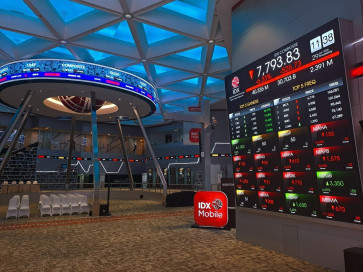
Foreigners, who control more than half of the publicly traded stocks at the local bourse, also dumped a net Rp 6.6 trillion in shares this month, pressuring the benchmark Jakarta Composite Index (JCI) downward by 6.29 percent in May to 3,917.92 on Wednesday.
A possible Greek exit from the euro, dissatisfying manufacturing and economic growth data from China, the world’s second-largest economy, along with weakening Asian currencies has sparked concerns that global economic recovery efforts will stall, forcing investors to trade off their emerging market assets for cash or for safer instruments such as the US dollar.
BI deputy governor Hartadi A. Sarwono said that the selling pressures on Indonesian assets that have weakened the rupiah was not because of the country’s failing policies, but due to the uncertainties looming over the global economy.
“The weakening of the currency rate is not due to Indonesia’s macroeconomic policy failures. It is the mistake of Europe, and has created negative sentiments,” Hartadi told reporters separately.
The central bank will start issuing foreign exchange (forex) term deposits — a deposit-like investment instrument for local banks to invest their forex cash — ,expecting to add a supply of US dollars into the market and in turn stabilize the rupiah due to the rich availability of the greenbacks.
“Bank Indonesia’s initiative to offer dollar deposits is structurally positive but may do little to address the structural dislocation in the onshore market,” Oversea-Chinese Banking Corp. (OCBC) analysts reported.
Aviliani, an economist at the Jakarta-based Institute for the Development of Economics and Finance (INDEF), urged the government to publicly declare it would keep its open market policy to assure foreign investors that the country would not shift its political-economic pendulum to the left amid growing concerns that Indonesia might head in that direction following recent government policies.