The Jakarta Post
Please Update your browser
Your browser is out of date, and may not be compatible with our website. A list of the most popular web browsers can be found below.
Just click on the icons to get to the download page.


Popular Reads
Top Results
No results found. Please check your search term and try again
Can't find what you're looking for?
View all search results
Popular Reads
Top Results
No results found. Please check your search term and try again
Can't find what you're looking for?
View all search resultsGraft in forestry sector to worsen ahead of 2014
Graft watchdogs and environmental groups have warned about increasing levels of graft in the forestry sector ahead of the 2014 election
Change text size
Gift Premium Articles
to Anyone
Share the best of The Jakarta Post with friends, family, or colleagues. As a subscriber, you can gift 3 to 5 articles each month that anyone can read—no subscription needed!
 Set as preferred source

G
raft watchdogs and environmental groups have warned about increasing levels of graft in the forestry sector ahead of the 2014 election.
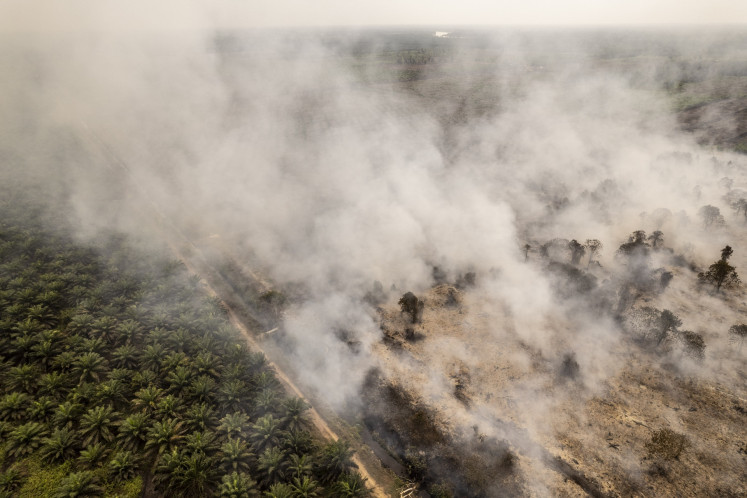
The groups suspect that contentious revisions of spatial planning bylaws and forestry bills could be used by politicians and businesspeople as a means to reap personal benefits.
Activist Pius Ginting from the Indonesian Forum for the Environment (Walhi) said that past cases showed that the government, in the run-up to general elections, rushed to pass regulations that benefited private companies at the expense of environmental protection.
He said that in 2004, then president Megawati Soekarnoputri signed a decree allowing for the operation of 13 open-pit mines in protected forests. Then, in 2009, the government of President Susilo Bambang Yudhoyono issued a regulation allowing another 13 mining companies to set up operations in protected forests.
'Such practices will likely be repeated this year. We now have several regions that are set to revise their spatial planning bylaws ahead of the 2014 elections, which will pave the way for mining and plantation companies to further reduce forest areas,' Pius told The Jakarta Post recently.
Data from Walhi shows that the regions due to conclude revisions on the bylaws by the end of this year include, among others, Aceh, Bangka Belitung, North Sulawesi and Southeast Sulawesi.
Pius added that the controversial bill aimed at combating deforestation, which has been suspended by the House of Representatives due to mounting protests, and a bill on plantations, were examples of regulations that could further destroy the country's forests.
The bill on combating deforestation, for example, will grant the Forestry Ministry the authority to determine forest areas, issue permits for exploitation of the forests and bring criminal charges against those carrying out illegal activities in forest areas, including illegal logging.
'On the surface, such a regulation appears good, but it can potentially be abused by officials and business groups. Corrupt practices may include shares offers or even bribes,' Pius said.
The antigraft watchdog, Indonesian Corruption Watch (ICW), said that corruption in the forestry sector centered on the issuance of permits for plantations, miners and change of land use.
The ICW has recorded that irregularities in the clearance of 8 million hectares of land for oil palm plantations between 2004 and 2007 resulted in Rp 169.797 trillion (US$17.5 billion) in state losses.
'The motives for corruption in the forestry sector remain the same; politics and business are closely related. Each use the other for personal benefits, especially ahead of elections, whether regional or national. This is what we need to anticipate as the legislative and presidential elections approach,' ICW employee Tama S. Langkun said.
Meanwhile, the Indonesian Forum for Budget Transparency (FITRA) recorded 278 irregularities involving the Forestry Ministry in 2011, which caused the state to lose up to Rp 7.1 trillion ($733 million).
A survey carried out by FITRA showed that the ministry ranked as the most corrupt of the 15 ministries led by party-affiliated politicians.
Based on the survey's findings, FITRA urged Forestry Minister Zulkifli Hasan, who is a member of the National Mandate Party (PAN), to drop his bid to become a legislator in South Sumatra.
Lawmaker M. Romahurmuziy, who chairs House Commission IV overseeing agriculture and plantations, denied that the bills currently under discussion would be used to win support from the business community.
'We are discussing those bills because we believe they are necessary to protect our forestry sector. It is wholly untrue that we politicians will raise so-called funds for our campaigns from any regulations we introduce,' Romahurmuziy, a United Development Party (PPP) politician, said.