TheJakartaPost
Please Update your browser
Your browser is out of date, and may not be compatible with our website. A list of the most popular web browsers can be found below.
Just click on the icons to get to the download page.


Popular Reads
Top Results
No results found. Please check your search term and try again
Can't find what you're looking for?
View all search results
Popular Reads
Top Results
No results found. Please check your search term and try again
Can't find what you're looking for?
View all search resultsPolice vow to protect minority in W. Java
Newly installed West Java Police chief Insp
Change text size
Gift Premium Articles
to Anyone
Share the best of The Jakarta Post with friends, family, or colleagues. As a subscriber, you can gift 3 to 5 articles each month that anyone can read—no subscription needed!

N
ewly installed West Java Police chief Insp. Gen. Moechgiyarto vowed on Friday that he would prioritize the protection of freedom of religion and worship in the province, widely perceived as the country's most intolerant region.
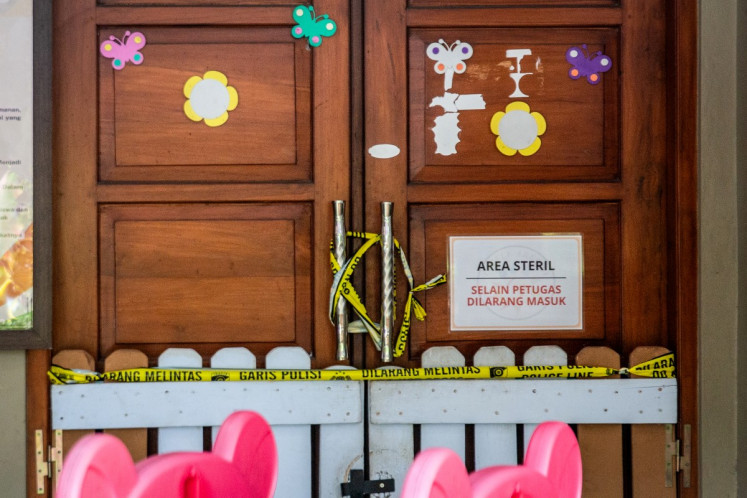
The two-star general issued these instructions to the whole police force in the province to ensure that there would be no more forced closures of houses of worship in West Java.
The closure of such places was under the authority of the local government and it could be implemented following a court ruling.
The former head of the law division of the National Police also pledged to protect minority religious groups, such as Ahmadiyah and Shia, which were prevented from practicing in the province following strong pressure from intolerant community groups.
'We will help local administrations. The [closure] process will no longer be [allowed], should everything be communicated well,' said Moechgiyarto.
He reiterated that closing a house of worship would only be allowed if there was already a court ruling on the matter. He also said that if there was a dispute, the substance of the problem had to be clear. If a building had to be shut down, he continued, then the local administration should enforce the ruling, not the police. The provincial police chief added that especially during the month of Ramadhan, the police were obliged to foster harmony among religions.
'We have to emphasize this to make Ramadhan run smoothly,' he said.
The National Commission on Human Rights (Komnas HAM) said that of all the provinces in Indonesia, West Java had the highest number of violations against freedom of religion and worship in 2014. In 2014, the commission received 67 complaints; in 2013 it only received 39. Many churches were forcefully shut down and damaged in a number of places, such as Bekasi.
Hardjoko of the Ahlul Bait Indonesia congregation in Bandung expressed his hope that law enforcers could perform their duties well, especially because his congregation was frequently discriminated against. He said his group often had difficulty getting permission to perform religious celebrations. The police would only issue the permit after his congregation got a recommendation from the Interfaith Brotherhood Forum (FKUB) and the Indonesian Ulema Council (MUI), he said. In many cases, he continued, the police would not even acknowledge the permit application unless recommendations from the two organizations were already there.
With regard to closing houses of worship, Nurjaman of Komnas HAM's monitoring and investigation division said that so far his side had never been asked for an opinion in court on freedom of religion and faith. Nurjaman said his office once received a complaint against the Ciamis regency administration's public order officer unit for closing the Ahmadiyah Nur Khilafat mosque on July 2, 2014.
'We clarified [the complaint] and conducted field monitoring. They [the Ahmadiyah congregation] themselves finally opened the mosque,' said Nurjaman, adding that such cases became common in West Java following Gubernatorial Regulation No. 12/2011, which banned Ahmadiyah activities in West Java.