TheJakartaPost
Please Update your browser
Your browser is out of date, and may not be compatible with our website. A list of the most popular web browsers can be found below.
Just click on the icons to get to the download page.


Popular Reads
Top Results
No results found. Please check your search term and try again
Can't find what you're looking for?
View all search results
Popular Reads
Top Results
No results found. Please check your search term and try again
Can't find what you're looking for?
View all search resultsUtilizing sun and waste: Risk mitigation for a 35,000 MW program
The fast track of building power plants to produce an additional 35,000 MW in power is quite urgent and most imperative, otherwise people in Java will experience a power crisis like what has been happening in some areas outside Java
Change text size
Gift Premium Articles
to Anyone
Share the best of The Jakarta Post with friends, family, or colleagues. As a subscriber, you can gift 3 to 5 articles each month that anyone can read—no subscription needed!

The fast track of building power plants to produce an additional 35,000 MW in power is quite urgent and most imperative, otherwise people in Java will experience a power crisis like what has been happening in some areas outside Java.
However, inevitably, this program will face many risks including difficulties getting permits and acquiring land that may cause delay for the whole project.
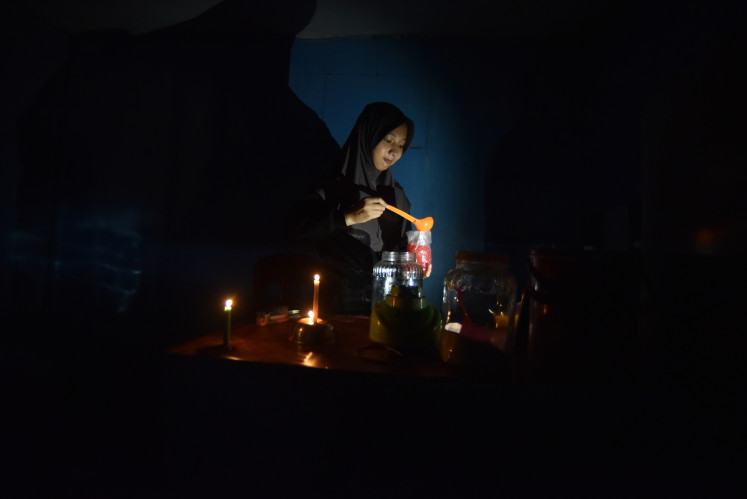
There is also a risk that may cause an electricity crisis due to the fact that the deficit of reserve capacity in Java is predicted to happen next year, while none of the power from the 35,000 MW program would likely come on stream and enter the system earlier than 2017.
Consequently, without any risk mitigation, the impact will not only cause an electricity crisis but also have severe negative repercussions on the economy, society and political stability.
Therefore, before it is too late, all responsible officials including the President are urged to make a back up plan for this fast track program, rather than getting trapped in the rhetorical choir preaching optimism that this project can be accomplished.
Building one 1000 MW power plant is the same as building 1,000 of 1 MW power plants. But building small plants can be faster, easier and can be done simultaneously in as many places as we want.
Such principles can be applied to the fast track program as a mitigation scenario to minimize the energy deficit if delay occurred with the 35,000 MW plants.
As illustrated in the following figure, it is possible to build a small 1 MW power plant in less than a year in 1,000 different places at the same time. In contrast, it takes five years to build one 1,000 MW power plant and the delay in any single process will impact the delay of the whole project.
Moreover, a big project will face more risks compared to that of a small project. It is recommended that we use clean energy from solar PV and the organic waste of small plants, which can be built easily everywhere.
Solar PV is chosen because annual sun-ray energy potential in Indonesia is high (1400-2200 kWh/m2) compared to Germany (900-1200 kWH/m2).
Economically, the current price of PV has dropped dramatically and its life cycle is very long (20-25 years), so it can be cheaper than diesel plants. PV also produces no air pollution and it will save about 300 liters of fuel oil in every 1 MWh produced.
The only problem with PV ironically came from the Ministry of Energy and Mineral Resources regulation, which limits the development of PV plants by quota and tender procedure.
The organic waste energy potential is also promising as the fact that Indonesian people produced around 66 million tons waste in 2010, equal to around 25,000 MWh energy. Gas engines that generate electricity from biogas are relatively simple compared to thermal plants and need no large space.
Small scale organic waste resources will be available in any house or public place as one man usually produces 0.76 kg of waste per day. Waste energy provides additional benefits for waste disposal and transportation.
Combined together, PV and waste power plants have no risk associated with transmission lines including land and right of way problems, because it can be connected directly to the nearest distribution lines.
There should not be any doubt regarding how to handle thousands of small power plants, since there is Smart Grid technology, which is sufficient to manage the so-called distributed generation consisting of several thousand sets of PV and organic waste power plants.
The last bonus from this scenario can be given to the local people as they can build and operate their own power plant and sell it to the utility company.
_________________________
The writer is director of STT-PLN (Technical College of PLN ). This is a personal opinion.