TheJakartaPost
Please Update your browser
Your browser is out of date, and may not be compatible with our website. A list of the most popular web browsers can be found below.
Just click on the icons to get to the download page.


Popular Reads
Top Results
No results found. Please check your search term and try again
Can't find what you're looking for?
View all search results
Popular Reads
Top Results
No results found. Please check your search term and try again
Can't find what you're looking for?
View all search resultsView Point: Waiting for graft convicts to contest presidential race
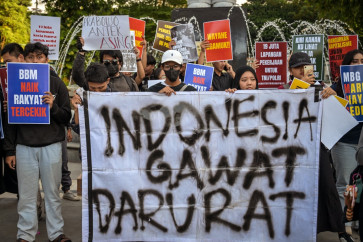
Many think Indonesia is regressing when it comes to its commitment to corruption eradication
Change text size
Gift Premium Articles
to Anyone
Share the best of The Jakarta Post with friends, family, or colleagues. As a subscriber, you can gift 3 to 5 articles each month that anyone can read—no subscription needed!
 Set as preferred source

Many think Indonesia is regressing when it comes to its commitment to corruption eradication. The recent arrest of North Sumatra Governor Gatot Pujo Nugroho, three judges of the Medan State Administrative Court (PTUN), a court clerk and two lawyers is just an example of the consistently high prevalence of corruption here.
Data from Transparency International Indonesia (TII) shows that the country's corruption perception index has improved over the last five years, thanks in part to the tough enforcement of the Corruption Law, which has resulted in many government officials, politicians and law enforcers getting sent to jail.
But the administration of President Joko 'Jokowi' Widodo has sent the wrong signal in its bid to fulfill his pre-election promise to fight corruption, particularly when he failed to defend the Corruption Eradication Commission (KPK) from the police's onslaught early this year.
To appease criticism against his silence in the KPK bashing, Jokowi asked for concerted efforts among the KPK, police and the Attorney General's Office (AGO) in battling corruption. Jokowi has also resisted the House of Representatives' move to revise KPK Law No.30/2002, which otherwise would've deprived the antigraft commission of its wiretapping and prosecution authorities.
Overall, however, public skepticism of the prospects of the anticorruption campaign is looming, not only because the KPK has effectively been in check following the third round of its standoff with the police but also due to a series of judiciary power exercises by the Constitutional Court.
The court, a product of the 1998 reform movement, has at least three times this year delivered verdicts that play havoc to one of the priority goals of reformasi, which is to eradicate corruption, collusion and nepotism.
First, the court justices declared in April that graft suspects can challenge their legal status in a pretrial hearing. The verdict strengthened an earlier decision by the South Jakarta District Court to invalidate the KPK's naming of then National Police chief candidate Comr. Gen. Budi Gunawan as a suspect.
Prior to the Constitutional Court's ruling, pretrial hearings were restricted to investigations in which arrests were deemed as flawed, such as an arrest without a warrant, illegal obtainment of evidence, etc.
The justices said there was no mechanism to examine how investigators reached a decision to name someone a suspect, therefore the process was prone to abuse of power. Whatever the reason behind the verdict, the judiciary power has opened Pandora's box.
All suspects now stand a chance of evading investigation, with some successful, such as former Makassar mayor Ilham Arief Sirajuddin and former Supreme Audit Agency (BPK) head Hadi Poernomo, while others have failed.
Second, the Constitutional Court ruled early last month in favor of plaintiffs who wish to build their political dynasties in their own regions. The verdict repeals an article in the Regional Elections (Pilkada) Law, which had barred family members of incumbents from contesting regional elections.
The law required the incumbents to step down if their family members ran for office to avoid conflict of interest.
The court justices said the article was discriminatory, which nobody would argue. But they turned a blind eye to the fact that the penchant for political dynasties was prone to corruption as in the cases of former Banten governor Atut Chosiyah and former Bangkalan regent Fuad Amin.
Not only will conflict of interest be inevitable when family members ' wives, sons, daughters or in-laws ' of incumbents run for public posts but a level playing field will also be elusive and hopes for democratic competition will go up in smoke.
A political dynasty paves the way for the concentration of power in the hands of one family, stymies free and fair elections and prevents the circulation of the elite, unfortunately thanks to (procedural) democracy, which Indonesia has embraced for more than 17 years. It is only a matter of time before corruption thrives.
Third, after justifying the practice of political dynasties, the Constitutional Court restored the right of newly freed graft convicts to aspire for regional head posts. The Pilkada Law had required former corruption convicts to wait five years after their release before they could run for public posts.
The court ruling only asks that ex-convicts and suspects publicly announce their criminal history, which former Semarang mayor Soemarmo Hadi Saputro has done. Soemarmo announced in a local newspaper his conviction of corruption, which had forced him to relinquish his mayoral post in 2012 to serve 18 months in prison, as a prerequisite for his bid to regain his old job.
The court ruling reminds us of the warning message that appears on cigarette packaging. Cigarette producers have to warn smokers of the risks of their habit, which include cancer, heart attacks and impotence, as part of the government's efforts to discourage people from smoking.
It seems the warning is not working. Cigarette giant PT HM Sampoerna, for example, registered nearly 12 percent sales growth in the first half of this year from the same period last year.
Similarly, voters, particularly those who are still struggling to make ends meet, will easily ignore the mandatory warning former graft convicts will have to publicize when vying for regional head posts. Past elections, both local and national, proved that candidates who offered something real like free education and health care would win.
We can therefore question the contribution of the Constitutional Court to the anticorruption drive, not because of the fact that its former chief Akil Mochtar has been convicted of graft, but because it upholds what is written in the Constitution without reading between the lines.
With the anticorruption culture far from being established, the court rulings have instead added confusion to the disorientation the country is suffering from its fight against graft.
There are at least 11 former graft convicts contesting the simultaneous regional elections on Dec. 9, courtesy of the Constitutional Court. Now corruption convicts have strong ground to gun for legislative and presidential posts in 2019 and beyond.