TheJakartaPost
Please Update your browser
Your browser is out of date, and may not be compatible with our website. A list of the most popular web browsers can be found below.
Just click on the icons to get to the download page.


Popular Reads
Top Results
No results found. Please check your search term and try again
Can't find what you're looking for?
View all search results
Popular Reads
Top Results
No results found. Please check your search term and try again
Can't find what you're looking for?
View all search resultsPolice chief admits difficulties in detecting flow of terrorist groups' funds
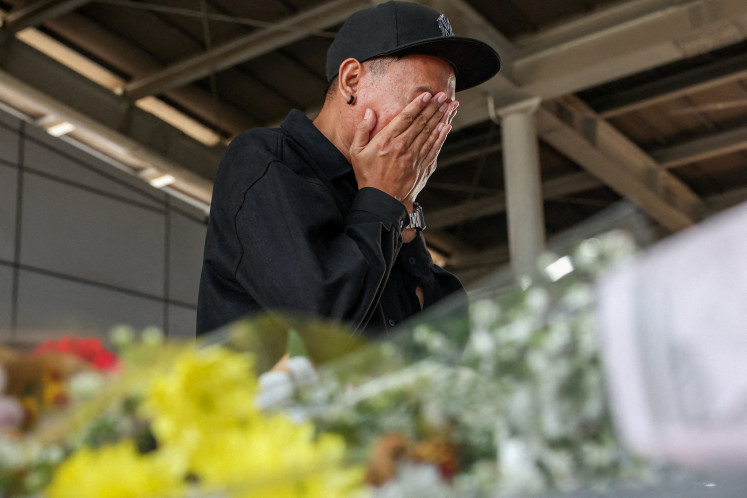
In solidarity: City residents join Jokowi Mania Nusantara, a group of President Joko âJokowiâ Widodoâs supporters, to spread flower petals on Friday at the location where the first of a series of blasts exploded on Jl
Change text size
Gift Premium Articles
to Anyone
Share the best of The Jakarta Post with friends, family, or colleagues. As a subscriber, you can gift 3 to 5 articles each month that anyone can read—no subscription needed!
 In solidarity: City residents join Jokowi Mania Nusantara, a group of President Joko âJokowiâ Widodoâs supporters, to spread flower petals on Friday at the location where the first of a series of blasts exploded on Jl. MH Thamrin, Jakarta, on Jan. 14. National Police chief Gen. Badrodin Haiti said the police were facing difficulties tracing the flow of foreign funds intended for terrorist groups in Indonesia.(thejakartapost.com/Wienda Parwitasari) (thejakartapost.com/Wienda Parwitasari)
I
span class="caption">In solidarity: City residents join Jokowi Mania Nusantara, a group of President Joko 'Jokowi' Widodo's supporters, to spread flower petals on Friday at the location where the first of a series of blasts exploded on Jl. MH Thamrin, Jakarta, on Jan. 14. National Police chief Gen. Badrodin Haiti said the police were facing difficulties tracing the flow of foreign funds intended for terrorist groups in Indonesia.(thejakartapost.com/Wienda Parwitasari)
The National Police say they are having difficulty tracing international transfers of funds, including the amount sent to finance a deadly bomb and gun attack in Central Jakarta in January, intended for terrorist groups in Indonesia.
National Police chief Gen. Badrodin Haiti said funds worth Rp 1.3 billion (US$96,225) were suspected to have come from the Middle East to Indonesia to finance terrorist attacks. However, he added that the police could not detect the wire transfers early enough to prevent them.
'This cannot be. It's difficult to detect it [the funds transfer],'the police chief said as quoted by kompas.com. He was speaking during a meeting held by the House of Representatives' Commission I overseeing defense and foreign affairs and Commission III overseeing legal affairs on Monday.
Badrodin said it was impossible for the police to cut off global payment companies, such as Western Union, to prevent money transfers to beneficiaries in Indonesia. 'We don't know whether or not it is for terrorists,' he said.
Western Union is registered as an international payment company. It is apparently often used by terrorist leaders in the Middle East to send money to Indonesia to fund terrorism.
Police say that most of the time they become aware of a money transfer only after members of terrorist networks are arrested and provide the information. Police also claim it is difficult for them to detect the senders of the money because it often happens that identities posted on the transfer forms are only names.
Foreign sources for terrorist attack funding were revealed after the police's counterterrorism unit, Densus 88, arrested 33 people suspected of involvement in terrorism following the fatal attack on Jl. MH Thamrin on Jan. 14, which left eight people dead, including four civilians, and more than 20 injured. One of the suspected terrorists arrested gave the police information that Rp 1.3 billion worth of funds had been sent from Jordan, Iraq and Turkey.
In Indonesia, the Rp 1.3 billion was allegedly received by a terrorist group led by Hendro Fernando. The Hendro group was one of three terrorist groups that police say were set to use the money to launch attacks against police offices.
The Hendro group later forwarded some of the money, in the form of cash, to the Philippines and Poso, Central Sulawesi. It was suspected that the money was used to buy weapons. The Hendro group was known to have had nine firearms supplied by the group's terrorist cells in the Tangerang prison, but it did not get ammunition.
The Hendro group was one of the main terrorist groups revealed following the Thamrin attack.
Another terrorist group, led by Helmi, was also reported to have received foreign funds. Badrodin said the Helmi group planned to bomb the Jakarta Police office. 'It was planned that they would attack the police office with a car bomb,' he added. Members of the Helmi group were arrested in Sumedang, West Java.
The third group was the Indramayu group, which reportedly aimed to launch attacks against on-duty traffic police, attacking them using sharp metal objects. 'It is their plan,' said Badrodin.
The police also arrested the Abu Musyak group in Bekasi, West Java, during New Year's Eve. 'It's a separate group and initially they were set to launch attacks on the New Year's Eve,' said Badrodin.
Badrodin said the terrorist groups actually lacked the funds they needed to execute their plans. The Thamrin bomb plan, for example, was estimated to have cost only Rp 900,000.
However, the police chief added that terrorism threats were still very real in Indonesia because many terrorist groups remained in contact with Bahrun Naim, an Indonesian fighting with the Islamic State (IS) group in Syria who is believed to have orchestrated the Thamrin attack.
"He motivates others with the spirit of jihad, trains people in bomb construction and will continue to send funds to those who are ready to carry out terrorism acts," he said. (liz/ebf)(+)