TheJakartaPost
Please Update your browser
Your browser is out of date, and may not be compatible with our website. A list of the most popular web browsers can be found below.
Just click on the icons to get to the download page.


Popular Reads
Top Results
No results found. Please check your search term and try again
Can't find what you're looking for?
View all search results
Popular Reads
Top Results
No results found. Please check your search term and try again
Can't find what you're looking for?
View all search resultsIndian buffalo meat finds place in Jakarta
Change text size
Gift Premium Articles
to Anyone
Share the best of The Jakarta Post with friends, family, or colleagues. As a subscriber, you can gift 3 to 5 articles each month that anyone can read—no subscription needed!
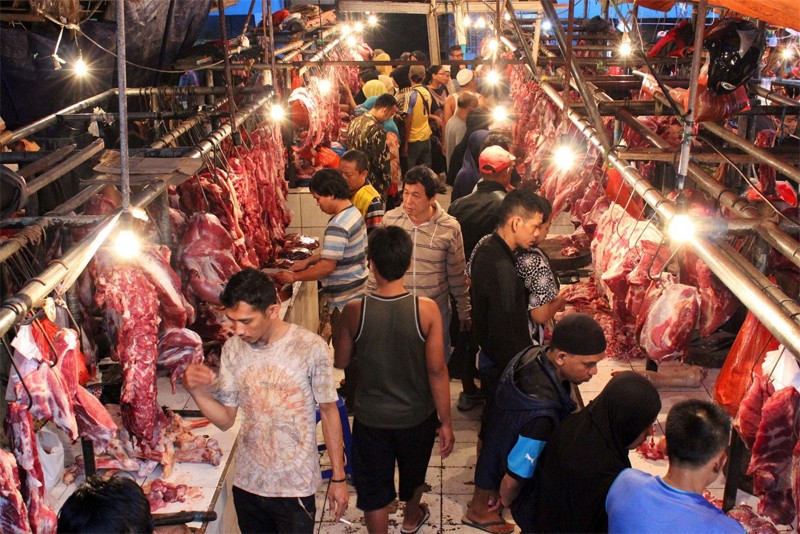 Consumers buy beef at the Pasar Minggu in South Jakarta in recent days. (JP/Viriya Paramita Singgih)
W
iting tresno jalaran soko kulino (love grows from familiarity) is a popular Javanese phrase that explains our growing affection for someone or something that we know better over time.
The expression might also summarize the gradually increasing popularity of imported buffalo meat among Indonesian customers not long after its maiden introduction to the country.
Starting this year, Indonesia has decided to import buffalo meat from disease-free regions of India as an alternative to beef to stabilize prices, especially to cater the low- and middle income buyers.
Although the buffalo meat is sold at around Rp 60,000 (US$4.6) per kilogram, almost half the current stubbornly high beef price, doubts loom regarding the public acceptance of the product as Indonesian households are all too familiar with beef dishes, including the famous rendang (beef simmered in coconut milk and spices) and semur (stew).
The doubt, however, gradually began to fade away after the arrival of the first batch of the product in Jakarta in late August. Within a month, 65 percent of 10,000 tons of buffalo meat had been successfully absorbed by customers in and around the country’s capital, data from the State Logistics Agency (Bulog) showed.
Meat vendors in local markets, meanwhile, reported that sales of the product had quickly picked up pace.
“Last month, I only managed to sell less than 50 kilograms of buffalo meat per day. But these days, I can sell up to 75 kg daily,” Arifin Nasmawi, a vendor in West Jakarta’s Grogol Market, told The Jakarta Post on Thursday.
Aman, a meat vendor in Tanah Abang Market, Central Jakarta, acknowledged a similar trend, attributing the rising popularity of imported buffalo meat to its relatively low price. He also could not resist trying the product at home.
“It’s denser than beef,” he said. “For me, it doesn’t taste as good as rendang. But if you make it as semur, it’s even tastier than beef.”
With a warm welcome from the public, Bulog is set to procure another 70,000 tons of buffalo meat by year-end. Bulog procurement director Wahyu said the supply would arrive in stages and would be distributed across the archipelago except in certain regions where beef supply is sufficient, like West Java, Central Java and South Sulawesi.
Wahyu said the buffalo meat would be distributed through wholesalers at Rp 56,000 per kg with expectations of maintaining a retail price of Rp 65,000 per kg.
While buffalo meat prices in regional administration-run markets can be easily monitored, those in privately run markets are tricky
to control.
A meat seller in South Jakarta’s Kebayoran Lama Market, who identified himself as Agus, said he sold imported buffalo meat for between Rp 90,000 and Rp 120,000 per kg without clearly identifying the product to customers.
“If they don’t ask, I wouldn’t tell them it’s buffalo meat. Many of them don’t complain and keep coming back, maybe because of its similar taste [to beef],” he said.
With the trick, Agus sees his frozen boneless buffalo meat sold out faster than the fresh boneless beef, which he opens at Rp 120,000 per kg.
In response to such a market trick, Bulog’s Wahyu said the practice was unacceptable and Bulog would soon investigate the case.
He expected, nevertheless, the cheaper meat to potentially reduce the public habit of beef consumption, which could lead to an increase in the country’s dependence on imported beef.