







Enjoy This Gifted Article!
You're reading this thanks to a The Jakarta Post subscriber.
Access is available for 30 days. For unlimited access, consider subscribing.
Please Update your browser
Your browser is out of date, and may not be compatible with our website. A list of the most popular web browsers can be found below.
Just click on the icons to get to the download page.

Can't find what you're looking for?
View all search resultsCan't find what you're looking for?
View all search results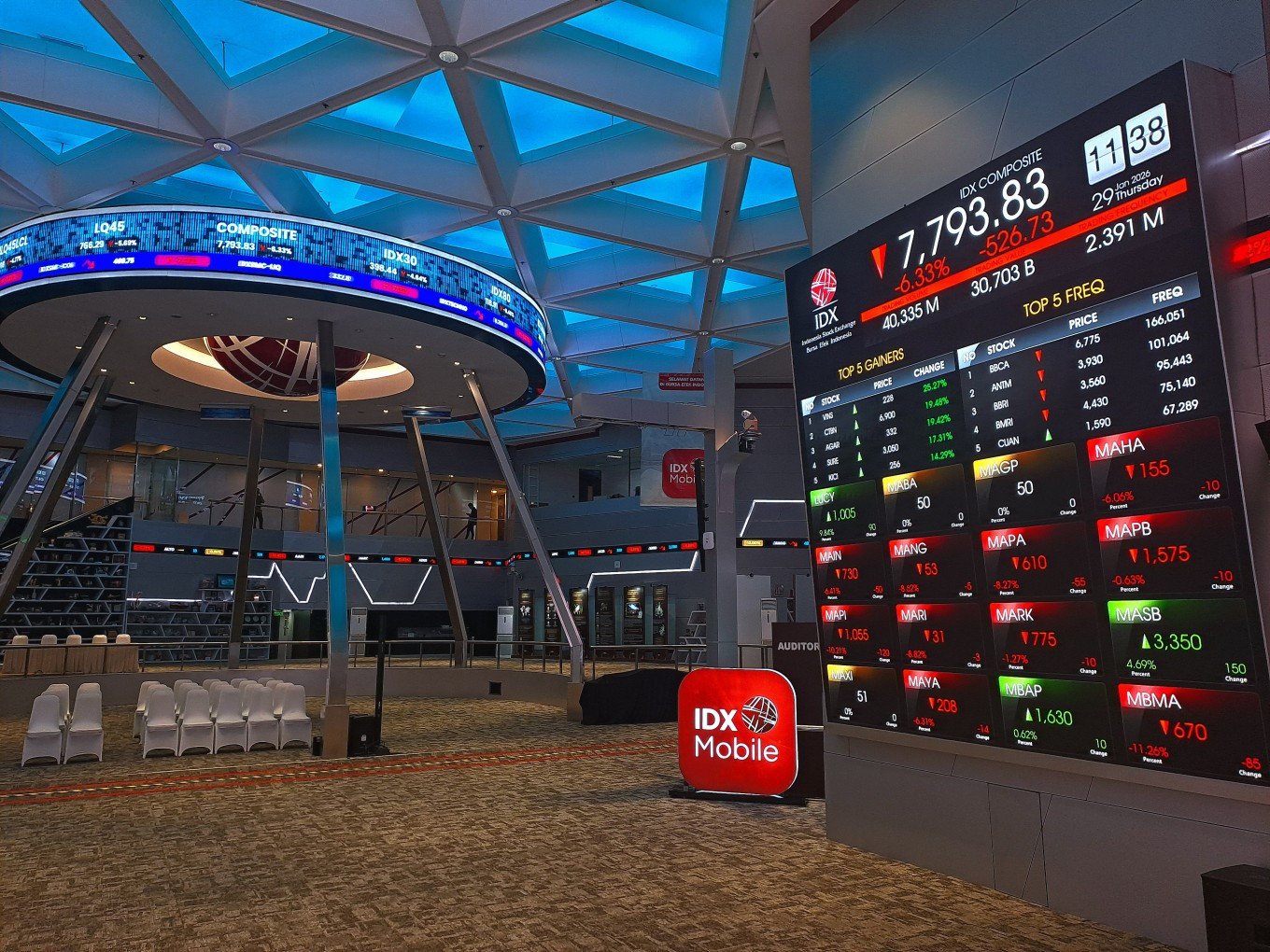 Red alert: An electronic display board inside the main hall of the Indonesia Stock Exchange (IDX) in South Jakarta shows an overall downward movement across most stocks during the lunch break on Jan. 29, 2026, when the IDX Composite index fell 6.3 percent after global investment firm MSCI raised concerns about free float and trading transparency. (TJP/Deni Ghifari)
organ Stanley Capital International (MSCI) has temporarily frozen Indonesia’s February market status review and warned of a potential downgrade from Emerging Market to Frontier Market, citing persistent structural and governance weaknesses in the equity market. Key concerns include opaque ownership structures, limited disclosure of ultimate beneficial owners, and significant price distortions in several heavily weighted stocks, particularly conglomerate- and state-owned enterprise-linked names, which have pushed the Jakarta Composite Index (JCI) higher without corresponding improvements in fundamentals.
MSCI has also pointed to weak enforcement against market manipulation and coordinated price formation, which it views as undermining market integrity and investability.
The announcement immediately rattled markets. After MSCI froze rebalancing due to investability concerns, the JCI plunged 7.35 percent to close at 8,320.56 on Jan. 28, falling well below the 8,880–8,780 support range ahead of the market open. In response, the Indonesia Stock Exchange (IDX) and the Financial Services Authority (OJK) stressed their ongoing coordination with MSCI, highlighting steps to improve transparency, including the publication of more comprehensive free-float data and continued engagement to address MSCI’s feedback rather than dismiss it.
Concerns over price manipulation are not new to policymakers. In October 2025, Finance Minister Purbaya Yudhi Sadewa announced that the government was intensifying efforts to crack down on and prosecute individuals involved in market manipulation, commonly referred to as “pump-and-dump” schemes. At the time, the IDX requested fiscal incentives to support the market, but Purbaya declined to grant them immediately, arguing that incentives should only follow a cleanup of manipulative practices to ensure adequate protection for retail investors.
The stakes are high. MSCI is a global index provider whose country classifications, developed, emerging, or frontier, serve as benchmarks for trillions of dollars in active and passive investment funds worldwide. Indonesia’s inclusion in the MSCI Emerging Markets Index determines its eligibility for investment by a large pool of institutional investors whose mandates are strictly tied to that classification.
The MSCI episode has, unsurprisingly, intensified a growing perception among market participants that Indonesia’s financial watchdog has failed to keep pace with the mounting structural risks in the equity market. For years, foreign investors have raised concerns over selective enforcement, tolerance of extreme price movements in illiquid stocks, and the absence of credible deterrents against coordinated trading and insider-driven speculation.

MSCI’s explicit reference to weak enforcement and price distortions has now effectively elevated these critiques to the international stage, lending them far greater weight than domestic complaints from analysts or minority shareholders.
These concerns have been further amplified by the recent decision of OJK chief commissioner Mahendra Siregar to step down, with rumors from investors circulating that Mahendra had not been prepared to manage the capital market.
What we’ve heard
Several sources say that MSCI’s disappointment with Indonesia’s stock exchange began with the “stock price rigging” of Barito Renewables Energy (BREN), owned by conglomerate Prajogo Pangestu, last year. At the time, MSCI was not satisfied with the explanation regarding BREN’s free float.
Since then, MSCI has conducted a comprehensive review of free float regulations on the Indonesian stock exchange. MSCI questioned the transparency of share ownership data as well as coordinated stock price movements, or so-called “rigged stocks”. What was released last week, according to several analysts, is essentially a set of recommendations stemming from MSCI’s review of the implementation of free float rules in Indonesia’s capital market, triggered by the BREN stock phenomenon.
Another source added that MSCI had, in fact, repeatedly conveyed its suspicions to regulators regarding stocks deemed irregular or allegedly the result of price manipulation. One of the stocks that particularly disappointed MSCI was Dian Swastika Sentosa (DSSA), part of the Sinar Mas group. MSCI reportedly had difficulty unloading its DSSA shares because there were no buyers, despite the fact that the stock’s price movements at the time were highly volatile. “The price movement was not natural,” said an analyst.
From MSCI’s perspective, many conglomerate-owned stocks have risen far beyond reasonable valuations. As a result, the JCI has surged without a solid underlying fundamental basis. “Over the past year, many stocks have risen insanely,” said a former chief economist at a private bank. Analysts argue that this distortion is closely linked to coordinated price formation and opaque free float structures that have gone largely unchecked.
This is why MSCI has pushed for improvements to prevent coordinated price manipulation from becoming entrenched as a de facto market norm. Although Indonesia’s Capital Market Law explicitly prohibits such practices, enforcement has been minimal, allowing price rigging to persist as something widely tolerated. It is also suspected that in several conglomerate-controlled stocks, many of which are included in the MSCI index, the ultimate beneficial owners are the conglomerates themselves, a lack of transparency that has deprived public investors of fair access and opportunity.
One official close to Prabowo reportedly asked IDX and OJK officials responsible for the capital market to resign. Several sources said the pressure to step down came directly from the government. This led to the resignation of Iman Rahman, president director of the IDX, followed by Mahendra Siregar, chairman of the OJK board of commissioners, along with two other senior OJK officials. Mirza Adityaswara, who had initially been prepared to serve as acting OJK chairman, declined the role and chose to resign instead.
Meanwhile, capital market sources criticized the IDX and OJK’s plan to provide ultimate beneficial owner data exclusively to MSCI, initially limited to IDX100 stocks, arguing that it reflects panic-driven and selective treatment that risks creating information asymmetry. Such a move, they warned, would disadvantage public investors and millions of domestic retail investors. Analysts stressed that transparency regarding free float and ownership structures should apply equally to the market at large, not solely to a global index provider.
Another source said the OJK is well aware of the practice of stock price rigging. The rise of the JCI over the past three years, the source noted, has been inseparable from stocks whose valuations have been artificially engineered. OJK officials recognize that the share prices of several listed companies have exceeded reasonable limits, yet enforcement has been constrained by political realities. Business figures allegedly involved in price manipulation are said to have close ties to the government, limiting regulators’ room for maneuver.
Share your experiences, suggestions, and any issues you've encountered on The Jakarta Post. We're here to listen.
Thank you for sharing your thoughts. We appreciate your feedback.
Quickly share this news with your network—keep everyone informed with just a single click!
Share the best of The Jakarta Post with friends, family, or colleagues. As a subscriber, you can gift 3 to 5 articles each month that anyone can read—no subscription needed!
Get the best experience—faster access, exclusive features, and a seamless way to stay updated.


