The Jakarta Post
Please Update your browser
Your browser is out of date, and may not be compatible with our website. A list of the most popular web browsers can be found below.
Just click on the icons to get to the download page.


Popular Reads
Top Results
No results found. Please check your search term and try again
Can't find what you're looking for?
View all search results
Popular Reads
Top Results
No results found. Please check your search term and try again
Can't find what you're looking for?
View all search resultsTraditional puppets enter the modern mall
High note: A musician strikes the final notes of a wayang kulit performance at Citos
Change text size
Gift Premium Articles
to Anyone
Share the best of The Jakarta Post with friends, family, or colleagues. As a subscriber, you can gift 3 to 5 articles each month that anyone can read—no subscription needed!
 Set as preferred source

High note: A musician strikes the final notes of a wayang kulit performance at Citos.
The singers filed in first, their glittering blue and purple tops, narrow batik sarongs and elaborately sculpted hair standing out in a sea of jeans and designer T-shirts.
Then came dalang Ki Joko Edan, a shadow-puppet master from Semarang, and a troupe of batik-shirted musicians. Before long, the deep ringing of the gongs, the clang of the saron and the high wavering voices of the chorus filled the halls of Cilandak Town Square (Citos) in South Jakarta.
Wayang kulit, the mainstay of traditional Javanese culture, had come to the shopping mall, bastion of modern life in Jakarta.
Beneath a bank of nine flat-screen televisions continuously playing ads for sports cars, hair salons and men’s magazines, organizers from the Lontar Foundation, Putrowijoyo Parwo and the Center for Development Studies had set up a different kind of screen.
Framed with red and gold lacquer carvings, a white cloth with a bright light behind it served as a stage for the wayang, the puppet-master expertly manipulating thin leather puppets to project their intricate shadows to the audience.
Traditionally, Javanese wayang would be performed outdoors at night, as part of community rituals and celebrations. Although it’s not uncommon these days to see wayang in a university or at a cultural festival, a performance in a shopping mall is a novelty.
“I’m just trying to preserve the culture, especially for the youth,” explained businessman Rohmad Hadiwijoyo, sponsor of the event and himself a former student of Ki Joko Edan. Unlike Singapore or Malaysia, where Rohmad says he found himself surrounded by museums, cultural centers and other efforts to preserve traditional arts, he believes that many young Indonesians have lost touch with their roots.
So he decided to bring wayang to where young people congregate – the mall.
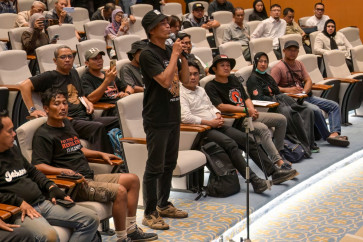
And it may prove an effective strategy. Elsewhere in the upscale shopping area, young people sipped lattes and listened to Western music. But when they reached the lobby, many stopped to join the growing crowd listening to the gamelan, or slipped around to the other side of the stage and stood transfixed, watching the silhouettes of the heroes and villains of the ancient Mahabharata epic flit across the screen.
The most harmonious blending of traditional and modern culture came during the show’s interlude, when Band Raffi, a group of young jazz-fusion musicians, stepped onto the side stage to support the troupe’s female singers.
Instead of blending with the traditional stringed rebab, the singers’ lovely high voices intertwined with the saxophone and floated over the bass guitar, charming the crowd with a cross-generational rendition of “Jakarta Indah”.
But even without such efforts at cultural fusion, Rohmad insists the ancient epics that form the basis of the wayang repertoire still have relevance for modern viewers. The tales may be populated with gods and ogres, but they are fundamentally stories about power and politics, good and evil, loyalty and treachery, love, hate and family feuds – as modern as any soap opera or political scandal.
Out of the shadows: Singers sit in the foyer at Citos, waiting to take the stage. Wayang kulit (photo left) proved something of a novelty in the modern environment of the shopping mall.
“The wayang is kind of a mirror you can use for your day-to-day life,” said Rohmad. And, indeed, sitting in a shopping mall in a city that has just gone through two highly contested elections and the deadly bombings of two luxury hotels, it was hard to watch the scenes from the Maha-bharata without finding parallels between the ancient epic and current events.
The selection for the performance, titled Bale Segala-gala, tells the story of a contested political secession in the kingdom of Astina, where the king has recently died. Prince Yudhistira, eldest of the heroic Pandawa brothers, is the popular choice for the next king.
However, their cousins and rivals, the scheming Kurawas, wish for one of their own to take the throne. To thwart the will of the people, the Kurawas conspire to build a luxurious but highly flammable villa, invite the Pandawa brothers and their mother Dewi Kunti to a banquet, and burn them to death in their sleep.
Bima, the second Pandawa brother, is warned of these plans by another branch of the family, who prepare a tunnel for their escape. As the gamelan reached full-pitch, and stylized puppets symbolizing fire engulfed the screen, the Pandawas and their mother escape to the underworld. Presumed dead, they go into hiding, setting the stage for an epic war that will eventually lay the kingdom to waste and lead to the downfall of the Kurawas.
And what can modern society learn from this?
“The Kurawas try to kill democracy,” said Rohmad, sowing the seeds for their own destruction by putting their personal motives above what is right.
“The majority of the people of Astina want the Pandawa princes to take over from their father,” he said. “We should listen to the majority of the people.”
The writer is an intern at The Jakarta Post
Bale Segala-gala was the second of five performances in the Bima Series. Future events, featuring simultaneous English translations, are planned for Aug. 14, Oct. 23 and Dec. 18. For more information, visit
thebimaseries.co.cc