The Jakarta Post
Please Update your browser
Your browser is out of date, and may not be compatible with our website. A list of the most popular web browsers can be found below.
Just click on the icons to get to the download page.


Popular Reads
Top Results
No results found. Please check your search term and try again
Can't find what you're looking for?
View all search results
Popular Reads
Top Results
No results found. Please check your search term and try again
Can't find what you're looking for?
View all search resultsDo not dwell on past glory, gov says
Bali Governor Made Mangku Pastika asked the Balinese Hindus to stop dwelling on the island's glorious past and to start devising effective strategies to cope with the fast-changing realities of the present globalized world
Change text size
Gift Premium Articles
to Anyone
Share the best of The Jakarta Post with friends, family, or colleagues. As a subscriber, you can gift 3 to 5 articles each month that anyone can read—no subscription needed!
 Set as preferred source

B
ali Governor Made Mangku Pastika asked the Balinese Hindus to stop dwelling on the island's glorious past and to start devising effective strategies to cope with the fast-changing realities of the present globalized world.
A failure to do so, Pastika warned, would prevent the Balinese from securing a better future as well as playing a significant role in the oncoming era of borderless economies.
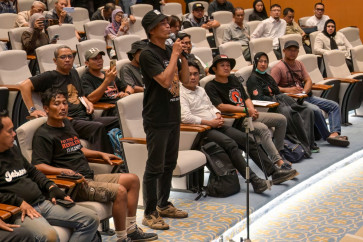
"We should not be intoxicated or take an excessive pride in the glory of our past because that time has gone," he said Saturday night in his speech on the opening of the congress of Mahagotra Pasek Sanak Sapta Rsi (MGPSSR).
Established in 1952, the Mahagotra is the oldest and arguably the largest clan-based organization in Bali.
It draws its membership exclusively from the descendants of the seven influential Hindu sages in ancient Bali.
Clan-based organizations are a common feature of modern Bali, where the island's middle classes and intellectuals redefine their Balinese identity by tracing back their ancestry to ancient Bali.
All of the existing clan-based organizations claim influential figures in the island's past - mighty kings, fearless warriors or sages with superhuman powers - as the founders of their respective clans.
These organizations, which play an influential role in contemporary Bali, provide their members with a sense of pride and, often, a feeling of superiority over other clans.
To some extent, the ancient feuds between their ancestors are reflected in the inter-clan competition in contemporary Bali.
One of the bitter feuds involved the Balinese of the low-caste families, which in modern times are grouped under the Mahagotra, and those of the royal and Brahmin families.
The former push for a more modern and egalitarian form of Hinduism while the other favors the old, highly stratified one.
"Let us build a modern society, a society of visionary thinkers who, instead of dwelling on what our ancestors had achieved in the past, are willing to tackle the challenges of the present and prepare this island and its people for greater achievements in the future."
For decades, the Mahagotra has been viewed as a progressive organization that consistently tried to reform Balinese Hinduism.
In the mid-60s it introduced the mass-cremation concept that significantly simplified the once elaborate ritual and made it possible for Balinese from low-income families to organize the ritual by sharing the cost with the other participants.
The organization took the reformation drive to the next level last year when it opened the first-ever, modern Hindu crematorium in Denpasar.
Naturally, the move drew strong protest from the more conservative elements of the religion.
Mangku Pastika belonged to this clan and his victory in the gubernatorial election was seen as the victory of the progressive elements of Balinese Hinduism.
Prior to Pastika's victory, the island was led by governors from either the royal or Brahmin families.