TheJakartaPost
Please Update your browser
Your browser is out of date, and may not be compatible with our website. A list of the most popular web browsers can be found below.
Just click on the icons to get to the download page.


Popular Reads
Top Results
No results found. Please check your search term and try again
Can't find what you're looking for?
View all search results
Popular Reads
Top Results
No results found. Please check your search term and try again
Can't find what you're looking for?
View all search resultsFloods cause widespread disruption in Jakarta
Rainfall may intensify again on Tuesday, Wednesday: BMKG
Change text size
Gift Premium Articles
to Anyone
Share the best of The Jakarta Post with friends, family, or colleagues. As a subscriber, you can gift 3 to 5 articles each month that anyone can read—no subscription needed!
H
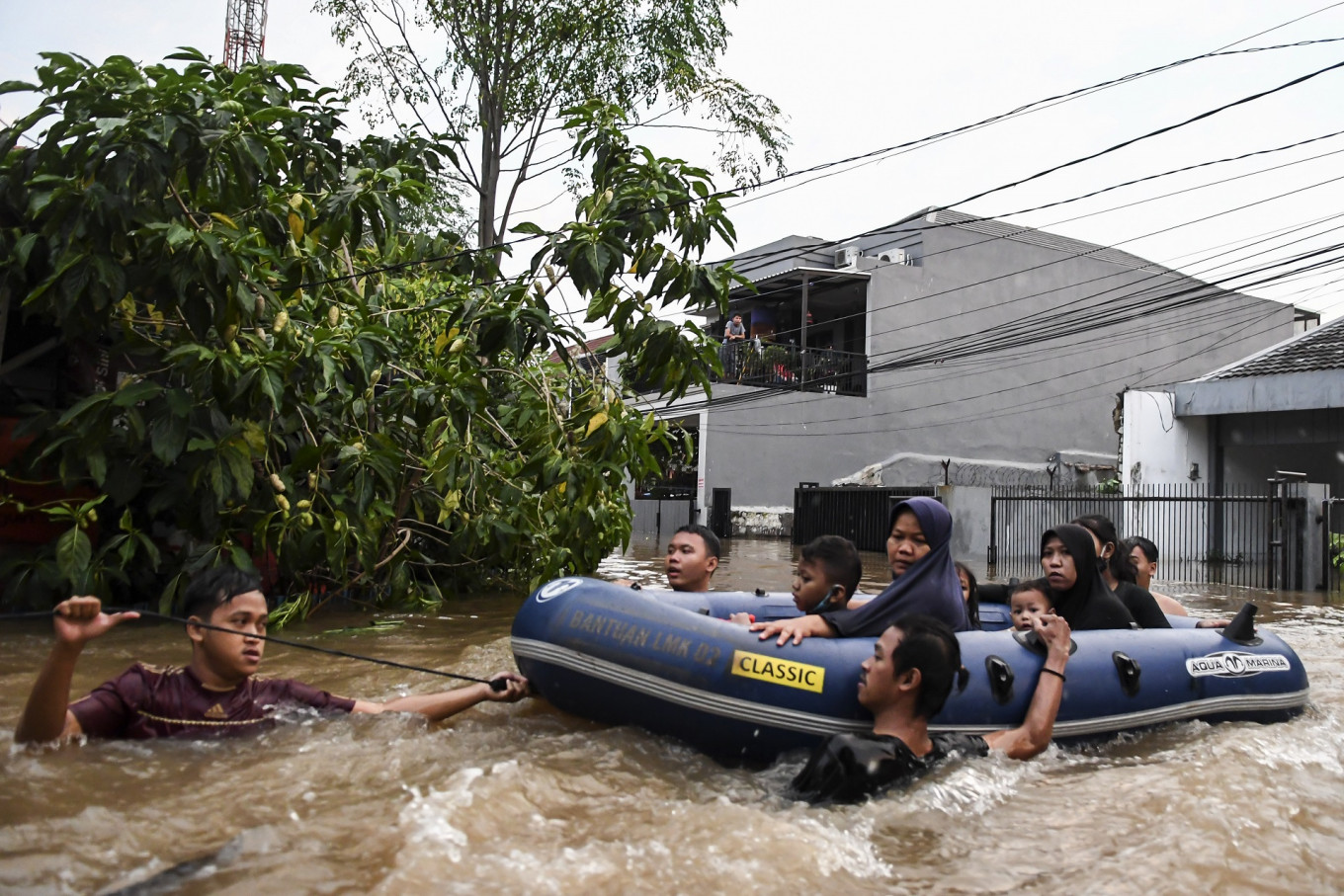
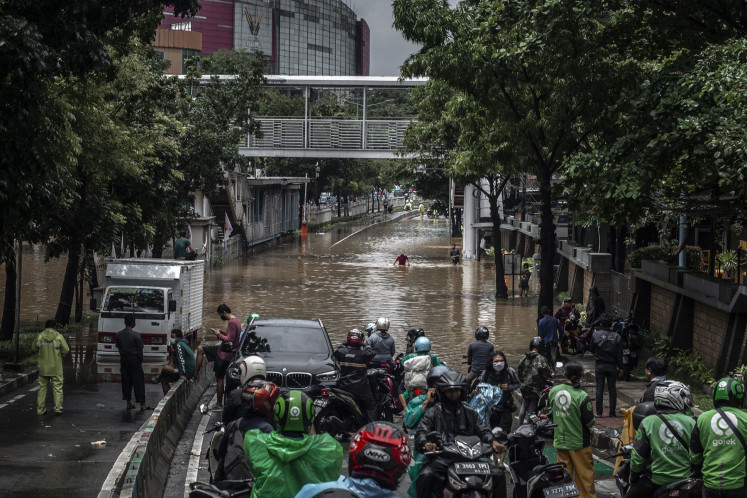
eavy rains in the capital city and surrounding areas from Friday to Saturday triggered floods that have deluged large parts of Greater Jakarta and disrupted the transportation system across the capital.
The flooding forced thousands of Jakartans to take to shelters and it is not expected to recede soon as the weather agency has forecast that the extreme weather conditions are expected to continue for the next several days.
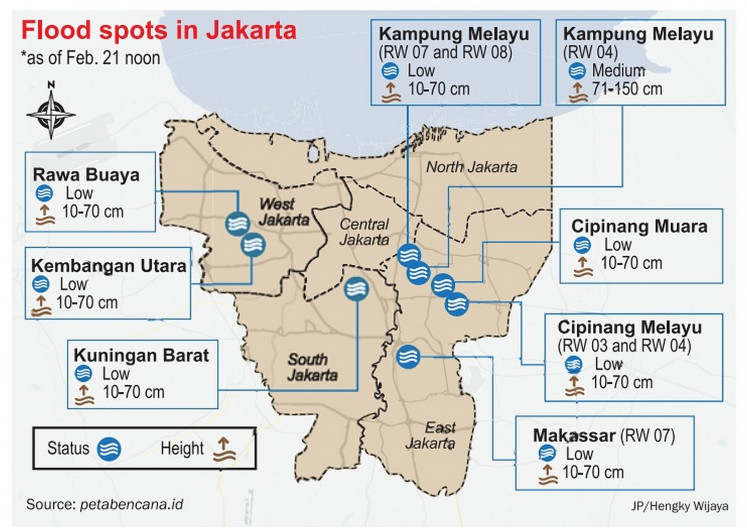
The Jakarta Disaster Mitigation Agency recorded nearly 200 neighborhood units (RT) across the capital inundated by floodwater as of Saturday morning with 1,361 people forced to take shelter away from their homes.
The flooding ranged from around 0.4 to 2.5 meters in depth, with East and South Jakarta the hardest-hit areas.
According to the provincial administration flood monitoring website pantaubanjir.jakarta.go.id, Cipinang Melayu subdistrict in Makasar district, East Jakarta, was among the worst hit areas as the floodwater reached depths of 2.5 m.
The floods came as Jakarta struggled with the highest COVID-19 caseload in Indonesia.
Rescue personnel in hazmat suits moved some COVID-19 patients out of self-isolation in inundated houses over the past two days, including a resident of Cipinang Muara, East Jakarta, on Saturday and a family of seven in Bintara, Bekasi, on the outskirts of Jakarta, on Friday, according to media reports.
BNPB spokesperson Raditya Jati said on Sunday that the agency had distributed 2,000 masks to people in shelters across Jakarta and that health authorities had screened all of the evacuees at one shelter in East Jakarta using antigen tests.
State-owned electricity firm PLN cut off electricity in several areas of Jakarta and West Java that were affected by the floods. PLN Java, Madura and Bali business director Haryanto said in a statement that the electricity firm had deployed 6,170 personnel to restore electricity in the affected areas.
The flood also disrupted the city’s transportation system as it inundated several arterial and toll roads in Greater Jakarta.
The Jakarta Police’s Traffic Management Center reported that several arterial roads were inundated by floodwater, including Jl. Kapten Tendean, Jl. Kemang Raya and Jl. Jenderal Sudirman. Kompas.com reported that several parts of Jl. Sudirman were still inundated as of Saturday evening.
Toll road operator PT Jasa Marga reported that several sections of the Jakarta-Cikampek, Jakarta-Tangerang, Jagorawi, the inner-city and outer ring road toll roads were impassable on Saturday due to the flooding. The operator applied a contraflow traffic system on the Jakarta-Cikampek toll road to alleviate traffic congestion.
Read also: Floods hit several Indonesian cities as rainy season nears peak
City-owned bus operator Transjakarta was forced to divert or suspend its operations in some areas due to inundated roads. Meanwhile, commuter train services were also disrupted as several stations were affected by the flooding.
Jakarta’s satellite cities were also flooded following heavy rains in the past several days, with Bekasi city and Bekasi regency in West Java being the hardest-hit regions.
The Bekasi Disaster Mitigation Agency said that at least 57 locations across the city were inundated by floodwater since Friday, with the water levels ranging from 0.1 to 1.2 m, as reported by tribunnews.com.
Meanwhile, Cikarang in Bekasi regency saw floodwaters reaching a depth of 2 m. Kompas TV reported that several residents climbed onto their roofs while waiting for evacuation.
Several parts of South Tangerang and Tangerang city in Banten were also inundated by floodwater throughout Saturday.
In Bekasi regency, floods hit four villages early on Sunday morning, sweeping away five houses, according to the BNPB.
Many Jakartans whose homes were hit by the flooding took shelter at the nearest safe place, while others decided to stay in their deluged homes while waiting for the waters to recede.
Prasetyo Hadi, a resident of Makasar district in East Jakarta, said he was preparing to relocate his 63-year-old mother to a relative’s home in the neighboring RT that was not affected by the flood. Meanwhile, he planned to take shelter with his parents-in-law in Jatinegara.
He added that his neighborhood was usually flooded once every five years. However, his home had been inundated twice last year and once this year.
Severe flooding deluged large parts of Jakarta and its neighboring cities on New Year’s Eve of 2020, killing over 60 people. Many regarded those floods as the worst in the capital since 2013.
Read also: Indonesia braces for more weather disasters. Climate crisis will make them worse.
Climatologists say the country saw a high number of extreme weather events last year as a result of La Niña.
In a press briefing on Saturday, the Meteorology, Climatology and Geophysics Agency (BMKG) forecast that the rainfall in the Greater Jakarta area would dissipate on Sunday and Monday but could intensify again on Tuesday and Wednesday. (ars)