TheJakartaPost
Please Update your browser
Your browser is out of date, and may not be compatible with our website. A list of the most popular web browsers can be found below.
Just click on the icons to get to the download page.


Popular Reads
Top Results
No results found. Please check your search term and try again
Can't find what you're looking for?
View all search results
Popular Reads
Top Results
No results found. Please check your search term and try again
Can't find what you're looking for?
View all search resultsRetrofitting buildings to support green recovery in ASEAN countries
Improvements in the existing stock of residential buildings will be key to reaching energy efficiency targets.
Change text size
Gift Premium Articles
to Anyone
Share the best of The Jakarta Post with friends, family, or colleagues. As a subscriber, you can gift 3 to 5 articles each month that anyone can read—no subscription needed!

C
OVID-19 has caused the building sector’s energy consumption to undergo significant shifts and volatility. The work-from-home culture has dealt a severe blow to demand for commercial real estate. The lack of occupancy translates to reduced energy use in buildings. This dampens the need for energy efficiency improvement in commercial buildings, which were previously the target of many energy efficiency initiatives.
As the world deals with the pandemic and with a more remarkable shift toward working from home, it is anticipated that residential buildings will be the epicenters of energy improvements. Improvements in the existing stock of residential buildings will be key to reaching energy efficiency targets. Issues arise, however, when considering the potential retrofit solutions for the current residential building stock.
Residential buildings typically utilize air-cooled split units, hence improvements in standards and labels are the only measures that can be implemented for residential space cooling. Aside from the use of LED lighting, building envelope improvements are the only energy-saving measure that can also be carried out, but this is typically very expensive despite studies that show that building envelopment improvements in residential units in Indonesia can potentially save 69 percent of energy use in a building’s 40-year lifespan.
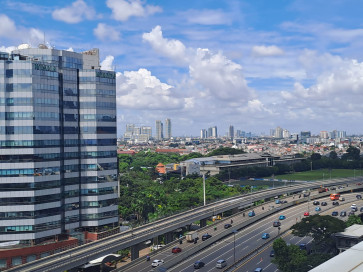
The pandemic continues to influence the building sector in the region. The occupancy rate of office spaces and hotels in the ASEAN region has suffered because of the movement toward working from home and strict travel restrictions. The occupancy rate has dropped in some ASEAN countries. Office occupancy in the central business districts of Jakarta has sunk to a five-year low in the second quarter of 2021, dipping below 80 percent for the first time, and it is projected to continue decreasing.
With building owners facing occupancy challenges due to the pandemic, energy efficiency measures have dropped down on their priority list. The legal perspective is that a low occupancy rate means low energy consumption.
However, in many cases, energy consumption in commercial buildings has remained the same when it could have gone down. Centralized chilled water systems have a minimum load, and hence, while occupancy decreases, total building load may not drop in tandem. This shows that even though office and hotel occupancy rates have been low, energy efficiency measures in the buildings sector are still necessary.
The benefits of energy efficiency have been acknowledged, with governments trying to recover from the pandemic sustainably or "greenly". Energy efficiency offers many benefits, including social, environmental and economic (macro and micro-economic) dimensions.
Among the many energy efficiency efforts in the building sector, retrofitting existing buildings is a method that can be chosen to support a green recovery from the pandemic. Retrofitting buildings offers several benefits, namely in job creation, emissions reduction and cost saving.
Energy efficiency provides society with employment opportunities because of its rapid job creation. The International Energy Agency (IEA) estimated in 2020 that up to 2.5 million new jobs could be created per year related to recovery efforts. They also stated that the most significant number of new jobs would be retrofitting existing buildings to improve their energy efficiency. Such projects are usually labor-intensive and are easy to scale up with relatively low skill demand from workers.
With many professionals searching for employment due to layoffs related to the ongoing pandemic, retrofitting existing buildings projects can become a mature solution to absorb unemployed workers.
Significant emission reductions can also be delivered with energy efficiency measures in the building sector, including retrofitting existing buildings. Data shows that structure accounts for almost 40 percent of global emissions. Space heating and cooling account for up to 40 percent of energy consumption in buildings, which results in 42 percent of the carbon dioxide emissions in the sector (IEA, 2020).
Furthermore, the sixth ASEAN Energy Outlook (AEO6) projected that the Total Final Energy Consumption (TFEC) from the commercial sector in ASEAN would increase from 29.5 million tons of oil equivalent (Mtoe) in 2017 to 87.4 Mtoe in 2040.
Implementing energy-efficient appliances, improving building envelopes and transitioning to digital energy management technologies are some ways to reduce energy demand and emissions. These retrofit solutions can be done during the pandemic, when occupancy rates are low, and will benefit building owners in the future.
Regarding reducing emissions, around one third of the decline in greenhouse gas emissions would also contribute to cost savings for consumers and industries (IEA, 2020). Low-income groups hardest hit by the pandemic’s effects will experience a reduction in their utility bills (IRENA, 2020). With quick payback times, energy efficiency retrofitting in buildings would be an attractive option for building owners to consider.
Appropriate public policy and financial support are also important. For example, a Thai revolving fund offers a building retrofitting subsidy program for nine eligible buildings and can be seen as a relevant approach to subsidizing costs to enable such investments.
Retrofitting existing buildings to improve energy efficiency has many advantages, which could be considered in any pandemic recovery plan. As a result, some nations have proposed, agreed to or implemented energy efficiency measures in the building sector as a stimulus package.
Germany has proposed extra funding for a carbon dioxide-focused building renovation program with 1 billion euros (US$1.13 billion) in 2020 and 2021. The European Commission proposed to at least double the annual renovation rate of the existing building stock through regulatory and financial support.
Across ASEAN, trends show that energy efficiency measures in the building sector still lack inclusion in recovery plans from the pandemic. As of January 2021, most of Indonesia's $6.8 billion stimulus for the energy sector had gone toward fossil fuels. In Thailand and the Philippines, economy-wide stimulus plans have not included concrete green initiatives.
Given the benefits of energy efficiency measures such as retrofitting buildings, this can be seen as a missed opportunity for the ASEAN member states. Energy efficiency should be an essential part of any green recovery strategy.
It is suggested that ASEAN countries incorporate such measures in recovery packages to help the region recover more quickly from the pandemic and establish a more sustainable future for the region.
***
Kianda Dhipatya Syahindra and Rio Jon Piter Silitonga are researchers at the ASEAN Center for Energy. The views expressed are their own.