Can't find what you're looking for?
View all search resultsCan't find what you're looking for?

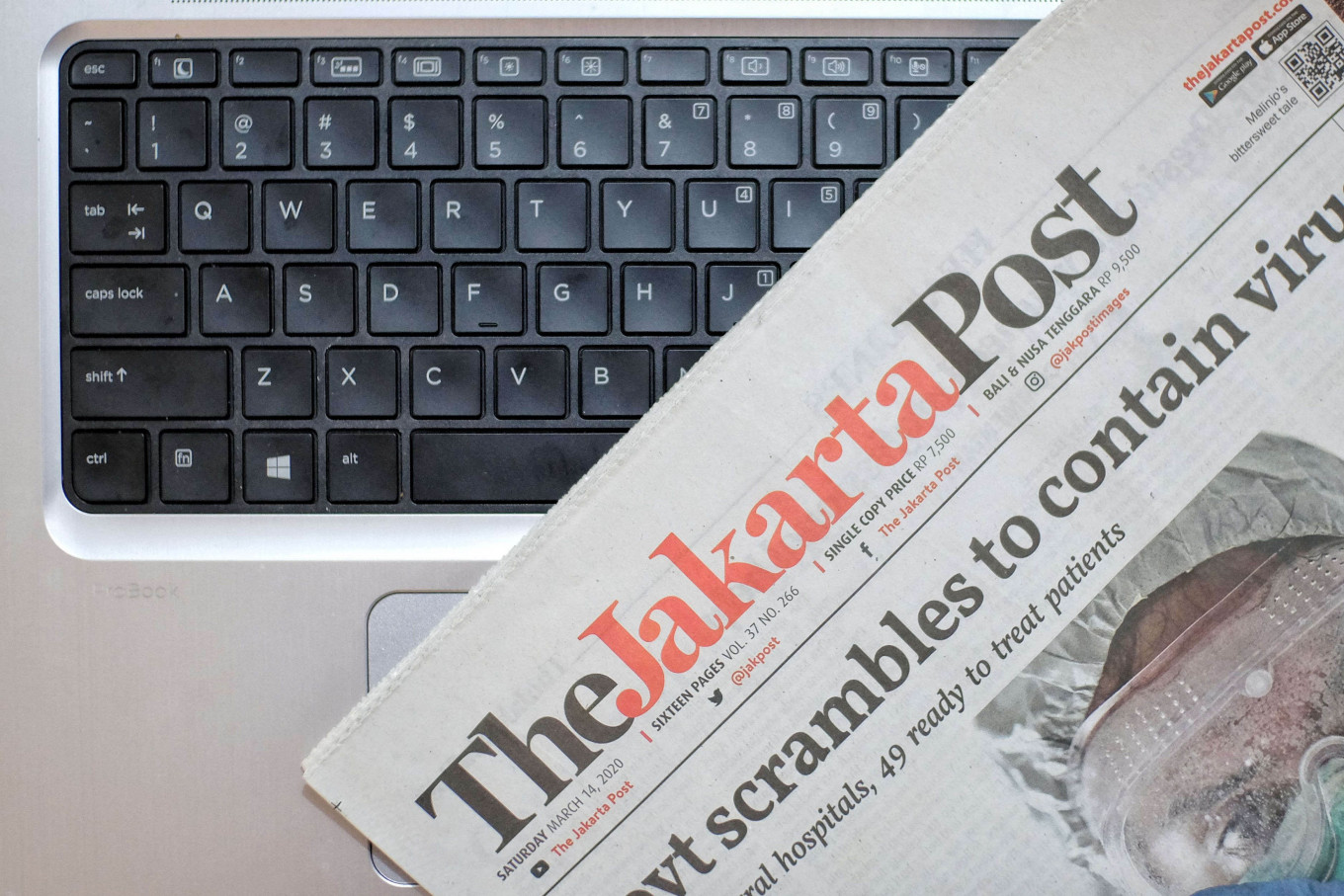
View all search resultshe Jakarta Post may have owed its birth to several key figures who worked under the New Order, a political regime that tightly controlled the flow of information and put in place curbs on freedom of speech, but over the course of almost 40 years, through the social and political upheaval that resulted in a regime change, five cycles of general elections and four new presidents, this newspaper has stuck to being bold and independent, sometimes at the risk of losing its voice altogether.
The journey begun when the Post’s founder, Jusuf Wanandi, held a meeting with then information minister Ali Moertopo – a close ally of New Order strongman Soeharto – and shared his proposal to set up a good quality English-language daily, one that was designed to be the world’s window into Indonesia.
For Jusuf, existing English-language dailies at that time just could not cut it. “Existing English-language dailies at the time did not manage to accurately capture the opinions of Indonesians,” he said. “Our main priority was to make the Post a credible paper.”
It was not an easy start and after a turbulent first five years, things started to look good for the paper and it was during this time that the Post began to play an "activist" role, writing about what the Indonesian people expected from the New Order government, as well as promoting Indonesia's place in the world.
It helped that the paper in the pre-internet era wrote in English, a language that was not too familiar to the majority of government workers and the censorship apparatus.
“We realized that since we were an English paper, we could be just that bit more expressive in voicing criticisms [toward the government]. There was a lot of hope on us, but it was a balancing act; we couldn’t take [the criticism] too far, or risk being shut down,” Jusuf said in a recent interview.
Bold under pressure
By the early 1990s, as Indonesia pushed itself to become a rising economic power in Asia, the New Order regime also stepped up its oppressive policies resulting in mounting cases of human rights violations, and it was during this period, the Post began taking a more confrontational stance toward the government.
In April 1993, the Post celebrated its 10th anniversary by sponsoring a survey initiated by rights groups and academics to look into the rights situation in the country. As a follow-up event, the newsroom held a round table discussion on human rights.
“By then, we established that The Jakarta Post would be going strong on human rights, and that included everything, from freedom of speech and labor rights, to the right to self-determination,” Endy M. Bayuni, the Post’s senior editor and former editor-in-chief, said recently.
And as the New Order regime upped its surveillance of the media, Endy recalled that publishing a newspaper was a risky affair, with journalists often having to weigh their options carefully, publishing a story allowed by the censor or going over the line and risk being shut down.
Even in the face of the prospect of closure, editors within the Post opted to challenge the regime's rules on censorship.
In an editorial published on June 23, 1994, days after the Information Ministry's decision to revoke the license for Tempo weekly for publishing a piece critical of the government, the Post editors criticized the lack of clear-cut guidelines and the regime’s firm grip on press freedom.
The editorial ended with a line that certainly sounds prophetic today. “Democracy will soon be recognized for what it is: an unstoppable phenomenon, beneficial to all.”
On the issue of human rights abuses, the Post editors made a consistent effort to bring to light rights violations, especially cases that became the subject of international scrutiny like the mysterious death of labor activist Marsinah, who was found dead only days after she organized a labor strike in East Java in 1993.
After a year of farcical trials and amid mounting pressure from international NGOs, the newly formed National Commission on Human Rights (Komnas HAM) made a commitment to fully investigate the murder.
In its March 7, 1994 editorial, the Post fully endorsed Komnas HAM’s stance, saying that the country’s “justice and judicial system are now in question and this is a matter we have to respond to seriously and courageously.”
New era of independence
As Indonesia entered the turbulent year of 1998, with a financial crisis and the attendant political crisis looming over the country, the Post took an even more activist stance with the newsroom making a conscious effort to stand with the students who were calling for the removal of Soeharto, while maintaining high journalistic standards.
In his book chronicling the journey of the Post, Reporting Indonesia, writer Bill Tarrant recounted that two of the newspaper's reporters stood guard in a morgue near Trisakti University making sure that they could get the most accurate information.
While all other media outlets published information that six students had been shot dead in a protest near the Trisakti campus, the Post’s two reporters insisted that the number of fatalities was four, which turned out to be the correct figure.
The biggest gamble the Post ever took was when its reporters got the scoop on the possible resignation of Soeharto on May 21, 1998. Editors had to stop the press on the night of May 21 to allow for the publication of what Tarrant described as “the biggest scoop in Indonesian press history.”
And with so much uncertainty regarding the future of the New Order regime, publishing an erroneous headline would certainly carry a political risk, not to mention the toll it would take on the newspaper's reputation.
“We struggled for hours [in coming up with the right headline]. We settled on ‘I Quit’ and we pushed for it to be as big as the page allowed,” Endy said.
When Soeharto finally announced on May 21 that he was stepping down, Endy said that everyone in the newsroom was certainly vindicated and with no other newspaper in the country publishing the same story, they could claim credit for publishing the biggest story in the country’s history.
The Post printed the “I Quit” story in bold 80-point characters for the May 22 edition, and when it came time to write a retrospective edition for the year, the newspaper honored protesting students by naming them the “men and women of the year.”
Protecting democracy
With the country's autocratic regime coming to an end, the next task for the media, including the Post, was to protect the fledgling democracy of the Reform era.
“The media’s role [at the start of the Reform era] was not only to provide information, but to influence policies, since [the media] has the ability to decide what is important on a given day,” senior political analyst Dewi Fortuna Anwar said. “This was especially true for The Jakarta Post, since the paper was being read by policy makers and the international community.”
Top of the agenda during the early Reform period was putting an end to the military’s role in politics and the Post put itself at the forefront of the campaign to call for the return of the Indonesian Military (TNI) to barracks.
The Post wrote in a November 1998 editorial titled “Facing a dilemma” that “like in the rest of the civilized world, Indonesians have long seen the military's socio-political role as an obstacle to democracy, but have lacked the courage to say so in public in any telling numbers.”
Dewi said the Post played a crucial role in disseminating ideas about these democratic ideals during the Reform era. "Academic circles had discussed these ideas in the beginning. But if the media did not cover those discussions, the wider public would not be informed of that," she said.
The Post also focused much of its early Reform era reporting on uncovering past human rights abuses as well as calling on the new democratically minded government to avoid committing fresh rights abuses.
Yet, the country appeared to have problems exorcising this ghost from its abusive past, especially after the murder of prominent rights campaigner Munir Said Thalib, who was poisoned with a lethal dose of arsenic during a flight from Jakarta to Amsterdam on Sept. 6, 2004.
In an editorial published on Sept. 7, 2006, the Post wrote that the murder of Munir was emblematic of a country transitioning from a troubled past. "This is a premeditated murder perpetrated by criminals who want to keep the nation ignorant of their past brutalities,” it said.
Share your experiences, suggestions, and any issues you've encountered on The Jakarta Post. We're here to listen.
Thank you for sharing your thoughts. We appreciate your feedback.
Quickly share this news with your network—keep everyone informed with just a single click!
Share the best of The Jakarta Post with friends, family, or colleagues. As a subscriber, you can gift 3 to 5 articles each month that anyone can read—no subscription needed!
Get the best experience—faster access, exclusive features, and a seamless way to stay updated.