TheJakartaPost
Please Update your browser
Your browser is out of date, and may not be compatible with our website. A list of the most popular web browsers can be found below.
Just click on the icons to get to the download page.


Popular Reads
Top Results
No results found. Please check your search term and try again
Can't find what you're looking for?
View all search results
Popular Reads
Top Results
No results found. Please check your search term and try again
Can't find what you're looking for?
View all search resultsThe (not so) impossible task of archiving Indonesia's mega biodiversity
Revealing and recording all of Indonesia’s mega biodiversity thoroughly is of course a very complicated task.
Change text size
Gift Premium Articles
to Anyone
Share the best of The Jakarta Post with friends, family, or colleagues. As a subscriber, you can gift 3 to 5 articles each month that anyone can read—no subscription needed!
L
et us contemplate how many species are out here in Indonesia, a country with both low and high terrains scattered over thousands of islands, with rich rivers and vast oceans. Among the thousands, probably millions of species living and originating in Indonesia’s territory, I believe we have studied less than half of them.
Revealing and recording all of Indonesia’s mega biodiversity thoroughly is of course a very complicated task that requires a lot of dedication and coordination between the government, researchers and communities in general. But is it an impossible task? Not really.
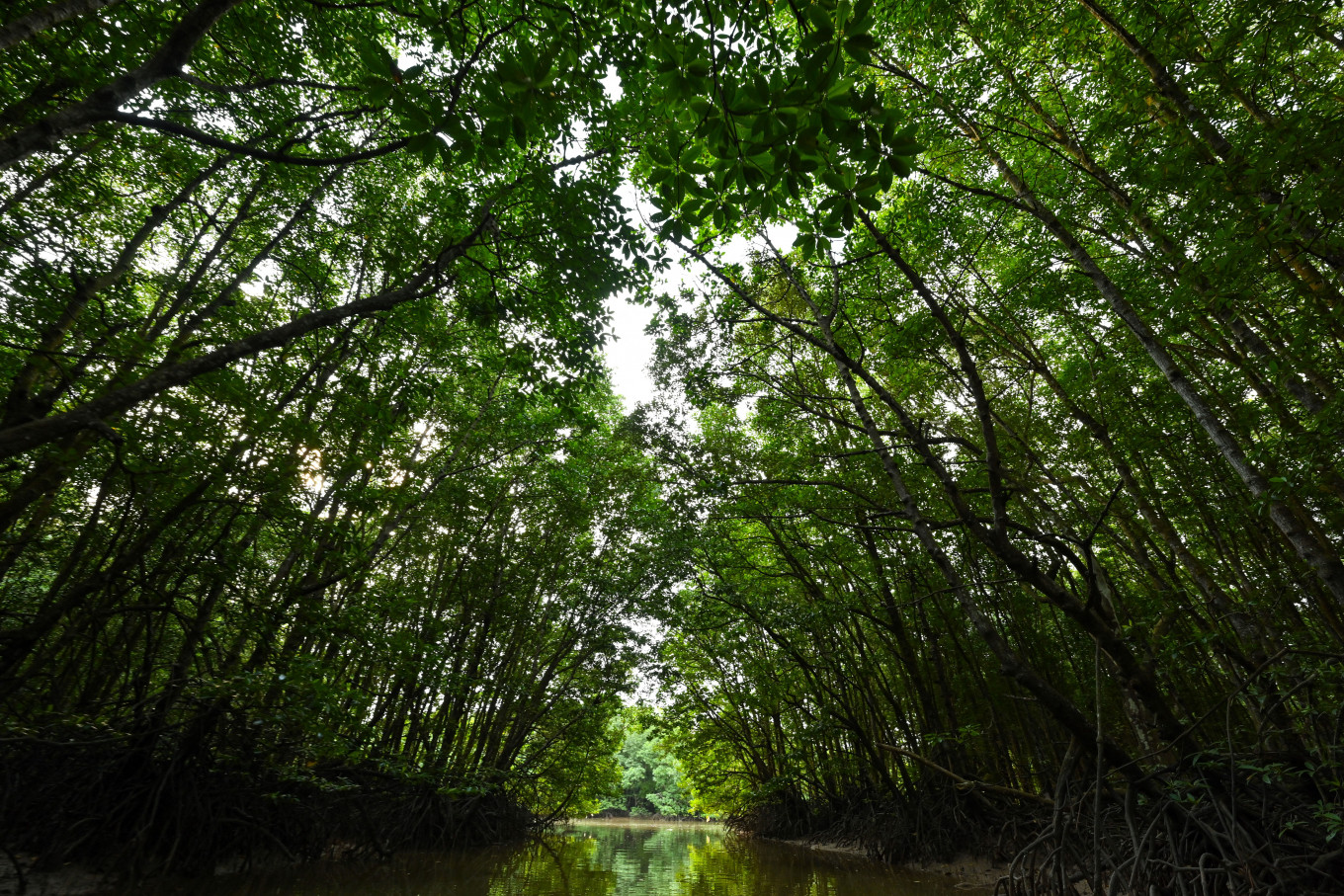
Indonesia is blessed with a vast territory that stretches 282,583 square kilometers and is under constant tropical rain and sun as it lies on the equator. With that kind of climate, it is very easy for many kinds of species to thrive. Any patch of land in Indonesia, both in urban or rural areas, is buzzing with life.
Despite being a home to rich biodiversity, Indonesia is not exemplary when it comes to recording and studying its own natural resources. In fact, we are far behind countries with smaller territories such as the United Kingdom and Singapore, which have their own biodiversity index projects as a continuous, state-funded projects. They also have creative, engaging displays of biodiversity information that are accessible to the masses: the UK has the highly popular London Natural History Museum, while Singapore has botanical gardens that are considered an integral part of its citizens’ life.
The UK and Singapore have two things in common that are imperative to their success in studying their biodiversity: their governments, which fully support and prioritize the preservation of their natural riches, and their people, who have a strong sense of belonging when it comes to their biodiversity.
These countries see their natural resources, although limited compared with Indonesia, as a part of their riches and should be enjoyed together. These countries put the study of their own biodiversity on top of the list, with great research management and healthy financial management.
Yet Indonesia is not starting from zero when it comes to the study of its biodiversity. Since 2019, the Indonesian Biology Consortium (KOBI) in collaboration with Indonesia’s Conservation Communication Forum (FKKI) has started efforts to make an efficient and working network among biologists across the country to archive species local to their areas.
There are 347 Biology study programs, including Biology Education, Biotechnology, Microbiology and applied Biology in Indonesia, from Sabang to Merauke, each is home to researchers, lecturers and students who are ready to be deployed with the task of archiving Indonesia’s biodiversity in their own respective provinces.
KOBI’s long-term goal now is to create the Indonesia Biodiversity Index (IBI), a comprehensive big-data archive of Indonesia’s living organisms. The IBI can be used to support the government, private companies, universities and research institutions, as well as NGOs in their works that might affect the status of local biodiversity.
Without comprehensive indicators, Indonesia’s national and regional development projects cannot gauge their effect the environment, meaning we are blind to the exact amount of our own natural wealth.
For example, we cannot say exactly how many species have been affected by the massive development of urban areas that substitute many lush, green patches for concrete, such as Jakarta. To avoid repeating this loss when building the new capital city in Kalimantan, Indonesia must have this index first before continuing the project. Without a comprehensive archive, we cannot measure how much we have had and how much of those riches we have lost.
When it comes to environmental issues, the problems at hand cannot be solved with lip service to green energy and the handling of global warming. In fact, preserving biodiversity is imperative to keep the earth healthy and thriving, and to put the planet back in a system that will combat climate change.
The government must recognize the urgency of Indonesia’s own biodiversity index and give us the proper support to make sure the IBI project runs effectively and will not end only as a ceremonial, half-baked project. The government must support us by providing properly enforced conservation-based policy, as well as financial and infrastructure support.
So far, we have Law No. 5/1990 on biodiversity and ecosystem conservation, Law No. 5/1994 on the United Nations convention on biodiversity. However, the laws are outdated by almost three decades, and we need an upgrade that is more in line with today’s situation, as well as better enforcement of the law.
KOBI proposed a biodiversity conservation bill to the House of Representatives Commission IV, which oversees agriculture, forestry, fisheries and food production, on June 30, 2021, as a means to update the old laws. However, we have not heard anything from the commission, suggesting that the problem of biodiversity is not considered an urgent matter by the House.
Besides updated and well-enforced policy, we also need a budget of at least Rp 15 billion (around US$990,000) to run education programs, field exploration and big-data mining. We are now running on a budget of only Rp 150 million as of 2022, which is a stark gap from the ideal budget.
Ideally, we also should have a Biodiversity Curator Profession study program in Indonesian universities to make biodiversity curator a recognized profession in Indonesia. For that, we can sample the Biocuration postgraduate program offered at the UK’s Cambridge University as a model to build the study program. Having a troop of locally educated biocurators means we can study other Indonesian species other than the iconic ones such as komodo dragons, Sumatran tigers and moon orchids.
Creating a biodiversity index should be a work in progress that runs forever. Singapore’s City Biodiversity Index is updated every year and is presented to the public as an open report. Japan concluded its biodiversity index in the 1960s but keeps conducting research to make sure the biodiversity status is up to date. The World Wildlife Foundation’s (WWF) Living Planet Report (LPR) is also reported yearly to the public. And this index will help implement Presidential Instruction No. 1/2023 on mainstreaming biodiversity conservation in sustainable development, which includes creating a biodiversity profile in each district.
It is important to keep the public aware of this project and keep them involved in its running. I imagine that we can make a productive collaboration with documentary filmmakers, writers, photographers and other creative workers to present the report annually to the public. It is also important to fund museums and install the best museum curators to make them more approachable to the masses as a means of fun and educative recreation.
---
The writer is head of the Indonesian Biology Consortium (KOBI). The views in this article are his own.