TheJakartaPost
Please Update your browser
Your browser is out of date, and may not be compatible with our website. A list of the most popular web browsers can be found below.
Just click on the icons to get to the download page.


Popular Reads
Top Results
No results found. Please check your search term and try again
Can't find what you're looking for?
View all search results
Popular Reads
Top Results
No results found. Please check your search term and try again
Can't find what you're looking for?
View all search resultsWhen the commodity boom went bust
This year was encouraging, although ultimately disappointing, for the country's commodity-heavy economy
Change text size
Gift Premium Articles
to Anyone
Share the best of The Jakarta Post with friends, family, or colleagues. As a subscriber, you can gift 3 to 5 articles each month that anyone can read—no subscription needed!

This year was encouraging, although ultimately disappointing, for the country's commodity-heavy economy.
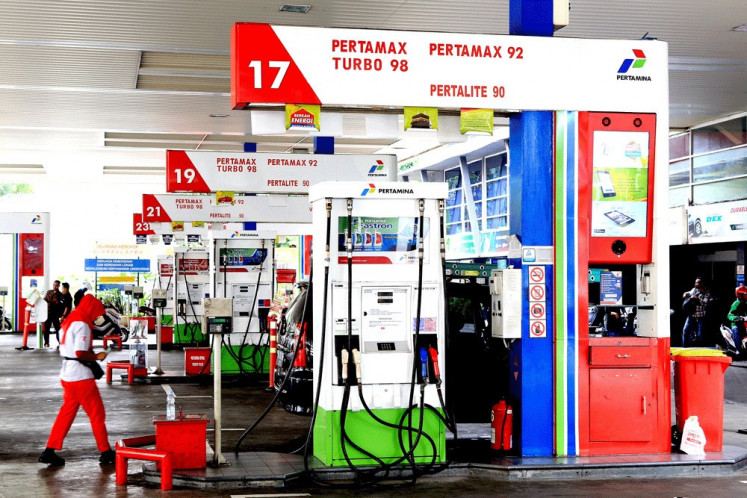
Following the continually rising trend in the global price of crude oil over the past two years, commodity prices soared too, setting some records during the boom this year.
Soaring commodity prices generated lucrative profits for Indonesia and boosted the economy of many regions across the archipelago.
But commodity prices have crumbled since the full force of the financial crisis hit in October, starting with the United States and triggering a global economic turndown with other countries soon following suit.
The global crude oil price fell on the back of fears the crisis would undermine oil consumption in industry-driven countries such as the United States, China, Japan and the European Union, hurting their economies.
Crude oil prices have dropped by about 71 percent to US$43 per barrel as traded in New York, since hitting a record high of $147 per barrel on July 11, Bloomberg reported.
It was inevitable that colossal drops in prices of other commodities would follow, including crude palm oil (CPO), rubber, coffee and cacao.
CPO, Indonesia's top commodity, has slumped 70 percent from its peak of 4,486 ringgit ($1,234) per metric ton in March.
CPO was trading at 1,494 ringgit ($410) per metric ton on Dec. 4 on the Malaysian Derivatives Exchange and at $480 a ton on Dec. 3 in Rotterdam, Amsterdam, the two industry benchmarks.
The CPO price in Rotterdam touched the year's low of $435 a ton on Oct. 27, less than half this year's average of $960, Bloomberg reported.
Indonesia, which produced an estimated 18.5 million tons of palm oil this year from more than 6 million hectares of plantations, is the world's largest producer of CPO.
Malaysia and Indonesia combined produce around 85 percent of the world's CPO and account for 88 percent of global CPO exports. Indonesia recorded exports worth $5.5 billion in 2007, with more than 75 percent of its palm oil output being exported as CPO. Malaysia posted a higher export value of $10.4 billion, with 80 percent of its output exported as value-added products.
The value of CPO exports increased to $13.45 billion in the first 10 months of this year from about $7.82 billion in the same period last year, according to the Central Statistics Agency (BPS).
But CPO exports in October, which amounted to $1.26 billion, already showed a drop from the $1.34 billion recorded in September -- an initial result of the global economic turndown affecting demand worldwide.
Shrinking demand in the automotive industry also caused sharp drops in rubber prices and exports.
The automotive industry worldwide is cutting production after being dealt a hefty blow by the global economic turndown.
Large quantities of natural rubber are used in the tire industry to support the automotive industry.
The price of natural rubber peaked at $3.30 per kilogram on June 27 before slumping to its lowest point at $1.53 per kilogram on Sept. 16.
The country shipped $6.8 billion worth of rubber and rubber products in the first 10 months of this year, a 34 percent increase from the $5.07 billion worth of exports booked in the same period last year, according to the BPS.
But, as with CPO, the October exports of rubber and rubber products had already experienced a 22.4 percent drop to $597.3 million from $769.8 million in September.
In response, Indonesia and other producing countries made policies to help bolster rubber and CPO prices.
Indonesia and Malaysia agreed last month to cut palm oil output by 75,000 tons this year and around 500,000 to 600,000 tons next year by replanting 50,000 hectares of oil palm trees in Indonesia and 250,000 hectares in Malaysia next year.
That policy is expected to help palm oil prices rebound to a commercially viable level of around $700 to $800 per metric ton.
For rubber, Indonesia, Malaysia and Thailand, which together meet 70 percent of the world's natural rubber demand, jointly agreed to cut rubber production by 210,000 tons next year, also by replanting trees.
With rubber production amounting to 2.7 million tons last year, Indonesia is the world's second-biggest producer of rubber after Thailand.
For coffee and cacao, the story is much the same.
Robusta coffee fell to its lowest price point of $1.50 per kilogram after peaking at $2.50 per kilogram around four months ago, according to Indonesian Coffee Exporters Association (AEKI) chairman Hassan Wijaya.
Indonesia is the fourth-largest producer of coffee after Vietnam, Colombia and Brazil, producing around 450,000 tons per year, of which 250,000 tons are exported.
Cacao also dipped to around $1,930 per ton from a record high of $3,200 per ton around August, according to Indonesian Cacao Association (Askindo) secretary-general Zulhefi Sikumbang.
Indonesia is the world's third-largest cacao producer with an estimated production of 500,000 tons. Ivory Coast and Ghana are the first and second largest.
As the crisis hurts the prices of these commodities, it also hurts the farmers.
Coffee farmers in Lampung have begun cutting down their own trees because traders are rejecting their coffee beans due to weakening demand.
A seasonal oil palm farmer in Jambi reported that his income had dropped by factor of 10, for similar reasons.
But apparently the government has turned its hand to helping rubber and CPO only, implementing policies for those two commodities because of the magnitude of the ramifications, "while other commodities are relatively fine", said the Agriculture Ministry's director general for plantations, Achmad Mangga Barani.