TheJakartaPost
Please Update your browser
Your browser is out of date, and may not be compatible with our website. A list of the most popular web browsers can be found below.
Just click on the icons to get to the download page.


Popular Reads
Top Results
No results found. Please check your search term and try again
Can't find what you're looking for?
View all search results
Popular Reads
Top Results
No results found. Please check your search term and try again
Can't find what you're looking for?
View all search resultsCreating the green superblock
What is the major dream of most residents of a metropolitan city? The answer is, of course, to have a home close to their office, children's school and shopping center
Change text size
Gift Premium Articles
to Anyone
Share the best of The Jakarta Post with friends, family, or colleagues. As a subscriber, you can gift 3 to 5 articles each month that anyone can read—no subscription needed!

W
hat is the major dream of most residents of a metropolitan city? The answer is, of course, to have a home close to their office, children's school and shopping center.
So, back to the heart of the city seems to be the most realistic and logical solution.
As land is limited in the cities nowadays, its price is very high and the environment has to a certain extent been degraded, green superblocks are the current breakthrough or solution.
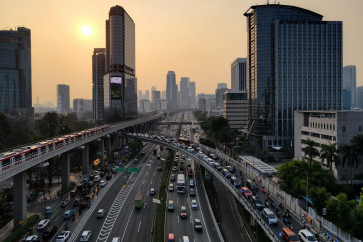
Living in a superblock in a city center obviously saves much time, cost and energy caused by traffic jams. Superblocks also save lots of land as they are integrated buildings with easy access.
A superblock also reduces infrastructure to a certain extent as it has flexible planning and much green space and water absorption areas.
The superblock concept also reduces traffic congestion as it is a combination of various functions: residence, offices, education centers, shopping center, hospital, places of worship, green space and entertainment all in one location.
There could be a cross subsidy using the 1:3:6 ratio composition, that is one hotel, three apartment towers and six low-cost multi-story residences, locally called rumah susun.
Superblocks also provide easy access for the residents as each block is connected so that one only has to walk or ride a bicycle for short distances. For going outside the superblock compound, integrated mass transportation should also be also available.
The pedestrian area is separated from that used by cars or motorcycles and residents feel comfortable walking in the shade of lush, green trees through the scenic parks that have ponds.
As the superblocks are integrated buildings, function-wise the residents do not have to go far or leave the area for various purposes, such as to go to work, school, the mall or to the cinema.
This means that there is not much traffic within the superblock compound, creating less pollution as many residents prefer to go by foot or bicycle.
Superblocks should ideally have a rapid transit system, such as buses and trains, close to the location.
The areas near the bus stops and the train stations could be developed into residents' and public activity centers or transit-oriented developments.
The physical development of cities should be focused around such activity centers based on the transit-oriented development pattern. This way the use of private cars and motorbikes can be limited to reduce congestion and pollution.
The towers of a superblock save much land so that lots of green space can be developed.
Both the developer and residents can be involved in the processing of organic and non-organic waste (reuse, reduce, recycle).
Non-organic waste can be made into handicrafts and sold as souvenirs at the malls, while the organic waste can be used as fertilizer. Thus the superblocks would be free from garbage (zero waste).
The residents should conserve water (reduce), and use it for other various purposes (reuse), recycle used clean water (recycle) and recharge with water from absorption wells and biopores.
Waste water from the residences (grey water) and rainwater would be recycled and used for toilets and for watering the parks and trees. This way there would be zero run off.
The architecture style should be based on local design and be environment friendly. The structure should be modular with the total of floors not exceeding 10 or 15.
There should be sufficient air circulation as well as natural light. The material used should be of high quality while the buildings should be energy and water savers and there should be roof gardens.
The city administration should issue regulations along with the related urban design guidelines to be applied by developers to make their superblocks green.
The development of green superblocks in the heart of highly populated cities will become a popular trend in the next 10 to 20 years. A well planned and integrated green superblock will certainly enhance the quality of residents' lives.
The writer is a specialist in architectural issues.