TheJakartaPost
Please Update your browser
Your browser is out of date, and may not be compatible with our website. A list of the most popular web browsers can be found below.
Just click on the icons to get to the download page.


Popular Reads
Top Results
No results found. Please check your search term and try again
Can't find what you're looking for?
View all search results
Popular Reads
Top Results
No results found. Please check your search term and try again
Can't find what you're looking for?
View all search resultsOur coal: its development and controversial issues
Indonesia’s production of coal has been growing amazingly
Change text size
Gift Premium Articles
to Anyone
Share the best of The Jakarta Post with friends, family, or colleagues. As a subscriber, you can gift 3 to 5 articles each month that anyone can read—no subscription needed!

I
ndonesia’s production of coal has been growing amazingly. In the mid 1980s, national coal production was less than 1 million tons per annum, whereas energy planners (in the fourth Five Year Development Plan: 1989-1994) pointed at 10 million tons as the national production target.
The current production has jumped dramatically, recorded as 237 million tons in 2008 (predicted to achieve 270 million tons this year), making Indonesia a world class producer and the largest exporter of coal around the globe. The skyrocketing growth of our coal production has also incited many controversial issues.
Coal is considered as the dirtiest among fossil fuels, making environmentalists oppose their wide use
as fuel.
However, the proposal for ceasing use of coal — power generation, for instance — would be challenged by power utilities demanding low cost fuel that coal may offer and by the government, which has the responsibility to provide electricity as well as have revenue from exploiting its energy resources.
Despite the world’s rising anxiety of global warming, IEA (International Energy Agency: World Energy Outlook 2009) statistics shows that the world consumption for coal, for the last decade, is still growing the fastest among primary energy sources.
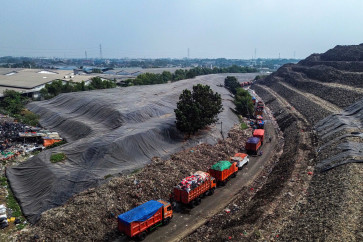
The environmental problem associated with coal in Indonesia is not limited to green houses gases (GHG), but also damage and pollution since its exploitation, transportation and uses to post mining.
It is easy to find where many coal fields are not mined appropriately according to “good mining and environmental practices”, coal transportation is not considering safety standards and is damaging rivers, (public) roads and seashores.
The coal mining has polluted the land, water and air of especially Kalimantan, where more than 90 percent of Indonesia’s coal mining operations take place.
It is sad that many of the previous mining areas have been abandoned without being properly reclaimed, whereas thousands of hectares of the island’s tropical forests have been converted into desert.
The soaring exploitation, including its negative impact on the environment, has a strong correlation with the number of licensing/permits awarded.
The introduction of the 1999 Regional Autonomy Law, subsequently followed by the 1999 Fiscal Balancing Law between the Central and Regional Governments have — to some degree — impacted on the coal licensing regime, where larger authorities had been given to regional/local governments.
Under the new licensing regime by local governments, requirements for coal permits tend to be relaxed whereas monitoring has not been done properly.
As a result, the number of permits (Mining Authorization/KP) has been growing considerably (currently 462, of which 169 are producing), coal production increases, but also environmental problems and the issues of illegal mining exist.
The question of who really owns the KP licenses exists, which was defined as that it can be owned by Indonesian national/companies only.
While the largest part of coal in Indonesia are being produced by large companies (the holders of Coal Contract of Work/PKP2B), some coal is mined by small scale and illegal miners.
It is believed that a significant amount of coal has been produced by illegal miners (some 5 million tons annually) and part has gone to meet export demand.
Wherever in the world, illegal miners lack interest in responsible mining and mine rehabilitation practices. Illegal mining is a problem for potential investors, the environment and government revenues.
The government has introduced measures to crack down on problems, including arresting illegal miners.
However, it cannot be the only solution since illegal mining is actually rooted in underemployment, local poverty and weak law enforcement, while the number of people involved in these activities is quite significant.
An alternative to confrontation to illegal miners by the central government (who awards the large scale PKP2B mining license) should be a cooperative and more comprehensive approach.
“Despite the world’s anxiety of global warming, IEA statistics shows that the world consumption for coal is still growing the fastest among primary energy sources.”
Work together with local/rural governments and communities to reduce poverty, educate/assist the illegal miners to increase their awareness on good mining practices (including mine rehabilitation), provide transition period fiscal incentives to encourage illegal mining toward the regulated mining sector, among others.
It needs to maintain an appropriate balance between the soaring exports of coal (about three quarters of production on average) and the domestic growing demand for the same fuel.
Push for exports is still coming largely from the traditional East Asians (Japan is the largest), while the coal-hungry India and China are also increasing their demand for our coal.
The exports will be competed with by the Blue Print for Energy Management 2005-2025 pointing out that one third of Indonesia’s energy primary energy mix in 2025 is to be supplied by coal, (the current share is about 15 percent).
Even though it is often mentioned that our coal reserves are quite large (current proven reserves of 5.5 billion tons; estimated resources of 105 tones) and that our reserves for coal are much larger than that of oil and gas, we should watch their fast rate of exploitation cautiously.
It needs to recalculate the benefit of exploiting them, taking into account their damage to the environment and what is left post mining. Where have all the revenues from exploiting that coal gone? Is the escalating export not jeopardizing the domestic energy security in the near future?
We have ample experiences, for instance in exploiting the resources-rich Kalimantan. The forests,
oil and gas reserves have been exploited for about four to five decades, but it seems that the island has not enjoyed the fruits of the excessive exploitation: the current regional economy remains weak, infrastructure is poor and energy supplies for local uses have not been secured.
It needs to promote the terms “resources balance, depletion, sustainability”, start internalizing the costs of environmental impact and enforce those concepts into workable policies for our coal mining development.
The writer is the senior energy planner and an economist with the National Development Planning Agency. The opinions expressed are his own.