The Jakarta Post
Please Update your browser
Your browser is out of date, and may not be compatible with our website. A list of the most popular web browsers can be found below.
Just click on the icons to get to the download page.


Popular Reads
Top Results
No results found. Please check your search term and try again
Can't find what you're looking for?
View all search results
Popular Reads
Top Results
No results found. Please check your search term and try again
Can't find what you're looking for?
View all search resultsHow can we ensure national food security?
Food security has continually emerged as one of the most prominent problems faced by the global community
Change text size
Gift Premium Articles
to Anyone
Share the best of The Jakarta Post with friends, family, or colleagues. As a subscriber, you can gift 3 to 5 articles each month that anyone can read—no subscription needed!
 Set as preferred source

F
ood security has continually emerged as one of the most prominent problems faced by the global community. An unreliable and uncertain food security status at a national level has serious impacts on populations in the form of under nutrition, malnutrition, hunger and possible starvation.
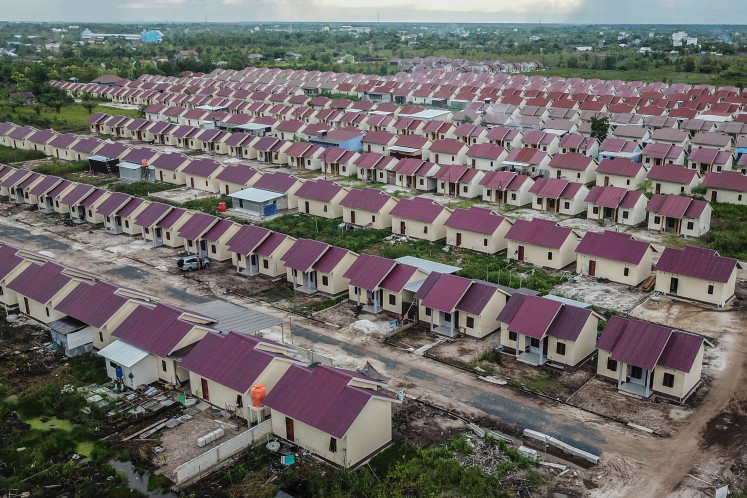
The massive amount of agricultural land converted to accommodate an increasing demand for industrial development, services, housing complexes, public facilities and other purposes, has had a clear impact on agricultural production levels.
In cases where agricultural land conversion cannot be controlled properly or supplemented by appropriate policies, it is no wonder agricultural production is diminished and as a consequence has no capacity to secure national demand for food.
Analyzing agricultural land conversion in Indonesia, the current situation and its impacts have become alarming. As reported by Fahmuddin Agus and Irawan (2006), between 1981 and 1999 an average area of 90,400 hectares of rice fields was converted every year, but this was supplemented with the addition of 178,900 hectares new rice fields each year; hence there was a positive balance of 88,500 hectares per year. Agricultural land conversion still can be compensated by opening up new agricultural fields mainly in outer islands.
However, the situation has been getting much worse. Between 1999 and 2002, an average of 187,700 hectares of agricultural land was converted, supplemented with the addition of 46,400 hectares of new rice fields each year; hence there was a negative balance of -141,300 hectares per year. This means that at national level, the area of agricultural land mainly for rice growing has been massively decreasing.
In the future, Indonesian food security will predictably come under siege. National food production that has traditionally been largely supported by the most fertile rice fields in Java, may change in future, since the most rapid pace of agricultural land conversion in Indonesia occurred in Java.
As reported by Joyo Winoto in 2005, spatial planning adjustments for the conversion of irrigated rice fields to non-farming purposes totaled 3.1 million hectares. Focusing on Java and Bali, 1.7 million hectares were converted. West, East and Central Java, regarded as the most fertile land, were where the biggest changes occurred.
In response to the serious impacts of agricultural land conversion, which in turn threatens national food security, and also to protect farmers nationwide, on Oct. 14, 2009, the Indonesian government through Law No. 41/2009 stipulated regulations for the protection of sustainable food farming land. Although this comes a little late, the law is regarded as a strategic potential solution to control the conversion of farming land and protect farmers.
The history of the implementation of laws related farming land tells us that in practice many complicated problems could not be resolved properly; and thus there were no significant benefits for farmers as main actors in food production. For instance, Law No. 56/Prp/1960 on land reform stipulated the minimum and maximum amounts of farming land that could be owned by farming families. The minimum was 2 hectares and the maximum was between 5 and 20 hectares, depending on whether the rice field was wet or dry.
However, it was impossible for the government to implement this law. While political will and law enforcement were lacking, the law was also met with strong opposition from the rural elite and landlords.
The main idea of Law No. 41/2009 is that each individual farmer who has a right to land that is stipulated as sustainable food farming land, should fully use the land based on its function as a food production area, and protect the land from irrigation destruction (article 34). Individual farmers who violate this law by converting farming land for non-farming purposes would be penalized with imprisonment and/or fines (article 72).
To support and protect farmers and maintain the function of farming land, the government will also provide measures as a protection strategy and guarantee, such as profitable commodity prices, providing farming inputs, food marketing, giving high priority to national food products and providing compensation for harvest failures (article 64).
It is of course still too early to evaluate the effectiveness of the farming land protection law. However, the government’s strategy and program are still far from ideal as defined in the law, such as for keeping commodity prices profitable and providing in the case of harvest failure. The principle of keeping food prices low is among one example of this failure.
The law likely has not touched the fundamental problems of small-scale farming in Indonesia. As reported by the Agricultural Census (2003), an the average plot of farmland is about 0.4 hectares per farming household.
In fact, many farming households remain alive under much smaller farming field than the average. Millions of farming households also live as landless peasants.
The basic solution could be finding ways to improve farm household access to farming land. Having a viable plot of 1-2 hectares of farming land per household, would have a significant impact on production efficiency, productivity and farming income.
As stipulated in the law, small-scale farmers will be given some protection measures; still it is unimaginable how farming households, holding only 0.1 or 0.2 hectares, could survive and have the capability to fulfill various needs in life such as for consumption, housing, healthcare and providing a proper education to children.
Relocating existing industrial areas from Java seems unrealistic. However, the government should urge and provide incentives for new proposed industries and services to be located in outer islands.
This would obviously reduce the pressure on farm land for conversion. It would also be a good strategy for the development of the outer islands, spreading the economic growth from Java as a center of growth to the whole nation.
The government also should promote and offer various facilities for the development of rural industries and services. Rural infrastructure development will likely be among the key issues.
Hopefully, some farming households could move from farming to non-farming activities. In turn, the unit of farming management per household will significantly increase.
The writer is a lecturer at the School of Agriculture, Gadjah Mada University, Yogyakarta, and a doctoral student at the University of Tokyo. This is a personal opinion.