TheJakartaPost
Please Update your browser
Your browser is out of date, and may not be compatible with our website. A list of the most popular web browsers can be found below.
Just click on the icons to get to the download page.


Popular Reads
Top Results
No results found. Please check your search term and try again
Can't find what you're looking for?
View all search results
Popular Reads
Top Results
No results found. Please check your search term and try again
Can't find what you're looking for?
View all search resultsAnalysis: Impact of fuel-price hike on banking industry's liquidity
Bank Indonesia (BI) raised its rate by 25 basis points (bps) to 7
Change text size
Gift Premium Articles
to Anyone
Share the best of The Jakarta Post with friends, family, or colleagues. As a subscriber, you can gift 3 to 5 articles each month that anyone can read—no subscription needed!

B
/span>Bank Indonesia (BI) raised its rate by 25 basis points (bps) to 7.75 percent ' with an increase of 50 bps on its lending-facility rate to 8.00 percent and deposit-facility rate to remain unchanged at 5.75 percent ' at an unscheduled meeting on Nov. 18, 2014.
The rate hikes were undertaken to anchor inflation expectations and to ensure that inflationary pressures remain under control and temporary following the increase in subsidized-fuel prices.
This policy was also undertaken in anticipation of the US Federal Reserve policy or the potential increase of the Fed funds rate next year. BI has moved ahead to keep the spread between the policy rate in the US and Indonesia and anticipate the effect of the Fed funds-rate increase to the volatility of rupiah.
The domestic banking sector had already been affected by the tightening monetary policy and the fuel-price hike last year. Loan growth slowed for 12 months straight. Credit growth slowed from 21.6 percent year-on-year (y-o-y) in 2013 to only 13.2 percent in September 2014 and asset growth also slowed significantly from 16.2 percent to only 10.3 percent at the same time.
Working-capital loan and investment growth were amongst the types of loan growth that were slowing significantly. Working-capital loans in September 2014 only grew 13.3 percent, much lower than 21.9 percent in the same period last year, while investment growth at the same time grew only 16.4 percent, much lower than 33.9 percent in September 2013.
On the other hand, the latest deposit-growth data in September 2014 was still relatively weak at 13.3 percent. The average level of deposit growth in 2014 from January to September was only 12.3 percent, slower compared to the average deposit growth in 2013 of 15 percent.
It was the first time that deposit growth was higher than loan growth since 2010. As a result, the loan to deposit ratio (LDR) decreased to 88.9 percent from 90.6 percent in the previous month. If we measure liquidity in a conventional way, by subtracting deposit to loans and reserves requirements, it improved from Rp 49 trillion in August 2014 to Rp 115 trillion.
But lower LDR and improving liquidity were not supported by stronger deposit growth due to slowing loan growth. We are not expecting that the deposit growth will increase significantly in the next few months, especially after the Financial Services Authority (OJK) already capped the deposit rate of banks in BUKU 4 (banks with assets of more than Rp 30 trillion) by 200 bps above the BI rate and banks in BUKU 3 (banks with assets of between Rp 5 trillion and Rp 30 trillion) by 225 bps above the BI rate. With an assumption that credit growth would be around 14 percent to 15 percent and deposit growth will reach 13 percent to 14 percent this year, we expect they will be at Rp 55.2 trillion and Rp 25.4 trillion, respectively, by the end of 2014 and 2015.
The slowing down of domestic economic growth and the tight monetary policy environment had an impact on banks' performances. Growth of the total net income of Indonesia's ten biggest banks slowed from 13.6 percent y-o-y in Q1 2014, to 11.3 percent in H1 2014 to, 8.1 percent in the first nine months of 2014. Among the 10 biggest banks in Indonesia, only five posted higher net income in the January-September period in 2014 compared to the same period of 2013. Those banks were BRI (+17.6 percent y-o-y), Bank Mandiri (+12.9 percent y-o-y), BCA (+17.7 percent), BNI (+16.4 percent) and Panin Bank (14.5 percent).
Meanwhile the net income of CIMB Niaga, Bank Danamon, Bank Permata, BTN and BII contracted in September 2014 compared to same period last year. The total loans of those banks in September grew 11.9 percent y-o-y, slowed compared to 19.9 percent in the first quarter of 2014 and 15.7 percent in the first half of 2014.
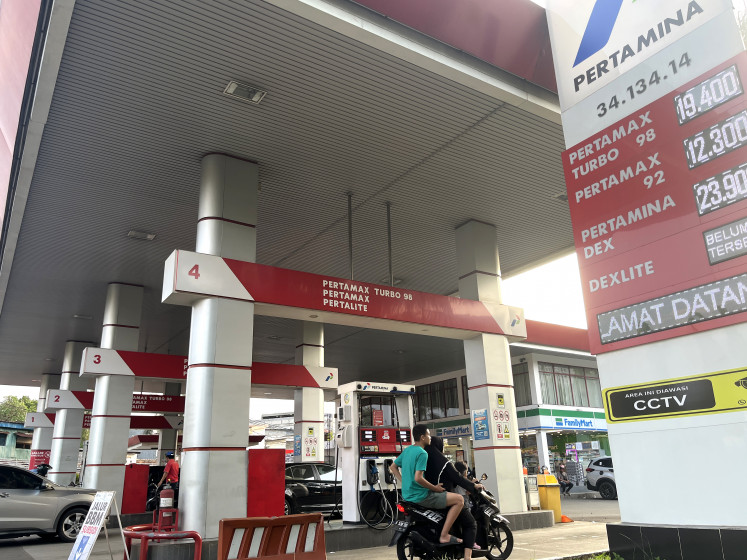
Historically, the hike in subsidized-fuel prices always caused deposit rates to increase, and decrease in interest-rate spread and credit growth. Banks usually increase deposit rates more aggressively than lending rates. In 2005, when the government increased fuel prices by 87.5 percent from Rp 2,400 to Rp 4,500 a liter, the one-month and three-month deposit rates each increased by 158 bps and 285 bps in three months while at the same time the working-capital loan and investment loan rates only increased by 114 bps and 89 bps, respectively.
In 2008, when subsidized-fuel prices increased by 33.3 percent from Rp 4,000 to Rp 6,000 a liter, the one-month and three-month deposit rates each increased by 342 bps and 349 bps in six months while at the same time the working-capital loan and investment-loan rates only increased by 221 bps and 192 bps, respectively. In 2013, when the government increased subsidized-fuel prices by 44.4 percent from Rp 4,500 to Rp 6,500 a liter, the one-month and three-month deposit rates increased 175 bps and 162 bps in six months, and at the same time the working-capital loan and investment-loan rates only increased 60 bps and 56 bps.
This showed that banks still prefer to keep liquidity and asset quality manageable, while sacrificing net interest income.
We expect that credit growth will continue to slow following the fuel-price hike and increased policy rates. In the 2005 fuel-price hike, credit growth slowed for 11 months before it began to pick up.
In the 2008 fuel-price hike, credit growth slowed for more than a year before it began to accelerate. We predict the credit will continue to slow in the next couple of months. Moreover, banks will still have tight liquidity because we do not expect the deposits will grow significantly higher in the future. We predict the banks' credit will grow around 14 percent this year and 15 percent next year, higher than deposit growth of 13 percent this year and 14 percent next year.
Hence, banking liquidity will probably remain tight. But the tight liquidity will probably have more impact on medium and smaller banks. Since the biggest banks, especially banks in BUKU 4, still managed to increase their profitability, they will have fewer problems increasing liquid assets in the future. Meanwhile the profitability of smaller banks is now decelerating, so they will have more homework to do to improve their liquidity.
A positive factor that could have an impact on banking liquidity next year is the government budget savings from the fuel-price increase. The amount of savings is estimated to reach around Rp 94 trillion. If 50 percent of the savings goes to the banking system, banks will have additional funds of Rp 47 trillion or around 16 percent average increases in third-party funds every year.
Meanwhile, a downside factor next year for banks' liquidity would be the possibility of foreign capital outflow as an impact of the Fed funds-rate increase. But we hope that the Fed funds-rate increase would not cause a massive foreign capital reversal. Currently, the spread between the BI rate and the Fed funds rate would still be quite wide.
If Fed funds rate increased by 25 bps, that there would still be 725 bps of spread, and the return of the money market in Indonesia would still be very attractive. Moreover, we believe that the Indonesian economy will perform quite well next year amid uncertainties in the global economy. Quicker structural reforms by the new administration next year will make investments in Indonesia even more attractive.
The writer is a financial market analyst at PT Bank Mandiri (Persero) Tbk