TheJakartaPost
Please Update your browser
Your browser is out of date, and may not be compatible with our website. A list of the most popular web browsers can be found below.
Just click on the icons to get to the download page.


Popular Reads
Top Results
No results found. Please check your search term and try again
Can't find what you're looking for?
View all search results
Popular Reads
Top Results
No results found. Please check your search term and try again
Can't find what you're looking for?
View all search resultsYear ender: New president, radically different style
New regime: A man offers photographs of President Joko âJokowiâ Widodo and Vice President Jusuf Kalla at a traffic light in Harmoni, Jakarta
Change text size
Gift Premium Articles
to Anyone
Share the best of The Jakarta Post with friends, family, or colleagues. As a subscriber, you can gift 3 to 5 articles each month that anyone can read—no subscription needed!

N
span class="caption">New regime: A man offers photographs of President Joko 'Jokowi' Widodo and Vice President Jusuf Kalla at a traffic light in Harmoni, Jakarta. JP/Jerry Adiguna
Out with the old, in with the new.
Ever since he was sworn in as president, former Jakarta governor Joko 'Jokowi' Widodo has introduced a more relaxed leadership, which many see as a breath of fresh air, a radical departure from the staid leadership of his predecessor, Susilo Bambang Yudhoyono.
White shirts with rolled-up sleeves, instead of formal suits or safari suits, comprise Jokowi's daily attire, a dress code that could indicate hard work and modesty, a style, although not always substance, which has rubbed off on his ministers. The State Palace's strict security protocols have also been relaxed to suit the new President's spur-of-the-moment style.
Jokowi prefers to conduct blusukan (impromptu visits) to see the problem for himself rather than getting briefings from his underlings in meetings.
For the sake of efficiency, Jokowi prefers a smaller entourage and takes only essential staff on trips, including on board the presidential Boeing Business Jet 2 procured during Yudhoyono's administration amid public criticism.
The two could not be more different in their style of public speech. While Yudhoyono preferred
long, English-peppered sentences, Jokowi likes his speeches brief. Also, while his predecessor kept to speech timings, Jokowi's speeches can overrun as he often engages in two-way conversation.
Yet, some of Jokowi's meetings take place outside his carefully planned schedule, creating glitches and confusion, especially among Palace staffers who are more familiar with the rigid schedules during Yudhoyono's tenure.
State Secretariat secretary Taufik Sukasah said the Palace staffers and officials were working hard to keep up with the new President's pace.
Individual ministries have also take the initiative to keep up with Jokowi and copy his style.
Administrative and Bureaucratic Reform Minister Yuddy Chrisnandi has issued three circulars banning all central government officials from engaging in lavish lifestyles and partaking in wasteful spending.
The circular has also ordered all government agencies to use their own meeting rooms and stop paying for meeting halls and other venues, including resorts and villas.
Jokowi has also dissolved 10 non-structural institutions established during Yudhoyono's tenure to cut red tape, including the Indonesian Sugar Council, the tasks of which will be transferred to the relevant ministries.
Differences in personal character have also resulted in differences in how policies are made.
Jokowi appears unafraid of losing his popularity by making tough decisions.
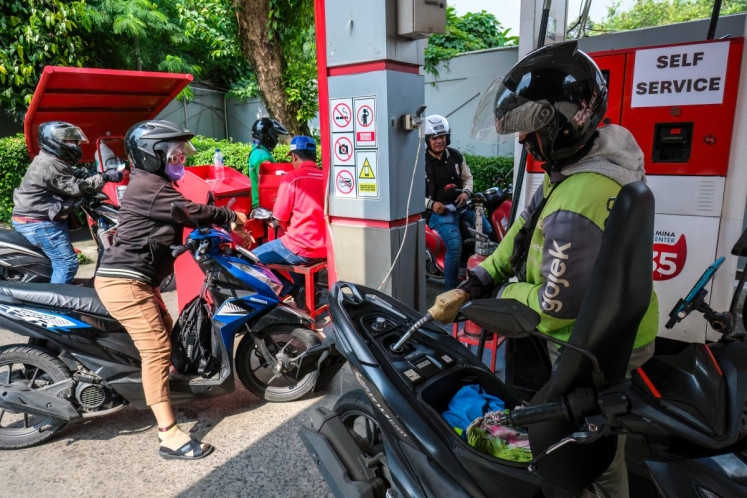
Less than one month after assuming office, Jokowi raised the price of subsidized fuel in a bid to allocate a larger slice of the state budget to development programs. Unlike Yudhoyono, who ordered his ministers to make the announcement in 2013, Jokowi announced the unpopular decision himself.
Jokowi also ordered the tough measure of sinking foreign ships caught illegally fishing in Indonesian waters.
Such a move is legal according to the Fishery Law, endorsed in 2009 during Yudhoyono's term. Yudhoyono himself was reported to have scolded the ministry for taking the drastic measure.
Another controversial call Jokowi has made was his order to expedite the execution of drug convicts, which has raised criticism, particularly from human rights activists.
Yudhoyono, meanwhile, is legendary for his U-turns and about-faces.
Less than three weeks before leaving office, Yudhoyono issued a government regulation in lieu of law (Perppu) to repeal the controversial Pilkada law ' that revoked direct elections for regional heads ' after his Democratic Party staged a walkout during the Pilkada law deliberation at the House of Representatives. The vote at the House provoked nationwide criticism of the then president and his party, and also took the international spotlight.
In late December 2013, Yudhoyono revoked two presidential regulations only days after signing them following protests that the policies were unfair as they allowed government officials to seek medical treatment abroad at the taxpayer's expense.
'A president's character impacts on his administration, although there is no guarantee that one is better than the other,' political communications expert Gun Gun Heryanto said.
'Yudhoyono's prefers style and order, and this at times resulted in a slow response, while Jokowi positions himself not as someone powerful, but rather a symbol of teamwork,' Gun Gun said.