TheJakartaPost
Please Update your browser
Your browser is out of date, and may not be compatible with our website. A list of the most popular web browsers can be found below.
Just click on the icons to get to the download page.


Popular Reads
Top Results
No results found. Please check your search term and try again
Can't find what you're looking for?
View all search results
Popular Reads
Top Results
No results found. Please check your search term and try again
Can't find what you're looking for?
View all search resultsAlternative energy, not a subsidy cut, is the only remedy
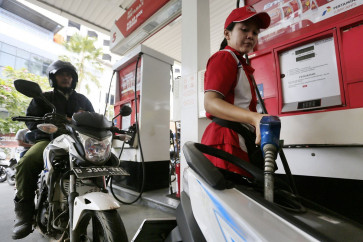
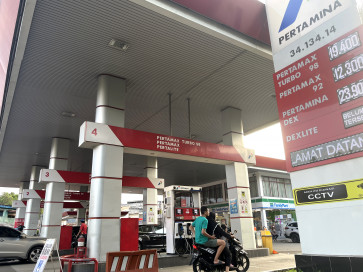
Finally, President Joko âJokowiâ Widodo has left domestic fuel prices to international market dynamics after the previous administration â considering political stability, economic capacity and social acceptability â set fuel subsidies as high as possible
Change text size
Gift Premium Articles
to Anyone
Share the best of The Jakarta Post with friends, family, or colleagues. As a subscriber, you can gift 3 to 5 articles each month that anyone can read—no subscription needed!

F
inally, President Joko 'Jokowi' Widodo has left domestic fuel prices to international market dynamics after the previous administration ' considering political stability, economic capacity and social acceptability ' set fuel subsidies as high as possible.
To carry out development, every strong nation must endeavor to attain energy security for both public consumption and national fuel industries. However, the Indonesian government seems to lack sustainable strategies for achieving energy security.
While most countries give priority to the fulfillment of domestic energy demand, Jokowi has followed in the footsteps of his predecessors, who opted to dedicate energy resources to global commerce.
Trying to awake from the 1998 economic crisis and its multidimensional impacts, post-reform national leadership has unfortunately been indecisive in directing national development. The State Policy Guidelines (GBHN) were removed and the Constitution was amended four times only to erode Indonesian sovereignty over its natural resources and surrender the national economy to the market.
It's impossible, for example, to let the prices of public goods and services, including public transportation fees, go up and down in accordance with world fuel-price fluctuations. Even the coordinating economic minister has warned from the beginning that the country should anticipate the possibility of living without fuel.
Without easy access to alternative energy, the Cabinet's fuel policy is threatening the sustainability of development.
Furthermore, having recognized former president Susilo Bambang Yudhoyono's achievements in addressing climate change by raising fuel prices by 165 percent so as to reduce greenhouse gas emissions from fossil fuels, fuel consumption has increased more than tenfold since 2003. There has been no notable effort to make alternative energy sources accessible to all people, not to mention environmentally friendly.
It's understood that the Indonesian government wants to keep the global honor of being part of G-20, consequently binding itself to the group's long-standing commitment to phase out fossil-fuel subsidies in conjunction with the IMF Letter of Intent (LoI) and the World Bank Development Policy Loan (DPL) prerequisites.
Climate change follows the global scheme, however. Since the outset, the Organization for Economic Cooperation and Development (OECD) and its working partner, the International Energy Agency (IEA), have been focused on renewable energy policies. They say that eliminating fossil-fuel subsidies by 2020 will cut global warming by 10 percent in 2050.
However, there has been a misunderstanding between the national living experience and global agencies, such as IEA and World Bank, who validate such a notion on the pretext that the rich become the beneficiaries of fuel subsidies.
As a matter of fact, it's not relevant to classify fuel consumers as poor or rich. Fuel has become a basic component along the economic value chain that involves both the rich and the poor in various synergistic roles. The ultimate consequence of the fuel-price hike is inflation that upgrades the market equilibrium, forcing the prices of goods and services to climb. This cannot be compensated by mere cash aid.
Compounded by the G-20 as the ultimate global forum, fossil-fuel subsidy means inefficiency, wasteful consumption, market distortion, clean-energy investment impediments and the trivialization of the climate change issue. The G-20 Summit in Brisbane, with the current slogan of 'global problems need global solutions' might have overwhelmed President Jokowi with euphoria. Going home, he was convinced of the need to start eliminating fossil fuel supplies and subsidies.
It's China that is determined not to follow the global trend of simply reasoning that expensive fuel will make it difficult for national development to run. Realizing the consequences, Beijing is developing renewable energy like solar, wind and biomass. The country allocates subsidy grants amounting to US$22.5-46.7 million to manufacturers of wind turbines without imported components.
As a result, its national energy self-sufficiency efforts make China the largest global wind-energy industry. It's not money that matters, but common initiative, commitment, hope and public faith in the administration.
Indonesia's distinctiveness as one of the wealthiest tropical nations must preserve its abundant assets to earn renewable kinds of organic energy sources. It needs to overhaul spatial planning, reset the national development priorities from euphoric global achievements to basic energy security, free household industries from lengthy red tape and promote autonomous budgetary distribution.
For too long we have neglected our richness in renewable energy sources.
______________
The writer is a freelance journalist and member of green group Sarekat Hijau Indonesia.