TheJakartaPost
Please Update your browser
Your browser is out of date, and may not be compatible with our website. A list of the most popular web browsers can be found below.
Just click on the icons to get to the download page.


Popular Reads
Top Results
No results found. Please check your search term and try again
Can't find what you're looking for?
View all search results
Popular Reads
Top Results
No results found. Please check your search term and try again
Can't find what you're looking for?
View all search resultsPGN sets aside $35 million for gas filling stations in eight cities
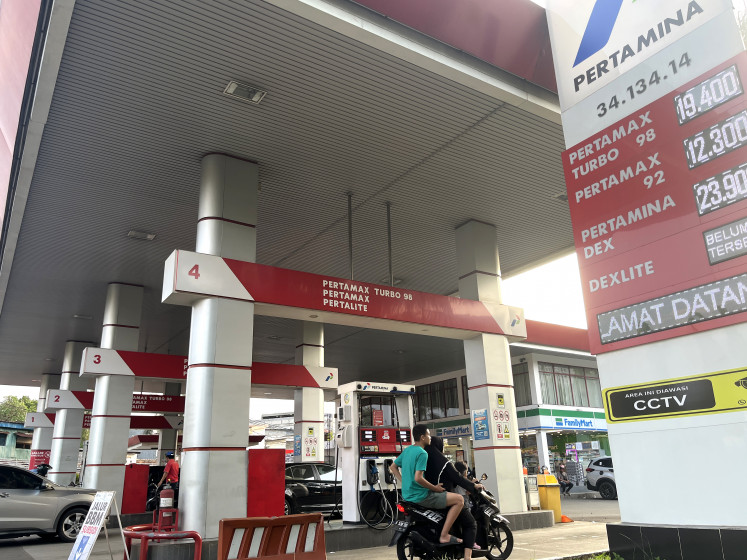
Through its subsidiary PT Gagas Energi Indonesia (GEI) state gas distribution company PT Perusahaan Gas Negara (PGN) will develop 16 gas filling stations in eight cities across the country to meet growing gas demand
Change text size
Gift Premium Articles
to Anyone
Share the best of The Jakarta Post with friends, family, or colleagues. As a subscriber, you can gift 3 to 5 articles each month that anyone can read—no subscription needed!

T
hrough its subsidiary PT Gagas Energi Indonesia (GEI) state gas distribution company PT Perusahaan Gas Negara (PGN) will develop 16 gas filling stations in eight cities across the country to meet growing gas demand.
GEI director Danny Praditya said the company would invest US$35.2 million for the construction of gas stations in Batam (Riau Islands), Bekasi, Bogor, Purwakarta and Sukabumi (West Java), Jakarta, Lampung and Surabaya (East Java).
'That amount of investment excludes the money for land purchases. It will be spent on the physical construction of gas stations, equipping them with two gas pumps,' Danny said on Monday.
Once the construction of the 16 gas stations is completed, the company hopes to see its gas sales reach 14.4 million liters of gasoline equivalent per month.
In Surabaya, the gas station will be located in the Ngagel area and will have a capacity of between 500,000 and 1 million standard cubic feet per day (mmscfd) or 15,000 to 30,000 liters of gasoline equivalent per day.
At present, PGN sells its gas for Rp 4,500 (US$0.34) per liter. For areas outside Greater Jakarta, however, the gas company will need a directive from the government to determine the price with regard to distance and transportation costs.
The construction of gas stations in eight cities across the country is made in response to growing demand from motorists.
Eventually, the availability of gas filling stations is expected to boost people's awareness to shift their use of gasoline to natural gas for their vehicles.
'In a bid to drive more people [to use gas fuel], we will cooperate with banks to provide gas converter kits for public transportation operators who are willing to shift from gasoline to gas. We will work with the banks,' Danny added.
PGN Surabaya business unit general manager Wahyudi Anas said PGN was coordinating with the Surabaya administration to find the best location for the mobile refueling unit (MRU).
The gas distribution company has also donated 25 converter kits, each of which is priced at Rp 16 million, to the operational vehicles of the Surabaya administration.
According to Wahyudi, the move was a symbol of the regional administration's support of the utilization of green energy.
Wahyudi claimed nearly 100 units of his office's operational vehicles used natural gas. He said gas conversion could reduce the company's energy costs by 44 percent.
Meanwhile, Surabaya taxi operator Taksi Zebra president director Adhi Pujianto said the construction of gas stations in the city would be very helpful and he would shift his taxis from gasoline to gas.
'I will invest by purchasing converter kits and put them in 300 of my taxis. I have 60 taxis using gas fuel. Some of them cannot operate because of a limited gas supply,' Adhi said.
He added that the government needed to help public transportation operators by providing them with a subsidy. He said it was expensive for operators to purchase gas converter kits.
'This will also benefit the government. [Using gas], the air will be cleaner and fuel consumption can be slowed,' he said.
A taxi normally uses the 27 kilogram-gas canister and it can run for 125 km in Surabaya before it requires more fuel.
If the taxi drives out of town, it can run for 160 km with the same volume of natural gas.
PGN has joined efforts to reduce the government's dependence on oil imports by developing gas stations through cooperation with regional companies and some integrated refueling stations, consisting of gasoline fuel and gas.