TheJakartaPost
Please Update your browser
Your browser is out of date, and may not be compatible with our website. A list of the most popular web browsers can be found below.
Just click on the icons to get to the download page.


Popular Reads
Top Results
No results found. Please check your search term and try again
Can't find what you're looking for?
View all search results
Popular Reads
Top Results
No results found. Please check your search term and try again
Can't find what you're looking for?
View all search resultsHanoi design supports healthy lifestyle
Many have said that techno-logy helps people to improve their lives
Change text size
Gift Premium Articles
to Anyone
Share the best of The Jakarta Post with friends, family, or colleagues. As a subscriber, you can gift 3 to 5 articles each month that anyone can read—no subscription needed!

M
any have said that techno-logy helps people to improve their lives. In most Indonesian cities, many old buildings have been demolished, roads are widened and motorized vehicles are replacing delman (horse carts), bajaj (three-wheeled pedicabs) and bicycles.
In Indonesia, people tend to think that going to work or to school by bicycle is backward, or only for the poor. For people in Jakarta and Bandung, cycling is only for fun on weekends. Modern life teaches people to use more mechanical means, replacing their muscle power when doing activities.
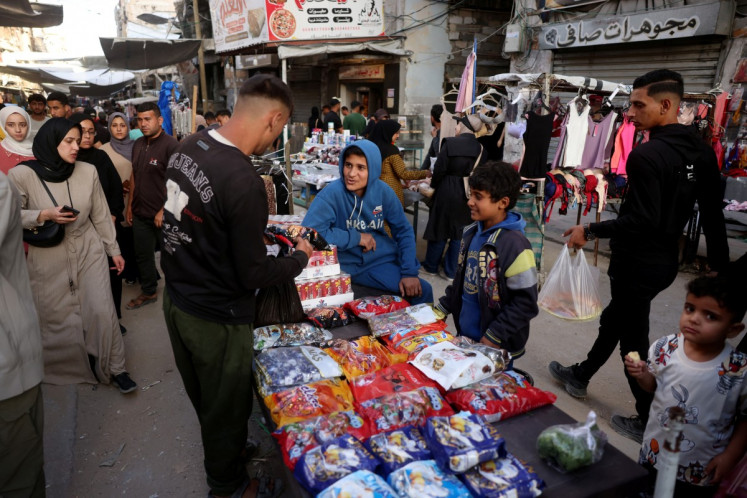
However, in Hanoi, Vietnam's capital, most people are still living in a traditional way. People shop for bread and groceries and fruits in the traditional markets, or from street vendors. It's not easy to find a supermarket, let alone a shopping mall, in the city center.
Many mobile dairy sellers walk or ride bicycles around the streets to offer their goods, mixing with small modern dairy shops in town. Many people, regardless of their economic and social status, wear bamboo hats everywhere, making them look like equals.
People in Hanoi tend to live naturally without using many mechanical means. The design of the city has supported this. Pedestrian sidewalks are provided everywhere, encouraging walking to reach a short or medium-distance destination.
Like in many European cities, Hanoi's city center is full of pedestrians walking around. Roads are shaded by big trees, while lakes and parks with big trees can be found in many places around the city, making the place even lovelier.
Parks are designed to attract inhabitants and tourists. Sports facilities are provided, allowing all people, regardless of age and social status, to use them. People sit on concrete or wooden benches around the lakes or in the parks, reading books or chatting with friends, making lakes and parks lively public spaces.
The design of a city like Hanoi thus makes it easy to do sports for free, too, rather than going to the gym. As a result, on average, the people of Hanoi, a former French colonial city, tend to be much healthier than people in Jakarta.
The life expectancy of the Vietnamese is significantly higher than that of Indonesians ' also because of the food.
Many old buildings in Hanoi are still being used. Unsurprisingly, the number of foreign tourists in Hanoi per thousand local inhabitants is much higher than in Jakarta, as most tourists likely want to visit a city that has a rich history with old and historic buildings.
Moreover, public transportation is designed in a modern system. Having a map of Hanoi helps visitors easily use public transportation as bus stops and the bus numbers are indicated clearly. The quality of the buses is very good, much better than Transjakarta's, and the services are excellent. Passengers do not need to wait for a long time as the number of buses adequately carry all the passengers.
To be a livable city like Hanoi, a city doesn't need to be modern. Old buildings and old houses must be prevented from being demolished or being converted into modern styles. Roads in the city center do not need to be widened.
Better public transportation would help narrow streets become free from traffic jams like in many European cities and in Hanoi. Keeping the old streets narrow, while improving the public transportation system is the way to minimize the use of private cars.
Having a modest way of living and minimizing the use of motorized vehicles, could help a city to be livable, healthy and attractive, without consuming much land or energy resources.
People consume their traditional foods, harvesting the crops, vegetables and fruits from their own land and distributing them to customers, mainly by bicycle, on foot, but some by motorized vehicles. Most Hanoi residents seem to live in small houses, using fans and thus less electricity, making the embodied energy of the houses quite low.
A study by Han Thuc Tran of the Vietnam National University at Hanoi revealed that based on the total ecological footprints (EF) of three of the main living sectors in town ''housing, transportation and food ' Hanoi has the lowest EF levels (0.80 gha/person) compared to Wellington in New Zealand (2.11 gha/person) and Oulu in Finland (2.96 gha/person).
This study shows that even only consuming a small amount of the Earth's resources, indicated by its low EF levels, a traditional city like Hanoi is still able to be a livable city and is still highly attractive to tourists. The modernism of converting many old buildings and old houses to shopping malls, hotels and big restaurants is completely wrong.
Not only is it destroying the city and erasing the history, but it also makes the city increasingly unattractive to see and live in.
______________
The writer is a professor of architecture at Tanri Abeng University, Jakarta.