TheJakartaPost
Please Update your browser
Your browser is out of date, and may not be compatible with our website. A list of the most popular web browsers can be found below.
Just click on the icons to get to the download page.


Popular Reads
Top Results
No results found. Please check your search term and try again
Can't find what you're looking for?
View all search results
Popular Reads
Top Results
No results found. Please check your search term and try again
Can't find what you're looking for?
View all search resultsBanks reinstate loans program for micro and small businesses
Three state banks have signed a partnership agreement for financing a peopleâs business credit (KUR) program, officially relaunching the program, which had been put on hold for more than seven months
Change text size
Gift Premium Articles
to Anyone
Share the best of The Jakarta Post with friends, family, or colleagues. As a subscriber, you can gift 3 to 5 articles each month that anyone can read—no subscription needed!

T
hree state banks have signed a partnership agreement for financing a people's business credit (KUR) program, officially relaunching the program, which had been put on hold for more than seven months.
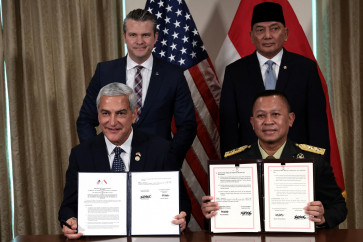
The lenders ' Bank Rakyat Indonesia (BRI), Bank Mandiri and Bank Negara Indonesia (BNI) ' signed the agreement on Thursday with the Cooperatives and Small and Medium Enterprises Ministry.
The KUR is a government-backed program that aims to disburse micro loans to owners of small businesses across the country at lower interest rates than most micro loans, made possible by an insurance plan provided by the government through state credit insurance firms Perum Jamkrindo and Askrindo.
The program was initially launched in 2007 during former president Susilo Bambang Yudhoyono's term and involved several lenders, including state, private and regional development banks (BPDs).
This year's program was put on hold in January because of the increasing number of bad loans that were recorded by several participating lenders in 2014.
Some of these lenders even posted non-performing loan (NPL) ratios of 30.9 percent and 21.2 percent, higher than the actual 5 percent threshold set by the banking regulator for 'regular' loans.
Bobby Hamzar, deputy minister for fiscal and monetary policy at the Office of the Coordinating Economic Minister, previously said that the bad loans had forced the government to revamp the program and scrap some of the participating banks.
'We are starting the revamped program with three state banks and some BPDs may follow suit later. The interest rate that is offered to customers has also been reduced to 12 percent from 21 percent,' he said.
For the program in 2015, the amount of KUR to be disbursed has been set at Rp 30 trillion (US$2.18 billion), lower than last year's target of Rp 37 trillion.
About Rp 20 trillion and Rp 9 trillion will be disbursed to existing micro and retail KUR, respectively. The remaining Rp 1 trillion will be channeled into a new type of KUR ' called KUR TKI ' that is specifically designated for migrant workers.
As reported before, BRI has been allocated the largest sum of Rp 21.4 trillion. Mohammad Irfan, BRI's director for institutional and state-owned enterprises banking, said that everything was already in place for the bank to rerun the program.
'During the time when the program was on hold, we continued channeling similar kinds of loans under our own Kupedes program. Both programs will now run concurrently,' he said on Thursday after the signing.
Meanwhile, Mandiri and BNI will each be responsible for disbursing around Rp 3.2 trillion worth of KUR.
BNI business banking director Sutanto said that the bank would continue to focus on channeling 60 percent of its KUR allocation to Java and the remaining 40 percent to other areas outside Java. 'The largest areas [outside Java] will be in Sumatra and Sulawesi,' he said.
According to Jamkrindo director Bakti Prasetyo, the company expects to see better credit quality this year, even though the insurance fee is only set at 1.5 percent for all KUR types, down from 3 percent.
'The participating banks are large lenders that have experience in disbursing micro loans, so we have no concern over the quality,' he said.